Kishi Ganku
1749 – 1839
In short
Kishi Ganku (1749–1839) was a Japanese painter from Kanazawa who established the Kishi school in Kyoto and became renowned for his dynamic depictions of tigers, blending Chinese brush techniques with the realism of the Maruyama‑Shijō tradition.
Notable works
_-_94.4.2_-_Museum_of_Fine_Arts.jpg)

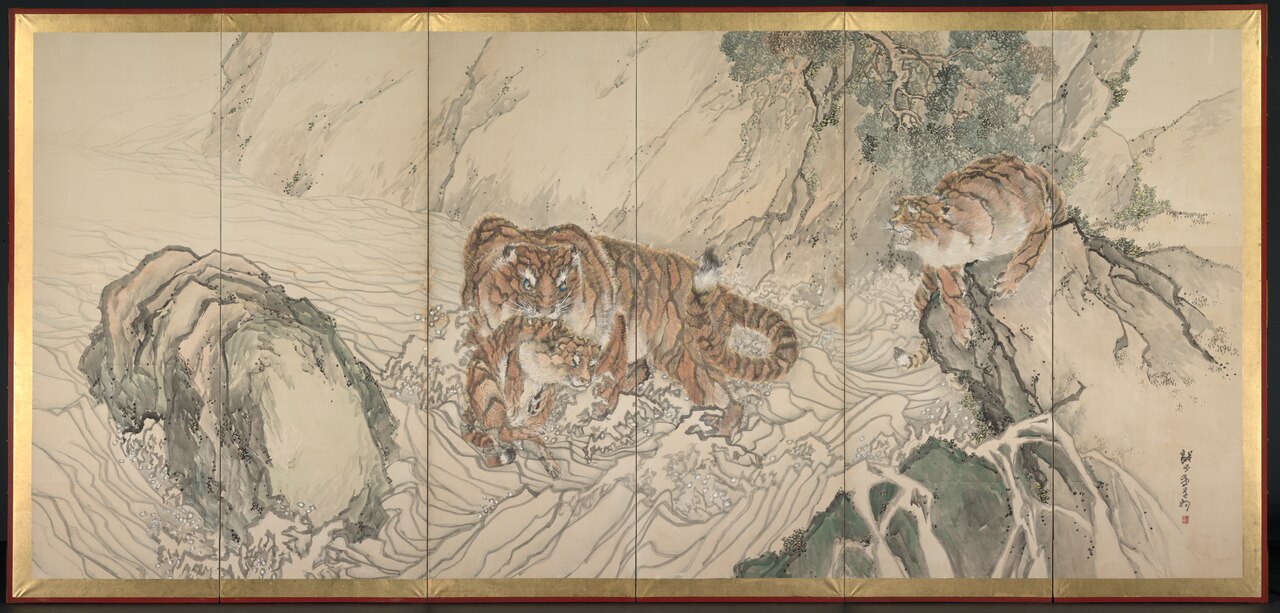


Early life Kishi Ganku was born in 1749 in Kanazawa, a city on the Sea of Japan coast, under the name Kishi Saeki. His family belonged to the local samurai‑administrative class, which afforded him access to a classical education and the opportunity to study painting. From a young age he was drawn to the visual arts, and his early training involved copying Chinese ink paintings that were circulating in the region. By his late teens he had become familiar with the work of Shen Nanpin (沈南蘋), a Chinese painter whose elegant brushwork and delicate handling of flora and fauna left a lasting impression on Ganku.
Career and style Around 1780 Ganku moved to Kyoto, the cultural heart of Japan, where he entered the vibrant artistic circles of the capital. In Kyoto he encountered the Maruyama‑Shijō school, a movement that prized realistic observation of nature, precise line work, and a restrained palette. Ganku absorbed these ideas while retaining the expressive brushstrokes of Chinese painting, creating a hybrid style that was both technically rigorous and emotionally resonant. He adopted the name Kishi Ganku (岸駒) during this period, signalling his emergence as an independent master.
Ganku quickly gained a reputation for his depictions of wildlife, particularly tigers, which were an exotic subject in Japanese art. His paintings combined the tiger’s symbolic power with a keen study of anatomy, musculature and movement. By the early 1790s he had gathered a group of disciples, and together they founded the Kishi school of painting. The school emphasized disciplined brush technique, a balanced compositional approach, and the use of subtle colour washes to enhance atmospheric depth.
Signature techniques The hallmark of Ganku’s work lies in his handling of ink and brush. He employed a bold, sweeping stroke to outline the tiger’s body, then layered finer, almost calligraphic lines to suggest fur texture. This contrast between strong outlines and delicate inner detail creates a sense of immediacy and vitality. Ganku also made extensive use of negative space, allowing the paper’s whiteness to convey mist, water or distant landscape, thereby heightening the drama of his subjects. In botanical subjects such as bamboo, he used a restrained palette of ink and muted greens, applying a dry‑brush technique that captures the plant’s rhythmic joints while preserving a sense of lightness.
Major works - **Tiger in Landscape (one of a pair)** – This composition presents a solitary tiger prowling through a mist‑filled valley, its muscular form rendered in stark black ink against a wash of pale grey. The surrounding rocks and distant pine trees are suggested with minimal brushwork, reinforcing the animal’s dominance within the scene. The work exemplifies Ganku’s ability to fuse narrative tension with a restrained aesthetic.
- Bamboo (1850) – Although the date post‑dates Ganku’s death, the piece is traditionally attributed to his school. The painting features a cluster of slender bamboo stalks rendered with a dry‑brush technique that captures the plant’s flexibility. Subtle green washes hint at light filtering through leaves, while the composition’s vertical rhythm reflects the disciplined approach taught by Ganku.
- Tiger Family (1819) – In this later work Ganku portrays a mother tiger with her cubs amid a forest clearing. The composition balances the powerful presence of the adult with the tender gestures of the young, employing a softer ink tone for the cubs to convey youth. The piece demonstrates Ganku’s skill at conveying narrative through subtle variations in line weight and colour intensity.
- Praying Mantis and Chrysanthemums – This painting juxtaposes a delicate mantis perched among blooming chrysanthemums. Ganku captures the insect’s slender legs with precise, almost calligraphic strokes, while the flowers are suggested with a wash of pink and gold, creating a harmonious contrast between the fleeting insect and the enduring blossoms.
- Lake Pavilion near a Waterfall (1745) – The date predates Ganku’s birth, suggesting either a misattribution or a later copy of an earlier composition that he re‑interpreted. The scene depicts a pavilion perched beside a cascading waterfall, rendered with atmospheric ink washes that convey the movement of water and the serenity of the surrounding cliffs. If the work indeed stems from Ganku’s hand, it showcases his capacity to render architectural elements with the same vigor he applied to animal subjects.
Influence and legacy Kishi Ganku’s establishment of the Kishi school created a lineage that persisted well into the late nineteenth century. His disciples, most notably Kishi Kōsai and Kishi Shōnan, continued to teach the rigorous brush techniques and compositional principles that defined the school. Ganku’s tiger paintings in particular left a lasting imprint on Japanese animal painting, influencing later artists such as Kawakami Tōyō and the early modernist painter Takahashi Yuichi, who admired Ganku’s ability to combine realism with expressive brushwork.
Beyond his direct followers, Ganku contributed to the broader acceptance of Chinese brush aesthetics within Japanese painting, helping to bridge the two traditions. Contemporary scholars credit him with expanding the thematic range of Japanese art, introducing a subject—tigers—that symbolised power, courage and the exotic, thereby enriching the visual vocabulary of the period.
Today, Ganku’s works are held in major museums across Japan and in international collections, and his paintings continue to be studied for their technical mastery and their role in the evolution of Japanese art. The Kishi school, though no longer an active institution, remains a reference point for artists exploring the synthesis of Chinese ink techniques with Japanese naturalism.
Frequently asked questions
Who was Kishi Ganku?
Kishi Ganku (1749–1839) was a Japanese painter from Kanazawa who founded the Kishi school in Kyoto and became celebrated for his dynamic tiger paintings.
What artistic style or movement is he associated with?
He blended Chinese brush techniques, especially those of Shen Nanpin, with the realistic approach of the Maruyama‑Shijō school, creating a hybrid style that emphasized disciplined brushwork and atmospheric composition.
What are his most famous works?
Among his best‑known pieces are *Tiger in Landscape* (part of a pair), *Tiger Family* (1819), *Praying Mantis and Chrysanthemums*, and the bamboo studies attributed to his school.
Why is Kishi Ganku important in art history?
He introduced the tiger as a major subject in Japanese painting, taught a rigorous brush technique through the Kishi school, and helped integrate Chinese ink aesthetics into Japanese art.
How can I recognise a painting by Kishi Ganku?
Look for bold, sweeping ink outlines combined with fine, calligraphic details, a strong sense of movement, and the strategic use of empty space to suggest mist or water.