Kanō Sanraku
1559 – 1635
In short
Kanō Sanraku (1559–1635) was a Japanese painter of the Kyō‑Kanō school, the sixth‑generation member of the prestigious Kanō family. He blended the bold, decorative vigor of the Momoyama period with the subtler colour palette of early Edo, producing works that remain central to Japan’s artistic heritage.
Notable works




Early life Kanō Sanraku was born in 1559 in the Gamo district of Japan, a region that would later become part of modern Shiga Prefecture. He entered the world of art through his family; the Kanō lineage had been the official painters to the shogunate for generations. Sanraku was the sixth‑generation member of this dynasty, and his early training was overseen by senior family masters. Known also by the names Kimura Heizō, Shūri, Mitsuyori and Sanraku, he absorbed the rigorous brush techniques and compositional principles that characterised the Kanō school’s workshop environment. His formative years coincided with the tumultuous final decades of the Sengoku (warring states) era, a period that demanded both political loyalty and artistic adaptability from court painters.
Career and style Sanraku’s professional career unfolded during the transition from the Momoyama period to the early Edo period. The former was marked by dramatic, large‑scale works that celebrated the power of warlords, while the early Edo era ushered in a more restrained, refined aesthetic under the Tokugawa shogunate’s stable rule. Sanraku managed to synthesize these divergent sensibilities. His paintings retain the assertive brushstrokes and vibrant pigments typical of Momoyama art, yet they are tempered by a calmer, more contemplative treatment of colour, reflecting the growing taste for subtlety in the Edo period.
Operating primarily out of Kyoto, Sanraku served both the imperial court and the shogunal administration. He was commissioned for a variety of subjects, ranging from religious iconography to secular landscapes. His work demonstrates a deep familiarity with Chinese literati traditions, especially in the rendering of scholarly figures, while also embracing native Japanese motifs. This duality positioned him as a bridge between the bold visual language of the late sixteenth century and the sophisticated, colour‑rich canvases that would dominate the seventeenth‑century artistic scene.
Signature techniques Sanraku’s technical repertoire was anchored in the Kanō school’s emphasis on brush control and layered composition. He frequently employed gold leaf and mineral pigments to achieve luminous surfaces, a hallmark of high‑status screen paintings. His brushwork combined swift, decisive strokes for structural elements—such as the outlines of mountains or architectural forms—with more delicate, feather‑like touches for foliage and clouds, creating a dynamic visual rhythm.
Ink wash (sumi) was another staple of his practice; Sanraku could render atmospheric depth through gradations of ink, a skill honed from the Zen‑influenced tradition of monochrome painting. In addition, he utilised the so‑called "tarashikomi" technique—dropping or splashing pigment onto a still‑wet layer—to produce subtle colour variations, especially in the depiction of water and sky. These methods, coupled with his keen sense of spatial balance, allowed him to produce works that were both grand in scale and finely detailed.
Major works Among Sanraku’s most celebrated pieces is the **"Jinshan Island and West Lake" (1630)**, a screen painting that captures an imagined Chinese landscape. The composition is dominated by towering cliffs and a tranquil lake, rendered with a deft interplay of gold leaf and muted blues, illustrating his mastery of both bold form and nuanced colour.
His series of "Buddhist, Daoist, and Confucian Patriarchs" showcases his ability to portray religious and philosophical figures with dignified poise. Each patriarch is set against a simple backdrop, allowing the viewer to focus on the subtle gestures and the rich, patterned robes that signify their respective traditions.
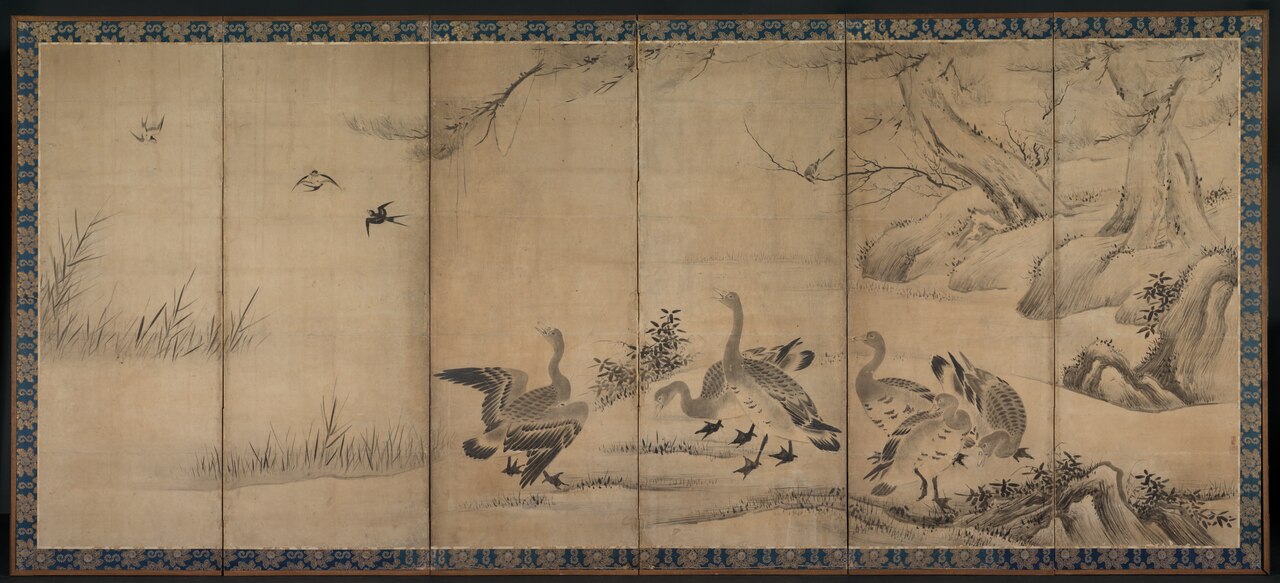
The "Wild Geese" (1607) screen demonstrates Sanraku’s skill in rendering natural subjects. A flock of geese glides across a misty river, their forms outlined in crisp ink while the water is suggested through soft washes. The work exemplifies the momentary, fleeting quality that Sanraku could achieve within a static medium.
The "Namban screen" (1700) and "Daruma" (1649) are later attributions that appear in some catalogues; their dates post‑date Sanraku’s death, and scholarly consensus treats them as either workshop pieces or later copies inspired by his style. Nevertheless, both works reflect the characteristic compositional balance and colour palette that are hallmarks of his oeuvre.
Influence and legacy Kanō Sanraku’s impact on Japanese art extends well beyond his own lifetime. By navigating the stylistic shift from the energetic Momoyama period to the more refined Edo aesthetic, he set a precedent for subsequent generations of Kanō painters. His approach to integrating bold brushwork with delicate colour modulation informed the visual language of later screen painters and contributed to the enduring prestige of the Kanō school.
Sanraku also played a role in disseminating Chinese artistic ideas within Japan, particularly through his depictions of Confucian and Daoist subjects. This cross‑cultural exchange enriched the intellectual climate of early Edo Kyoto, where scholars and artists increasingly engaged with continental philosophies.
In contemporary scholarship, Sanraku is regarded as a pivotal figure who encapsulated the transitional spirit of his era. His works continue to be displayed in major museums, and reproductions are frequently used as teaching examples for students of East Asian art. The combination of his technical virtuosity, his ability to balance opposites—force and tranquility, tradition and innovation—ensures that Kanō Sanraku remains a central reference point for anyone studying Japanese painting.
Sanraku died in Kyoto in 1635, leaving behind a body of work that exemplifies the synthesis of two major artistic epochs. His legacy persists not only in the surviving screens and scrolls but also in the lasting influence he exerted on the visual culture of Japan for centuries to follow.
Frequently asked questions
Who was Kanō Sanraku?
Kanō Sanraku (1559–1635) was a Japanese painter of the Kyō‑Kanō school, the sixth‑generation member of the renowned Kanō family, known for blending Momoyama vigor with early Edo refinement.
What artistic movement or style is he associated with?
He worked within the Kyō‑Kanō school, merging the bold, decorative force of the Momoyama period with the subtler colour palette and compositional balance of early Edo painting.
What are his most famous works?
Key works include the screen "Jinshan Island and West Lake" (1630), the series of Buddhist, Daoist and Confucian Patriarchs, the "Wild Geese" screen (1607), and later-attributed pieces such as the "Namban screen" and "Daruma".
Why is Kanō Sanraku important in art history?
He exemplifies the transition between two pivotal Japanese periods, influencing later Kanō painters and helping to integrate Chinese philosophical motifs into Japanese visual culture.
How can I recognise a painting by Kanō Sanraku?
Look for the combination of bold, decisive brush outlines with refined, layered colour—often gold leaf and muted pigments—alongside balanced compositions that feature both grand landscapes and intimate figure studies.