Julius Rolshoven
1858 – 1930
In short
Julius Rolshoven (1858–1930) was an American painter born in Detroit and active until his death in New York City. He is noted for portraiture and Western-themed works such as the 1900 portrait of Anson Phelps Stokes and the 1920 piece Dilettante.
Notable works
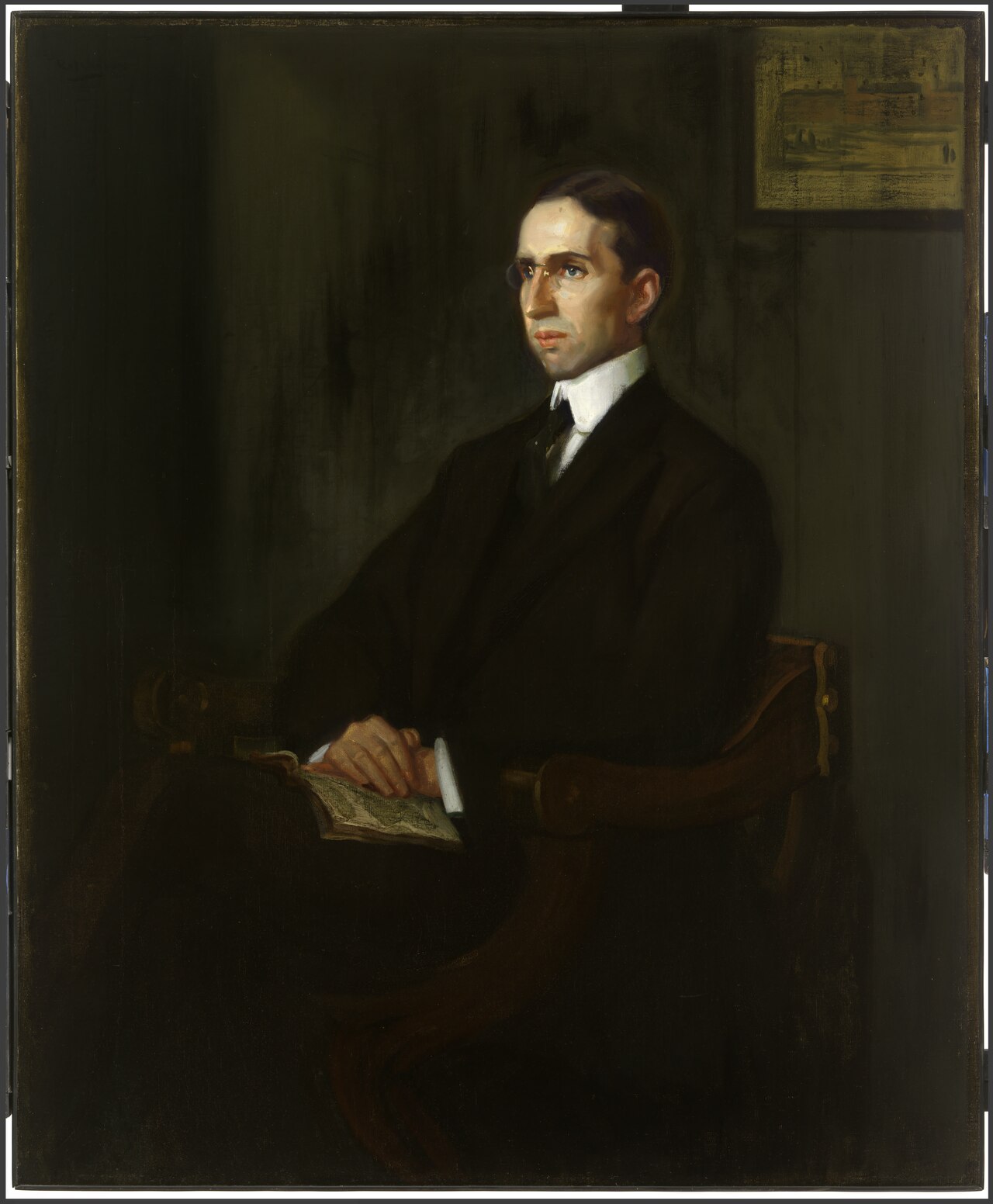


Early life Julius Rolshoven was born in 1858 in Detroit, Michigan, into a family that valued education and the arts. Little is recorded about his childhood, but the industrial growth of Detroit in the late nineteenth century provided a vibrant backdrop for his formative years. He received his first artistic instruction locally, learning basic drawing and painting techniques in community art classes. By his late teens, Rolshoven had shown sufficient promise to pursue further study beyond his hometown.
Career and style In the 1880s Rolshoven moved to New York City, the cultural hub of the United States, where he enrolled in the National Academy of Design. The Academy’s curriculum blended classical academic training with exposure to contemporary trends, giving Rolshoven a solid grounding in figure drawing, composition, and colour theory. While his exact artistic affiliation remains unclear, his oeuvre reflects an eclectic blend of realism, impressionistic brushwork, and a fascination with the mythic qualities of the American West.
The early part of his career focused on portraiture for affluent patrons in the Northeast. His portrait of the philanthropist Anson Phelps Stokes (1900) demonstrates a restrained, almost reverential approach to the sitter, highlighting both the subject’s social standing and an underlying psychological depth. By the 1910s Rolshoven began to travel westward, spending time in New Mexico and Colorado, where he encountered Indigenous cultures and the dramatic landscapes of the Southwest. These experiences informed a shift in his subject matter, moving from urban portraiture to depictions of Native American figures and frontier life.
Signature techniques Rolshoven’s technique is characterised by a careful modelling of form combined with a looser, more expressive handling of surface texture. In his portraits, he employed a muted palette of earth tones, using subtle glazing to achieve a luminous skin tone that evoked the sitter’s vitality. When tackling Western subjects, he adopted a brighter, more saturated palette, often juxtaposing warm desert hues with the deep blues of the sky. His brushwork in these later works became increasingly gestural, suggesting movement and the raw energy of the frontier.
A hallmark of his practice was the use of layered washes to build atmospheric depth. He would often lay down a thin, transparent layer of colour, let it dry, and then apply a more opaque tone on top, creating a sense of luminosity that is especially evident in the sky of "Sun Eagle Tail". Additionally, Rolshoven favoured a compositional balance that placed his figures against expansive, often simplified backgrounds, allowing the viewer to focus on the narrative content of the piece.
Major works - **Anson Phelps Stokes (1900)** – This oil portrait showcases Rolshoven’s mastery of academic realism. The sitter is rendered with meticulous attention to facial expression and clothing texture, while the background remains understated, drawing focus to the dignified presence of Stokes. - **Dilettante (1920)** – A later work that marks a departure from strict realism, "Dilettante" presents a young woman in a loosely rendered, impressionistic style. The brushstrokes are visible and fluid, suggesting a fleeting moment rather than a static pose. - **Sun Eagle Tail** – Although the exact date is uncertain, this painting reflects Rolshoven’s fascination with Native American subjects. The work depicts a tribal figure against a radiant sky, employing his characteristic layered washes to convey both the figure’s solidity and the ethereal quality of the surrounding light. - **Taos War Chief** – This composition captures a warrior in traditional regalia, set against the rugged cliffs of the Taos region. Rolshoven’s use of strong contrast and a limited colour scheme underscores the dignity and resilience of the subject.
These works collectively illustrate Rolshoven’s evolution from a conventional portraitist to an artist intrigued by the cultural narratives of the American West.
Influence and legacy Julius Rolshoven never achieved the widespread fame of some of his contemporaries, yet his paintings occupy a distinctive niche within early twentieth‑century American art. By bridging the worlds of Eastern academic portraiture and Western genre painting, he contributed to a broader visual dialogue about national identity and cultural diversity. His depictions of Indigenous subjects, while filtered through a Euro‑American perspective, were among the earlier attempts by a mainstream artist to engage with Native American iconography in a respectful manner.
After his death in New York City in 1930, Rolshoven’s works were collected by regional museums and private collectors, particularly those with an interest in the American West. Contemporary scholars reference his paintings when discussing the transition from nineteenth‑century realism to the more expressive, narrative‑driven art of the interwar period. Though not a household name, his paintings remain valuable for their technical skill, cross‑regional subject matter, and the way they document a period of rapid cultural change in the United States.
Frequently asked questions
Who was Julius Rolshoven?
Julius Rolshoven (1858–1930) was an American painter born in Detroit who worked mainly in New York City and is known for portraits and Western-themed paintings.
What artistic style or movement is he associated with?
His style blends academic realism with impressionistic touches, reflecting both traditional portraiture and the expressive qualities of early twentieth‑century Western genre painting.
What are his most famous works?
Key works include the portrait "Anson Phelps Stokes" (1900), the impressionistic piece "Dilettante" (1920), and the Western subjects "Sun Eagle Tail" and "Taos War Chief".
Why does Julius Rolshoven matter in art history?
He bridges Eastern academic portraiture and Western genre painting, offering a unique perspective on American cultural identity and early visual representations of Native American subjects.
How can I recognise a Julius Rolshoven painting?
Look for a combination of finely modelled figures, layered washes that create luminous atmospheres, and a balance between detailed portraiture and broader, often simplified backgrounds.