Julien de Parme
1736 – 1799
In short
Julien de Parme (1736–1799) was a Swiss painter born in Cavigliano who worked mainly in Paris, producing history paintings and self‑portraits that combine Baroque drama with early Neoclassical influences.
Notable works


Early life Julien de Parme was born in 1736 in the small Swiss town of Cavigliano, located in the canton of Ticino. Little is recorded about his family background, but the region’s proximity to Italy meant that he was exposed early to the artistic traditions of the Lombard and Venetian schools. As a teenager he likely received basic drawing instruction from local artisans before moving to a larger centre for formal training. By the early 1750s he had relocated to Paris, the epicentre of European art, where he sought apprenticeship with an established master—an experience typical of Swiss artists of his generation who wished to broaden their technical repertoire.
Career and style De Parme’s career unfolded during a period of stylistic transition. The dominant Baroque language of dramatic chiaroscuro and theatrical composition was gradually giving way to the more restrained, idealised aesthetics of Neoclassicism. Although no contemporary documents assign him to a specific movement, his surviving works reveal a synthesis of these currents. He favoured large‑scale history subjects—biblical, mythological and classical narratives—rendered with a heightened sense of drama reminiscent of the late Baroque, while his handling of line and anatomy shows the influence of emerging Neoclassical principles. His choice of Paris as a permanent base placed him in contact with the Académie Royale, where the academic hierarchy of genres dictated a preference for historical painting, a category in which de Parme specialised.
Signature techniques De Parme’s technique is characterised by a meticulous approach to drawing, evident in the precise contours of his figures. He employed a layered modelling of light and shadow, often beginning with a warm, amber ground that enhanced the depth of flesh tones. In his compositions, he used a limited palette of earth tones punctuated by rich reds and blues for focal points, a strategy that heightened narrative emphasis without overwhelming the viewer. His brushwork varies between smooth, almost invisible strokes for the flesh and more textured passages for drapery and landscape, suggesting a deliberate differentiation between the mortal and the divine. The artist also demonstrated a keen interest in facial expression, using subtle variations in eyes and mouth to convey psychological tension.
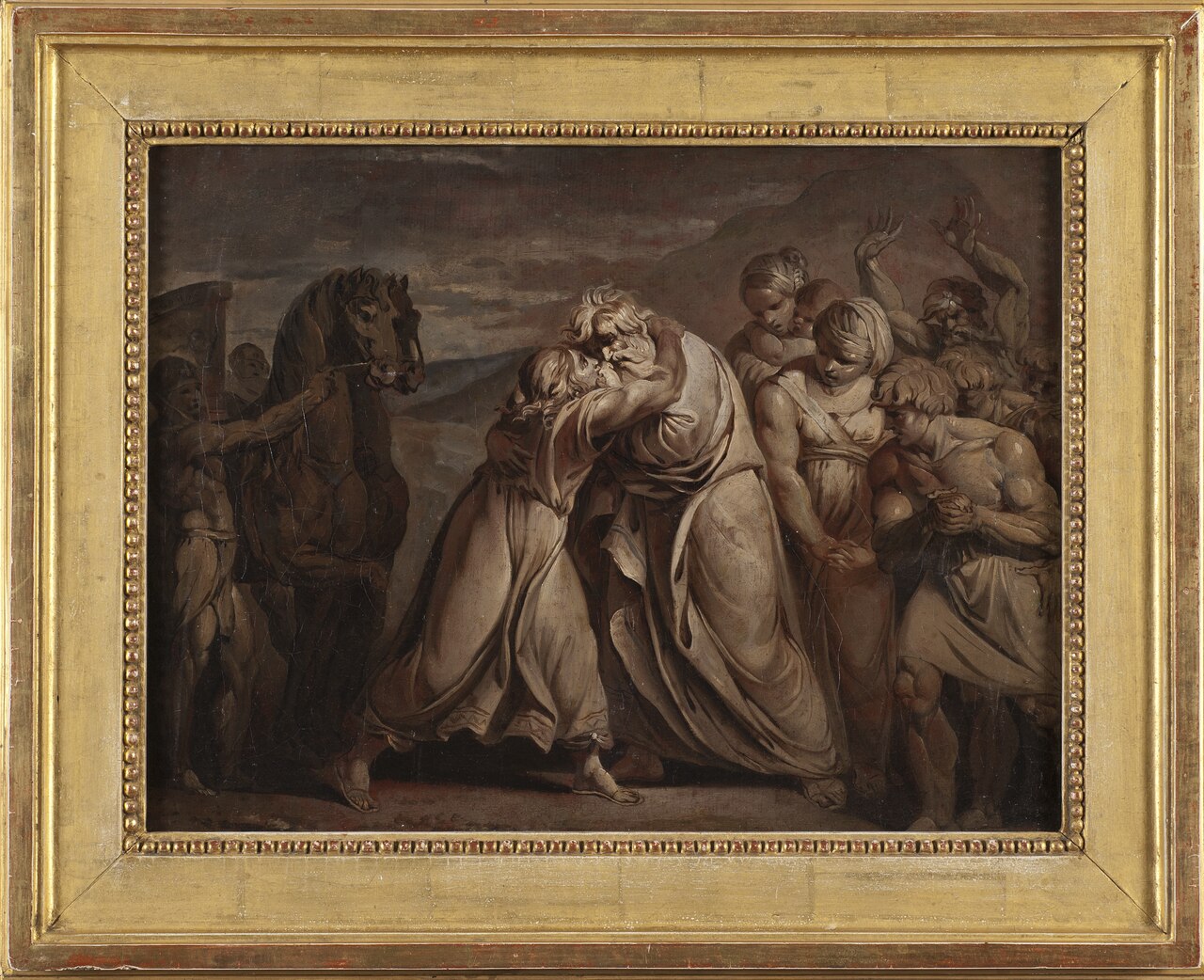
Major works - **Joseph meets his father Jacob in the desert** – This canvas, undated but likely executed in the early 1770s, depicts the biblical reunion of Joseph and Jacob after years of separation. De Parme places the figures against a stark desert backdrop, using a low horizon to accentuate the distance between them. The composition balances intimacy—Jacob’s outstretched hand—with the broader narrative of providence, a hallmark of the artist’s ability to fuse personal emotion with grand storytelling.
- Aeneas and Achates Meet Diana (1770) – Rendered in 1770, the work illustrates a lesser‑known episode from the *Aeneid* in which the Trojan heroes encounter the goddess Diana. De Parme arranges the scene on a moonlit shoreline, employing a silvery light to delineate the divine figure. The painting’s restrained colour scheme and crisp linearity align with early Neoclassical tendencies, while the dramatic gesture of Diana’s hand retains a Baroque vitality.
- Caracalla Kills his Brother Geta (1775) – This 1775 history painting captures the violent fratricide of Roman emperors Caracalla and Geta. The artist’s use of chiaroscuro intensifies the brutality of the moment; a stark contrast between the blood‑stained sword and the dim interior heightens the moral gravity. The piece demonstrates de Parme’s comfort with macabre subjects and his skill in rendering muscular tension.
- Autoportrait of Julien de Parme (circa 1799) (1777) – Although the portrait is dated 1777, the inscription suggests it was revisited near the end of his life, around 1799. In this self‑portrait the artist presents himself in a modest studio setting, clothed in a dark frock with a faintly illuminated background. The careful rendering of his aged face, marked by subtle wrinkles, offers insight into his self‑perception and the dignified professionalism he cultivated.
Influence and legacy Julien de Parme’s name never achieved the fame of contemporaries such as Jacques-Louis David, yet his oeuvre provides valuable insight into the transitional phase of late‑18th‑century European painting. His works were exhibited at the Paris Salons of the 1770s and earned modest critical acknowledgement for their narrative clarity and disciplined execution. Swiss art historians later recognised de Parme as a pioneer who helped introduce Parisian academic standards to his native canton, influencing a subsequent generation of Swiss painters who sought training abroad. Although his paintings are housed primarily in private collections, occasional loan exhibitions have revived scholarly interest, prompting reassessments of his role as a cultural bridge between Swiss regional art and the French academy. Today, de Parme is regarded as a representative of the lesser‑known artists who navigated the shifting aesthetic currents of his era, leaving a body of work that, while not revolutionary, exemplifies the high technical standards of the academic tradition.
Frequently asked questions
Who was Julien de Parme?
Julien de Parme (1736–1799) was a Swiss painter born in Cavigliano who spent most of his career in Paris, known for history paintings and self‑portraits that blend Baroque drama with early Neoclassical style.
What artistic style or movement is he associated with?
He is not tied to a single movement, but his work reflects a synthesis of late Baroque dynamism and the emerging Neoclassical emphasis on line, idealised form, and restrained colour.
What are his most famous works?
His most cited canvases include *Joseph meets his father Jacob in the desert*, *Aeneas and Achutes Meet Diana* (1770), *Caracalla Kills his Brother Geta* (1775) and his self‑portrait dated circa 1799.
Why is Julien de Parme important in art history?
He exemplifies the transitional generation of artists who mediated between Baroque and Neoclassicism, and he helped introduce Parisian academic standards to Swiss art circles.
How can I recognise a painting by Julien de Parme?
Look for carefully drawn figures, a limited but rich palette, dramatic chiaroscuro, and a compositional focus on narrative moments that combine emotional intensity with classical restraint.
More Switzerland artists
References: Wikidata