Joseph Karl Stieler
1781 – 1858
In short
Joseph Karl Stieler (1781–1858) was a Bavarian painter best known for his neoclassical portraiture, especially his depictions of cultural figures such as Beethoven and Goethe and his work for the Bavarian court. From 1820 to 1855 he served as the royal court painter, producing iconic images that remain reference points in 19th‑century portrait art.
Notable works




Early life Joseph Karl Stieler was born on 23 October 1781 in Mainz, then part of the Holy Roman Empire. He grew up in a family that valued the visual arts; his father, Johann Stieler, was a modest painter who introduced the young Joseph to drawing and the fundamentals of academic training. Stieler displayed a precocious talent for rendering the human form, and after completing his basic schooling he entered the Academy of Fine Arts in Munich, where he absorbed the prevailing neoclassical doctrines that emphasised idealised anatomy, balanced composition, and a restrained colour palette. His formative years coincided with the rise of Bavarian cultural patronage, a circumstance that would later shape his professional trajectory.
Career and style In the early 1810s Stieler began to attract commissions from aristocratic patrons, but his breakthrough came in 1820 when he was appointed the court painter to King Ludwig I of Bavaria. The appointment secured a steady flow of high‑profile commissions and allowed him to develop a distinctive style that blended the clarity of neoclassicism with a subtle psychological depth. Stieler’s portraits are characterised by their crisp delineation of facial features, careful modelling of light, and an emphasis on the sitter’s status through the inclusion of symbolic regalia or fashionable attire. While he adhered to the academic standards of his day, he also introduced a degree of naturalism that set his work apart from the more rigidly idealised portraits of his contemporaries.
Signature techniques Stieler worked primarily with oil on canvas, employing a layered approach that began with a finely drawn under‑drawing, often executed in charcoal or graphite. He would then apply a thin glaze of earth tones to establish the tonal foundation before building up richer colours in successive layers. This method allowed him to achieve a luminous quality in skin tones and a subtle gradation of light across fabrics. Another hallmark of his technique was the meticulous rendering of textiles and metal, where he used fine brushwork and a controlled palette of whites, greys and muted golds to convey texture without overwhelming the sitter’s visage. His attention to the eyes—often painted with a reflective sheen—contributed to the sense of presence that many viewers associate with his portraits.
Major works Stieler’s oeuvre includes several works that have entered the visual canon of the 19th century. In 1820 he painted the now‑iconic portrait of Ludwig van Beethoven, a study that captures the composer’s intense gaze and gaunt features against a dark, unadorned background. The portrait, commissioned by the composer’s friend and patron, Johann Nepomuk Hummel, remains one of the most reproduced images of Beethoven and is valued for both its artistic merit and its documentary significance.
In 1823 Stieler completed the *Bildnis Prinzessin Amalie*, a portrait of Princess Amalie of Bavaria. The sitter is shown in a regal dress with delicate lace, her pose elegant yet relaxed, illustrating Stieler’s ability to balance formality with a sense of personal intimacy. Two years later, in 1826, he rendered *King Ludwig I of Bavaria in Coronation Regalia*, a monumental portrait that showcases the monarch in full ceremonial dress, complete with a richly embroidered mantle and the golden insignia of the order of Saint George. The work was intended for display in the royal galleries and underscores the painter’s role as a chronicler of Bavarian sovereignty.
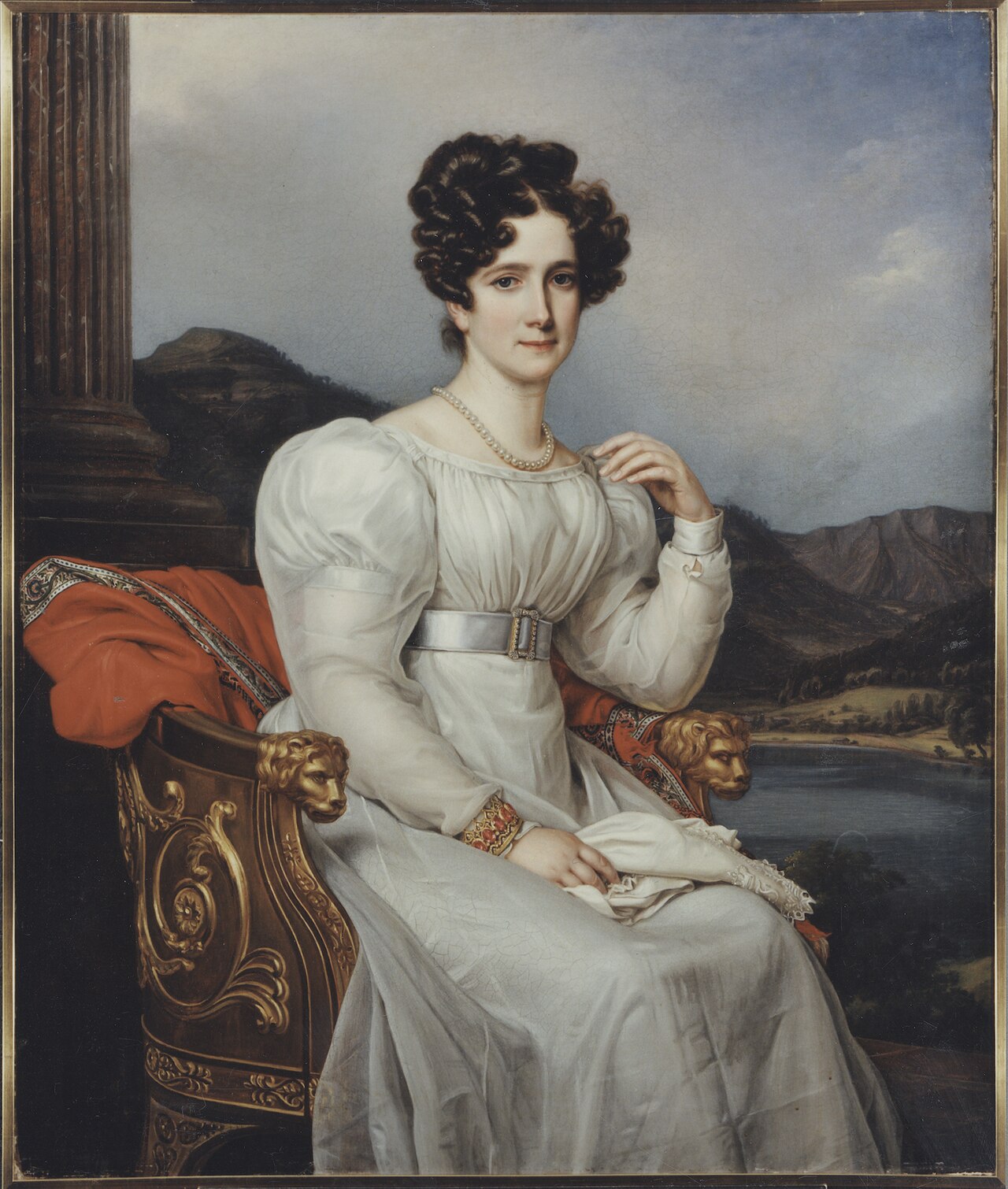
Also in 1826 Stieler painted *Fredrika Dorotea Vilhelmina, 1781‑1826, Drottning av Sverige*, a portrait of the Swedish queen consort, which highlights his international reputation and his capacity to adapt his style to varied cultural contexts. The composition presents the queen in a sumptuous gown, her expression calm and dignified, while the background is rendered in muted tones that keep the focus on her features.
In 1828 Stieler turned his attention to the literary world with a portrait of Johann Wolfgang von Goethe. The German poet is depicted seated, holding a manuscript, his gaze directed outward as if contemplating the act of creation. The portrait’s restrained palette and careful modelling echo the intellectual gravitas associated with Goethe, while Stieler’s skillful handling of light gives the figure a palpable immediacy.
These works, together with his contributions to the *Gallery of Beauties* at Nymphenburg Palace—an ambitious series of portraits of women celebrated for their beauty—exemplify Stieler’s mastery of portraiture and his ability to imbue each sitter with a distinct personality within the conventions of neoclassical art.
Influence and legacy Stieler’s influence extended well beyond his lifetime. His portraits set a benchmark for court painting in Bavaria, and his technical innovations in glazing and textural rendering were studied by later generations of German portraitists. The *Gallery of Beauties* in particular inspired similar collections across Europe, where the idealised yet realistic portrayal of women became a fashionable genre. Moreover, his image of Beethoven continues to dominate visual representations of the composer, shaping public perception of the musician’s appearance for nearly two centuries. While later movements such as Romanticism and Realism diverged from the neoclassical aesthetic, Stieler’s dedication to precise draftsmanship and psychological insight ensured that his work remained a reference point for artists seeking to balance idealisation with individual character. He died in Munich on 9 September 1858, leaving behind a corpus that still serves scholars, collectors, and the general public as a vivid record of early‑19th‑century cultural and political life.
Frequently asked questions
Who was Joseph Karl Stieler?
He was a Bavarian painter (1781–1858) renowned for his neoclassical portraiture and served as the royal court painter for the Bavarian kings from 1820 to 1855.
What artistic movement did Stieler belong to?
Stieler worked within the Neoclassical movement, emphasizing idealised forms, balanced composition, and restrained colour while incorporating a subtle naturalism.
What are his most famous works?
His best‑known portraits include the 1820 portrait of Ludwig van Beethoven, the 1826 portrait of King Ludwig I in coronation regalia, and portraits of Goethe (1828), Princess Amalie (1823), and the Swedish queen Fredrika Dorotea Vilhelmina (1826).
Why does Stieler matter in art history?
Stieler set a high standard for court portraiture, contributed to the celebrated Gallery of Beauties, and his iconic images—especially of Beethoven—have shaped visual representations of key cultural figures.
How can I recognise a Stieler portrait?
Look for meticulous under‑drawings, layered glazing that gives luminous skin tones, precise rendering of fabrics and metal, and a calm, focused gaze that conveys both status and personality.