Joos de Momper the Younger
1564 – 1635
In short
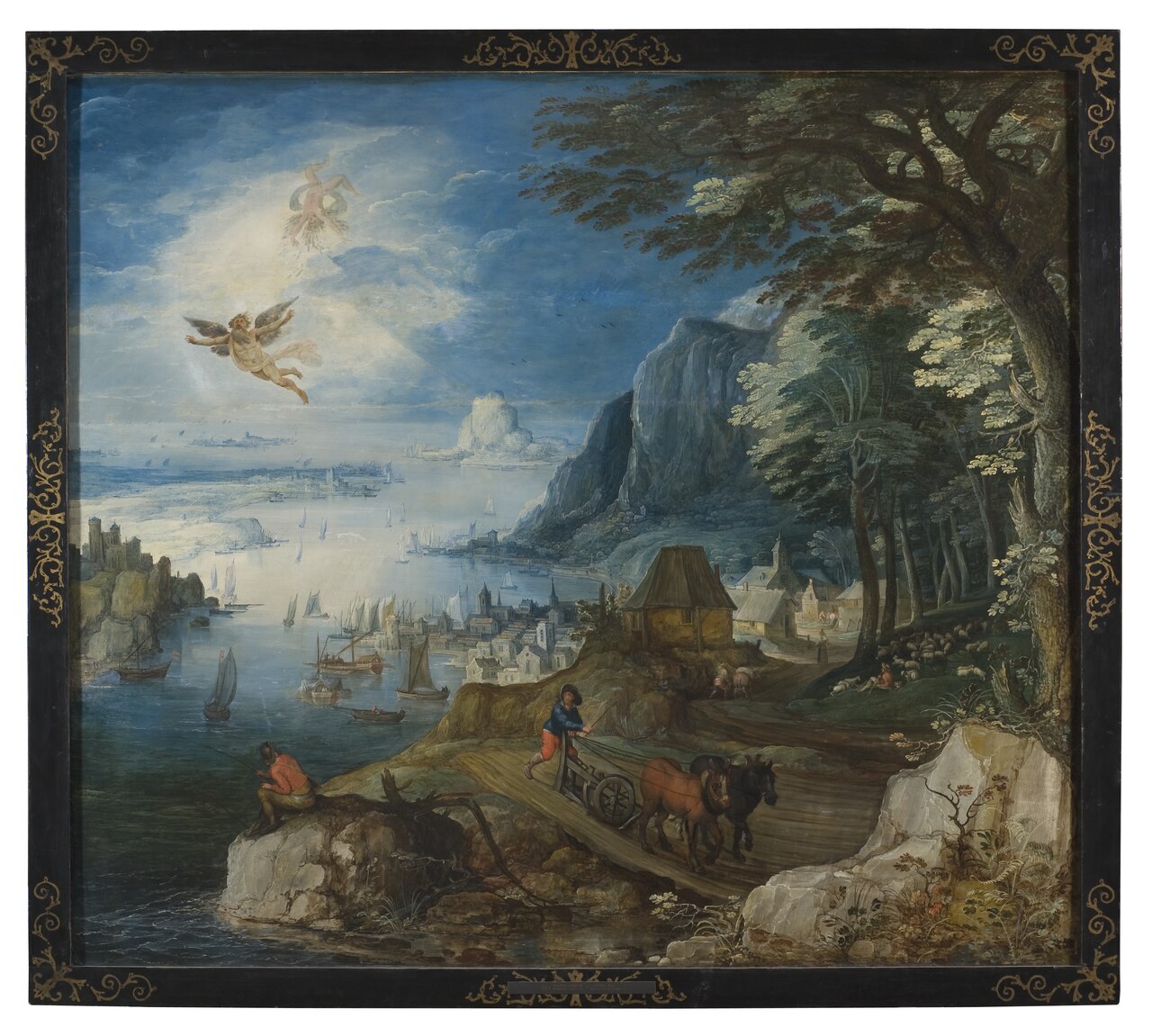
Joos de Momper the Younger (1564–1635) was a Flemish landscape painter from Antwerp, known for sweeping, imaginative vistas that blend Mannerist fantasy with emerging naturalism, and for works such as The Storm at Sea and Landscape with the Fall of Icarus.
Notable works
_Storm_ar_sea_038b.jpg)

.jpg)
.jpg)
Early life
Joos de Momper the Younger was born in 1564 into a prominent artistic family in Antwerp, a city that was then the cultural hub of the Habsburg Netherlands. His father, Joos de Momper the Elder, was a painter and dealer, and the younger Joos was apprenticed within the family workshop, where he absorbed the technical foundations of Flemish painting. The de Momper household maintained close ties with other leading artists of the period, providing young Joos with early exposure to the vibrant market for decorative and devotional works that characterised late‑sixteenth‑century Antwerp.
Career and style
De Momper began his independent career in the 1580s, a time when the city’s artistic scene was dominated by the legacy of Pieter Bruegel the Elder and the flourishing of Mannerist landscape conventions. His early canvases display the exaggerated perspective and stylised foliage typical of that tradition, yet they also hint at a growing interest in atmospheric depth. By the turn of the century, de Momper’s style had evolved into a distinctive synthesis: the dramatic, often fantastical panoramas of Mannerism were tempered by a more measured observation of light, colour, and topography. This transitional approach placed him at the forefront of a movement toward greater realism in landscape painting, a shift that would be fully realised by artists such as Rubens and Jan Brueghel the Elder.
The artist’s oeuvre is characterised by sweeping vistas that frequently employ a high, distant viewpoint. In these compositions, the foreground is populated with diminutive figures engaged in hunting, travel, or leisurely activity, while the middle and background recede into a haze of blues and greys, creating a sense of vast, uncharted space. De Momper’s palette often juxtaposes warm earth tones with cool atmospheric blues, a device that enhances the illusion of depth and reinforces the narrative quality of his scenes.
Signature techniques
Several technical hallmarks identify a de Momper landscape. First, his use of a three‑tiered compositional structure—foreground, middle ground, and background—allows him to guide the viewer’s eye across the canvas. Second, he favours a rapid, almost sketch‑like brushstroke for foliage, giving trees and shrubs a lively, wind‑blown appearance. Third, his handling of water is notable for its reflective surface and subtle ripple effects, which he achieves through thin, layered glazes that catch the light. Finally, de Momper often integrates a faint, almost invisible horizon line, a device that heightens the sense of endlessness in his imaginative topographies.
Major works
Among de Momper’s most celebrated pieces are several that illustrate both his narrative skill and his mastery of landscape composition. *The Storm at Sea* (1610) captures a turbulent maritime scene where towering waves clash with a darkened sky, while tiny vessels struggle against the elements—a powerful reminder of humanity’s vulnerability before nature. *River Landscape with Boar Hunt* (1600) portrays a dynamic chase through a wooded river valley, the hunters rendered in vivid detail against a backdrop of mist‑shrouded hills. In *Excursion in the Countryside of Infanta Isabel Clara Eugenia* (1601), de Momper documents a royal outing, blending portraiture with landscape to celebrate the Habsburg patron’s connection to the land. *The Infanta Isabel Clara Eugenia in the Mariemont Park* (1601) similarly situates the young princess within a lush, idealised park, highlighting the artist’s ability to fuse courtly representation with natural scenery. Finally, *Landscape with the Fall of Icarus* (1607) interprets the classical myth in a contemporary setting, placing the tragic figure almost unnoticed among everyday labourers—a composition that underscores de Momper’s interest in the juxtaposition of myth and daily life.
These works not only demonstrate de Momper’s technical proficiency but also his capacity to embed narrative content within expansive, atmospheric settings. Each painting serves as a visual record of the cultural and environmental concerns of early‑modern Antwerp, from the fascination with exotic travel to the celebration of Habsburg patronage.
Influence and legacy
During his lifetime, Joos de Momper the Younger enjoyed considerable commercial success, supplying works to both local collectors and the Habsburg court. His landscapes helped shape the visual vocabulary of the early‑seventeenth‑century Flemish school, influencing younger artists who sought to balance imaginative composition with emerging naturalistic trends. The transmission of his compositional formulas can be observed in the works of Jan Brueghel the Younger and later Dutch landscape painters, who adopted his high‑vantage points and atmospheric colour schemes.
De Momper’s legacy persists in the way modern scholars understand the transition from Mannerist fantasy to the more empirical approach that characterised the Baroque period. His paintings remain a primary source for studying the interplay of myth, courtly life, and landscape in the Habsburg Netherlands, and they continue to be exhibited in major European museums, where they are appreciated for both their aesthetic qualities and their historical significance.
Frequently asked questions
Who was Joos de Momper the Younger?
He was a Flemish landscape painter (1564–1635) from Antwerp, known for large, imaginative vistas that bridge Mannerist fantasy and early naturalism.
What artistic style or movement is he associated with?
De Momper worked at the crossroads of late‑16th‑century Mannerism and the emerging realistic landscape tradition of the early 17th century.
What are his most famous works?
Key paintings include *The Storm at Sea* (1610), *River Landscape with Boar Hunt* (1600), *Excursion in the Countryside of Infanta Isabel Clara Eugenia* (1601), *The Infanta Isabel Clara Eugenia in the Mariemont Park* (1601), and *Landscape with the Fall of Icarus* (1607).
Why is Joos de Momper important in art history?
He helped define the transition to more naturalistic landscape painting, influencing later Flemish and Dutch artists and providing a visual record of Habsburg court culture.
How can I recognise a de Momper painting?
Look for sweeping, high‑vantage landscapes with a three‑tiered depth structure, delicate atmospheric blues, miniature figures in the foreground, and a sketch‑like treatment of foliage.