John Theodore Heins
1697 – 1756
In short
John Theodore Heins (1697–1756) was a German‑born painter and engraver who built his career in Norwich, England. He is best known for portraiture and a handful of allegorical and historical works that document the cultural life of 18th‑century Britain.
Notable works
.jpg)


_-_The_Meeting_of_Abraham_and_Melchizedek_-_1401284_-_National_Trust.jpg)
Early life John Theodore Heins was born in 1697 in the German territories, likely in a region with a strong tradition of guild‑based artistic training. Details of his family background remain scarce, but the prevailing practice of the time suggests he would have begun an apprenticeship in his early teens, mastering drawing, oil painting, and the emerging art of engraving. By the turn of the 1720s he had migrated to Great Britain, a move common among continental artists seeking patronage in the expanding British market.
Settling in Norwich, a city experiencing rapid commercial growth, Heins quickly integrated into the local artistic community. Norwich’s prosperous mercantile families offered a steady stream of commissions, and Heins’s ability to combine continental technique with an English sensibility made him a desirable portraitist.
Career and style Heins’s professional activity in Norwich began in earnest around 1720, when he embarked on a series of portraits for prominent local families. His work reflects a transitional style that bridges the late Baroque sensibilities of his German training with the emerging Rococo lightness favored by British patrons. He favored a restrained palette of earth tones, allowing the flesh tones of his sitters to emerge with subtle chiaroscuro. The compositions are typically straightforward, with a focus on the sitter’s face and hands, while background elements hint at status—such as draped fabrics, books, or architectural motifs.
Although Heins never formally aligned with a specific British art movement, his oeuvre mirrors the broader shift toward naturalism and psychological depth that characterized mid‑18th‑century portraiture. He also produced a limited number of allegorical and historical paintings, indicating an ambition to engage with the intellectual currents of his time.
Signature techniques Heins’s paintings are identifiable through several recurring technical hallmarks:
1. Fine brushwork in facial features – Heins rendered eyes, lips, and skin with a delicate, layered approach, creating a lifelike translucency. 2. Controlled use of light – A soft, diffused light often falls from the left, illuminating the sitter’s face while casting gentle shadows that model the form. 3. Engraving‑influenced line quality – His background details and clothing folds display crisp, linear definition reminiscent of his engraving practice. 4. Subtle colour modulation – Rather than bold contrasts, Heins employed gradual tonal shifts, particularly in the rendering of hair and fabric textures. 5. Signature placement – In many works he inscribed a modest monogram (J.T.H.) on a discreet corner of the canvas, a practice that aids authentication.
These techniques combine to produce portraits that feel both intimate and formally composed, allowing viewers to sense the personality of the subject while appreciating the artist’s technical mastery.
Major works Heins’s surviving catalogue includes several notable pieces that illustrate his range:
- Portrait of Georg Friedrich Handel (1750) – Executed near the end of Handel’s life, this portrait captures the composer in a contemplative pose, with a manuscript scroll subtly placed on a table. The work’s restrained colour scheme and the soft illumination highlight Handel’s introspective character, and it remains a key visual source for scholars of the composer.
- Family Group on a Terrace (1740) – This multi‑figure composition depicts a Norwich merchant family enjoying leisure on a garden terrace. The painting showcases Heins’s ability to handle complex group dynamics, with each figure rendered individually yet harmoniously within the shared space. The inclusion of architectural elements and a distant landscape reflects the period’s fascination with genteel domesticity.
- Allegory of Trade (1743) – An allegorical canvas that personifies commerce through a female figure bearing a cornucopia, surrounded by symbols of shipping and industry. The work underscores the economic optimism of mid‑century Norwich and demonstrates Heins’s competence in integrating symbolic content with his characteristic portrait style.
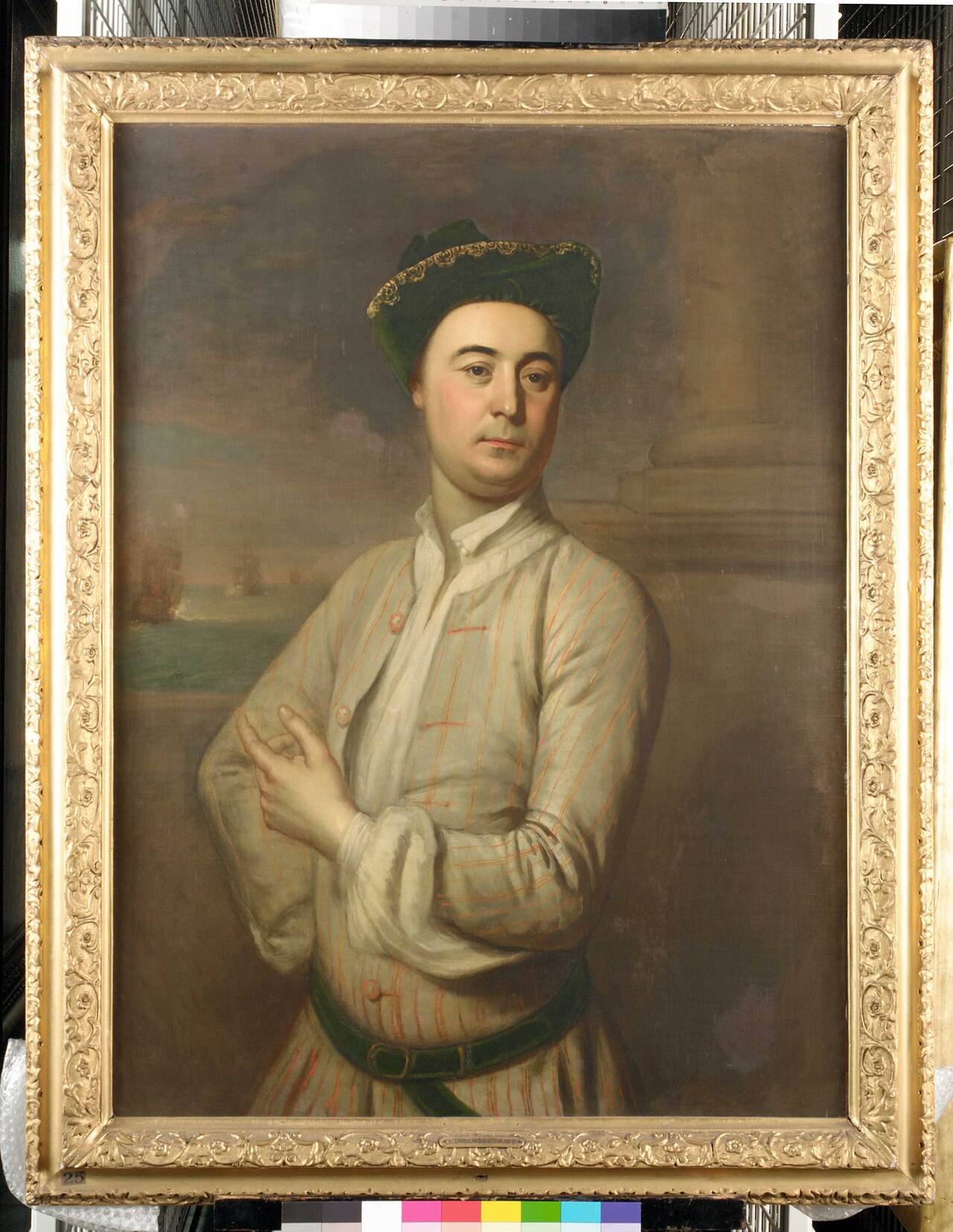
- Admiral Sir Robert Harland, circa 1715‑1784 (1747) – A formal naval portrait presenting the admiral in uniform, complete with epaulettes and a background of naval rigging. The painting’s meticulous attention to uniform detail and the admiral’s resolute expression illustrate Heins’s capacity to convey authority and status.
- The Meeting of Abraham and Melchizedek (1736) – One of Heins’s few overtly biblical subjects, this work portrays the Old Testament encounter with a calm, almost theatrical composition. The figures are illuminated by a divine light source that creates a sense of spiritual revelation, revealing Heins’s willingness to experiment beyond portraiture.
These works collectively document Heins’s adaptability—from intimate portraiture to grand allegorical narratives—while maintaining a cohesive visual language.
Influence and legacy John Theodore Heins did not found a school or movement, yet his presence in Norwich contributed to the city’s reputation as a regional artistic hub during the 18th century. His portraits provided a visual record of the mercantile elite, offering historians insight into dress, interior décor, and social hierarchy of the period. Moreover, his occasional forays into allegorical and biblical subjects suggest an engagement with the intellectual and religious discourse of his time.
Later Norwich artists, such as Thomas Gainsborough’s early Norwich connections, benefited indirectly from the precedent Heins set for a professional studio capable of serving both local patrons and itinerant visitors. While Heins’s name is less widely known than some of his London contemporaries, his work continues to appear in regional collections and exhibitions, and his paintings are frequently cited in scholarly discussions of provincial portraiture.
In recent decades, renewed scholarly interest in provincial artists has prompted a reassessment of Heins’s oeuvre, positioning him as a bridge between continental techniques and British taste. His surviving works, particularly the Handel portrait, remain valuable reference points for curators, conservators, and art historians seeking to understand the nuanced evolution of 18th‑century British portraiture.
---
Through meticulous craftsmanship, a restrained yet expressive style, and a portfolio that spans portraiture, allegory, and biblical narrative, John Theodore Heins stands as a noteworthy figure in the tapestry of British art history, embodying the cross‑cultural currents that shaped the visual culture of his era.
Frequently asked questions
Who was John Theodore Heins?
John Theodore Heins (1697–1756) was a German‑born painter and engraver who worked primarily in Norwich, England, producing portraits and occasional allegorical works.
What artistic style or movement is Heins associated with?
Heins did not belong to a formal movement; his style blends late Baroque influences from his German training with the emerging naturalism of mid‑18th‑century British portraiture.
What are his most famous works?
His most notable paintings include the Portrait of Georg Friedrich Handel (1750), Family Group on a Terrace (1740), Allegory of Trade (1743), Admiral Sir Robert Harland (1747), and The Meeting of Abraham and Melchizedek (1736).
Why is Heins important in art history?
Heins provides a valuable record of Norwich’s mercantile elite, illustrates the cross‑cultural exchange between continental and British art, and helped establish Norwich as a regional centre for portraiture.
How can I recognise a painting by John Theodore Heins?
Look for finely rendered facial features, soft left‑hand lighting, crisp linear details reminiscent of engraving, subtle colour modulation, and often a modest J.T.H. monogram in a corner of the canvas.