John Francis Rigaud
1742 – 1810
In short
John Francis Rigaud (1742–1810) was a British painter of French descent, born in Turin and active mainly in England. He specialised in history and portrait painting, producing notable works such as his portrait of Captain Horatio Nelson and collaborative group portraits of leading artists and architects.
Notable works


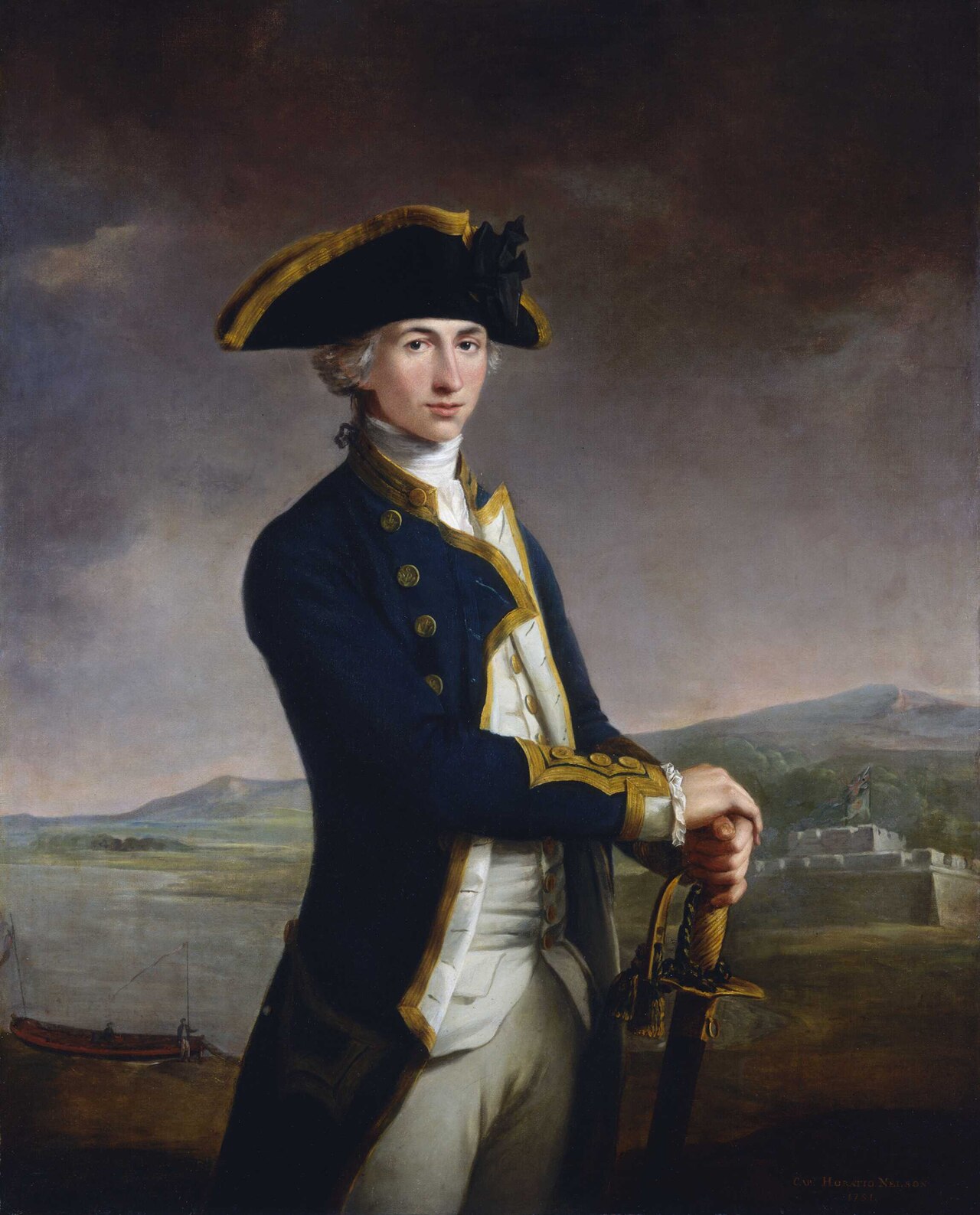


Early life John Francis Rigaud was born in 1742 in Turin, a city that was then part of the Kingdom of Sardinia. His family was of French origin, and his early exposure to the artistic traditions of both Italy and France shaped his formative years. Rigaud received his initial training in Italy, where he absorbed the classical principles of the Renaissance and the Baroque emphasis on dramatic narrative. By his early twenties, he had moved to London, attracted by the flourishing art market and the opportunities offered by the British aristocracy.
Career and style In England, Rigaçud quickly established himself as a competent history painter, a genre that required the depiction of classical, biblical, or historical subjects with a high degree of narrative clarity. He also became known for portraiture, particularly of prominent figures in the arts, sciences, and military. While Rigaud did not align himself with a single, identifiable movement, his work reflects the prevailing neoclassical sensibilities of the late 18th century, combined with a lingering baroque vigor. His canvases often display a balanced composition, careful anatomical rendering, and a restrained colour palette that favours earth tones and muted blues, typical of the academic style of his day.
Rigaud exhibited regularly at the Royal Academy from the 1770s onward, gaining the patronage of notable patrons such as Sir William Chambers and Sir Joshua Reynolds. His reputation as a reliable and skilled painter of both grand historical subjects and intimate portraiture secured commissions from both private collectors and public institutions.
Signature techniques Rigaud’s technique is characterised by several recurring elements: 1. **Linear clarity** – He employed a precise drawing style that emphasised contour and form, often using a fine brush to outline figures before filling in colour. 2. **Subtle chiaroscuro** – Rather than the stark contrasts of Caravaggio, Rigaud utilised gentle gradations of light to model the three‑dimensionality of his subjects, creating a sense of depth without overwhelming drama. 3. **Narrative detail** – In his history paintings, Rigaud paid close attention to props, costumes, and architectural settings, ensuring that each element supported the story being told. 4. **Polished finish** – His works typically exhibit a smooth, almost enamel‑like surface, achieved through careful layering of glazes and a final varnish that enhanced colour depth. 5. **Collaborative portraiture** – Several of his most famous works are group portraits that bring together multiple distinguished individuals, a format that required careful composition to give each figure a distinct presence while maintaining overall harmony.
Major works Rigaud’s oeuvre includes a series of collaborative and individual portraits that highlight his versatility:
- Agostino Carlini, Francesco Bartolozzi, Giovanni Battista Cipriani (1777) – This group portrait brings together three leading artists of the period. Rigaud captures each sitter with individualized detail: Carlini’s sculptural gestures, Bartolozzi’s delicate hand reminiscent of his engravings, and Cipriani’s compositional poise. The work reflects Rigaud’s ability to balance multiple personalities within a single canvas.
- Sir William Chambers, Joseph Wilton, Sir Joshua Reynolds (1782) – In this composition, Rigaud portrays the architect Chambers, the sculptor Wilton, and the painter Reynolds, three pillars of British artistic practice. The painting’s measured arrangement and subdued lighting underscore the dignified status of each figure, while the subtle interplay of textures—silk, marble, and oil—demonstrates Rigaud’s technical skill.
- Captain Horatio Nelson, 1758‑1805 (1781) – Although created before Nelson’s famed victories at the Nile and Trafalgar, the portrait anticipates his later heroism. Rigaud presents the young captain in a naval uniform, with a calm yet determined expression. The background is a muted seascape that hints at his maritime career, and the meticulous rendering of the uniform’s gold embroidery showcases Rigaud’s attention to detail.
- Captain Vincenzo Lunardi with his Assistant George Biggin, and Letitia Anne Sage (née Hoare), in a Balloon (1785) – This work captures the excitement of early aeronautics. Rigaud depicts the balloon ascending against a cloudy sky, with Lunardi and his assistant poised confidently. Letitia Sage, a noted society figure, is shown observing from the ground, adding a narrative of public fascination. The painting’s dynamic composition and delicate handling of clouds illustrate Rigaud’s skill in rendering atmospheric effects.
- Joseph Nollekens with His Bust of Laurence Sterne (1772) – In this intimate portrait, the sculptor Nollekens stands beside his marble bust of the novelist Laurence Sterne. Rigaud emphasizes the contrast between the soft flesh of Nollekens and the hard stone of the bust, using subtle lighting to highlight the sculptor’s craft. The work serves as a tribute to both the literary and sculptural arts, reflecting the interdisciplinary spirit of the period.
These works collectively demonstrate Rigaud’s capacity to document the cultural elite of his time while maintaining a consistent aesthetic language.
Influence and legacy John Francis Rigaud may not have founded a distinct artistic movement, but his contributions to British portraiture and history painting were significant. By bridging continental training with British patronage, he helped to disseminate neoclassical ideals across the island. His collaborative portraits provided a visual record of the artistic community, preserving the likenesses of figures who would shape British art for decades.
Rigaud’s teaching and mentorship of younger artists, though less documented, contributed to the continuation of academic painting practices in the early 19th century. His works remain in public collections such as the National Portrait Gallery and the Royal Academy of Arts, where they are valued for their historical documentation and technical proficiency.
In contemporary scholarship, Rigaud is often cited as an example of the transnational flow of artistic ideas in the Enlightenment era—a painter of French descent, born in Italy, who made his career in England. His legacy endures through the continued study of his portraits, which offer insight into the visual culture of late‑Georgian Britain and the individuals who defined its artistic landscape.
Frequently asked questions
Who was John Francis Rigaud?
John Francis Rigaud (1742–1810) was a British painter of French descent, born in Turin, who specialised in history and portrait painting during the late 18th century.
What style or movement is Rigaud associated with?
Rigaud worked within the neoclassical tradition, blending classical composition with a restrained palette and academic technique, though he did not belong to a specific movement.
What are his most famous works?
His notable works include group portraits of Agostino Carlini, Francesco Bartolozzi and Giovanni Battista Cipriani (1777); Sir William Chambers, Joseph Wilton and Sir Joshua Reynolds (1782); a portrait of Captain Horatio Nelson (1781); the balloon scene with Captain Vincenzo Lunardi (1785); and Joseph Nollekens with his bust of Laurence Sterne (1772).
Why does Rigaud matter in art history?
Rigaud documented the leading cultural figures of his era, helped spread neoclassical ideals in Britain, and exemplifies the cross‑European artistic exchange of the Enlightenment.
How can I recognise a Rigaud painting?
Look for precise linear drawing, subtle chiaroscuro, smooth enamel‑like finishes, and careful narrative details that balance multiple figures within a harmonious composition.