Johannes Wierix
1549 – 1615
In short
Johannes Wierix (1549–1615) was a Flemish engraver, draughtsman and publisher from Antwerp, renowned for his precise and highly finished prints, many of which were portraits of notable artists, and for his work on silver and ivory.
Notable works


,_1572.jpg)
Early life Johannes Wierix was born in 1549 in Antwerp, a major centre of the Habsburg Netherlands' artistic production. He came from a family of artists; his brothers, Hieronymus and Anton II, were also active engravers, and the workshop environment provided him with early training in drawing and printmaking. Antwerp's bustling market for printed images, combined with its thriving guild system, offered a fertile ground for a young artist keen on mastering the technical demands of engraving.
Career and style Wierix established himself as a professional engraver and publisher by the late 1560s. He produced prints after his own designs as well as after the works of other Northern and Southern European artists, a common practice that allowed engravers to disseminate popular compositions. His output includes portraiture, religious subjects, and ornamental designs, reflecting the diverse market for prints in the late sixteenth and early seventeenth centuries.
Stylistically, Wierix's engravings are characterised by a meticulous line quality, a tight control of hatching, and an eye for fine detail. His figures often display a restrained elegance, with careful attention to facial features and clothing textures. While he did not align himself with a specific artistic movement, his work embodies the Northern Renaissance's emphasis on precise observation and the burgeoning Baroque taste for intricate surface treatment.
Signature techniques Wierix's technical repertoire centred on the burin, the traditional engraving tool, which he wielded to achieve exceptionally fine lines. He frequently employed cross‑hatching to model volume, creating subtle gradations of tone without resorting to heavy stippling. In addition to paper prints, he executed engravings on metal and ivory, demonstrating a versatility that was unusual among his contemporaries. His ability to render delicate textures—such as the sheen of silk or the grain of wood—contributed to the high regard in which his prints were held.
Major works Among the works most frequently associated with Johannes Wierix are a series of portrait engravings that commemorate leading artists of the Low Countries:
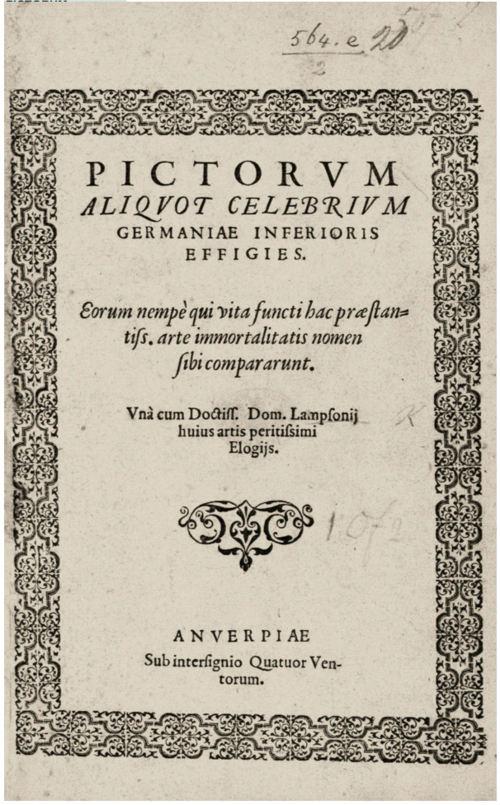
- Pictorum aliquot celebrium Germaniae inferioris effigies – a collective portrait plate that gathers likenesses of several celebrated painters from the southern Netherlands. The composition showcases Wierix's skill in rendering individual features within a cohesive group setting. - Portrait of Jan Gossaert (Ioanni Mabvsio, Pictori) (1620) – although the date post‑dates Wierix’s death, the engraving is traditionally linked to his workshop, suggesting that it may have been completed by his brothers or apprentices using his designs. - Portrait of Pieter Coecke van Aelst (Petro Coecke Alostano, Pictori) (1577) – an early example of Wierix's portraiture, this plate captures the architect‑designer’s dignified bearing and fine attire, rendered with the characteristic crispness of his line work. - Portrait of Quinten Massijs (Qvintinvs Mesivs, Anver Pianvs Pictor) (1620) – like the Gossaert portrait, this engraving is associated with the Wierix workshop and reflects the continuation of his stylistic approach beyond his lifetime. - Portrait of Jan van Eyck (Ioanni ab Eyck Pictor) (1572) – a homage to the early Netherlandish master, this print illustrates Wierix’s capacity to blend reverence for historical figures with the technical precision of his own hand.
These portrait plates not only served as commemorative items but also functioned as a visual record of the artistic lineage of the Low Countries, reinforcing the cultural prestige of the region’s painters.
Influence and legacy Johannes Wierix’s reputation rested on the high quality of his engraving, which set a benchmark for later Flemish printmakers. His meticulous approach influenced younger artists who sought to achieve comparable clarity and refinement. The Wierix family workshop contributed to the diffusion of Northern Renaissance aesthetics across Europe, as prints could be easily exported and collected.
The survival of his works on silver and ivory adds a dimension to his legacy, highlighting a cross‑medium versatility that prefigured later Baroque experimentation with mixed materials. Modern scholars regard his portrait series as valuable documentary sources, offering insight into the appearance and self‑presentation of prominent artists of the period.
Overall, Johannes Wierix occupies a respected place in the history of printmaking, bridging the detailed realism of the late Renaissance with the emerging decorative sensibilities of the early seventeenth century. His prints continue to be studied for their technical mastery and for the way they encapsulate the artistic networks of the Habsburg Netherlands.
Frequently asked questions
Who was Johannes Wierix?
Johannes Wierix was a Flemish engraver, draughtsman and publisher (1549–1615) from Antwerp, known for his finely detailed prints and portrait engravings of prominent artists.
What style or movement is his work associated with?
Wierix did not belong to a specific movement; his work reflects the Northern Renaissance’s precision and the early Baroque’s interest in intricate surface detail.
What are his most famous works?
His most cited works are a series of portrait engravings, including portraits of Jan Gossaert, Pieter Coecke van Aelst, Quinten Massijs, Jan van Eyck, and the collective plate ‘Pictorum aliquot celebrium Germaniae inferioris effigies.’
Why is Johannes Wierix important in art history?
He set a high technical standard for engraving in the Low Countries, documented the visual identity of key Northern artists, and helped spread Flemish artistic styles through his prints.
How can I recognise a work by Johannes Wierix?
Look for exceptionally fine, tightly controlled lines, precise cross‑hatching for tonal modelling, and meticulous rendering of textures; his portrait plates also often include Latin inscriptions naming the sitter.