Jean Lemaire
1598 – 1659
In short
Jean Lemaire (1598–1659) was a French painter noted for his classical landscapes and architectural scenes, often populated with mythological figures. He worked closely with Nicolas Poussin and is sometimes referred to as Lemaire‑Poussin.
Notable works

_D%C3%A9dale_et_Pasipha%C3%A9_-_Jean_Lemaire_-_Mus%C3%A9e_des_Beaux-Arts_d%27Agen.jpg)


Early life Jean Lemaire was born in 1598 in the small town of Dammartin‑en‑Goële, located in the northern reaches of the Kingdom of France. Little is recorded about his family background, but contemporary accounts suggest that he displayed an early aptitude for drawing and was encouraged to pursue artistic training. Around the turn of the 17th century, he likely moved to Paris, the cultural hub of France, where he could access workshops and the burgeoning artistic community. The precise details of his apprenticeship remain obscure, though it is reasonable to assume that he was exposed to the classical ideals that were then permeating French art.
Career and style Lemaire’s professional career unfolded during a period when French artists were increasingly looking to Italy for inspiration. By the 1620s he had established a reputation as a painter of landscapes that combined natural scenery with the ruins of antiquity. His style is characterised by a measured compositional balance, a muted palette, and a calm, almost theatrical arrangement of figures within architectural settings. The influence of the classical tradition is evident in his choice of subject matter—mythological narratives, historical episodes, and idealised pastoral scenes—all rendered with a restrained elegance that aligns with the broader French Classical movement, even if he is not formally attached to a specific school.
Signature techniques Lemaire’s technique centres on the careful modelling of light and atmosphere to create depth. He often employed a delicate sfumato to soften the transition between sky and architecture, lending his works an ethereal quality. In the rendering of figures, he favoured a restrained draughtsmanship, using fine, controlled brushwork to delineate drapery and anatomy without excessive detail. His handling of architectural elements displays a precise knowledge of Roman construction, with columns, arches and vaults depicted in proportionate perspective. The overall effect is a harmonious integration of human activity within a timeless, idealised environment.
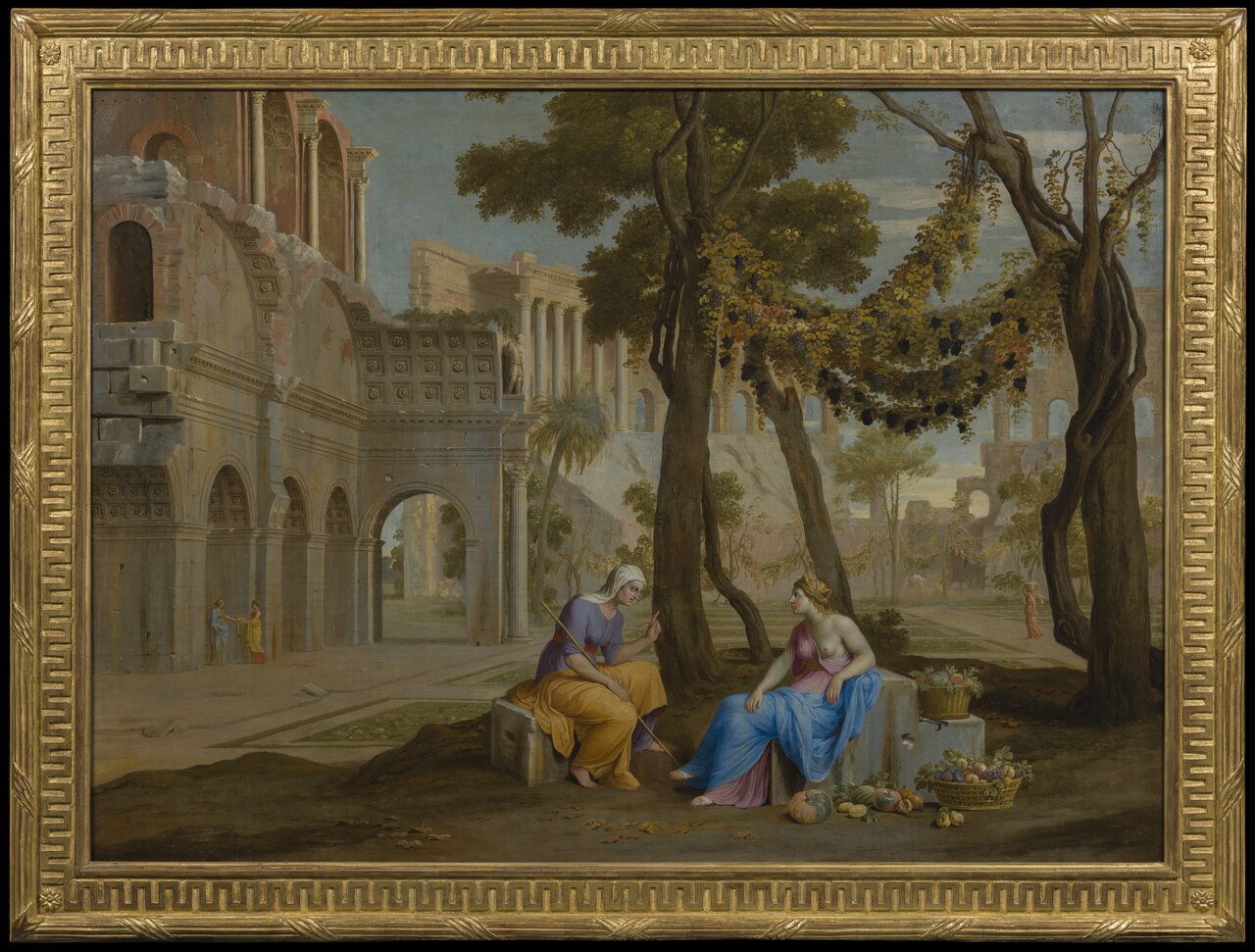
Major works Among Lemaire’s surviving oeuvre, several pieces illustrate his thematic preoccupations. **Roman Senators and Legates (1613)** is an early work that showcases his interest in historical narrative, placing Roman officials within a spacious courtyard framed by classical columns. **Figures in an Ancient Ruins Landscape (1639)** demonstrates his mature handling of space, juxtaposing a decaying temple against a verdant foreground populated by shepherds and mythic beings. The **Landscape: View from the Neighbourhood of Rome** captures a panoramic vista of the Roman countryside, where the distant cityscape merges with rolling hills, emphasizing Lemaire’s skill in rendering atmospheric perspective. In **Vertumnus and Pomona**, the painter interprets the Ovidian tale with a lush garden setting, the figures rendered in soft, harmonious colours that echo the serenity of the surrounding foliage. Finally, **Daedalus and Pasiphaë (1650)** presents a dramatic mythological scene, with the tragic figure of Pasiphaë set against an architecturally rich backdrop, underscoring Lemaire’s continued fascination with classical drama toward the end of his career.
Influence and legacy Although Lemaire never achieved the fame of some of his contemporaries, his work contributed to the diffusion of classical landscape painting in France. His frequent collaborations with Nicolas Poussin—so close that he was sometimes identified as Lemaire‑Poussin—facilitated a cross‑fertilisation of ideas between the two artists. Lemaire’s emphasis on integrating architecture with natural scenery anticipated later French landscape painters such as Claude Lorrain, who would further develop the genre. Modern scholarship regards Lemaire as an important, if understudied, figure whose paintings provide insight into the early 17th‑century French engagement with antiquity. His surviving canvases, held in both public and private collections, continue to be examined for their compositional clarity and their subtle synthesis of myth, history, and landscape.
Frequently asked questions
Who was Jean Lemaire?
Jean Lemaire (1598–1659) was a French painter known for classical landscapes and architectural scenes, often featuring mythological figures.
What style or movement is he associated with?
He worked within the French Classical tradition, blending landscape painting with antiquarian architecture, though he is not tied to a specific movement.
What are his most famous works?
Key works include *Roman Senators and Legates* (1613), *Figures in an Ancient Ruins Landscape* (1639), *Vertumnus and Pomona*, *Daedalus and Pasiphaë* (1650) and the *Landscape: View from the Neighbourhood of Rome*.
Why does he matter in art history?
Lemaire helped shape the French classical landscape genre and influenced later artists such as Claude Lorrain through his integration of architecture and myth.
How can I recognise a painting by Jean Lemaire?
Look for balanced compositions that combine tranquil natural settings with Roman architectural elements, a muted colour palette, and mythological or historical figures rendered with restrained brushwork.