Jan van Scorel
1495 – 1562
In short
Jan van Scorel (1495–1562) was a Dutch painter from the Habsburg Netherlands who introduced Italian Renaissance ideas into Northern art, working in a Romanist style after several years in Italy and serving as court painter to Pope Adrian VI.
Notable works

.jpg)
.jpg)

Early life Jan van Scorel was born in 1495 in the coastal village of Schoorl, in what is now the Netherlands. Little is recorded about his family background, but the region’s proximity to major trading routes meant that artistic influences from across Europe could reach the young Jan. He likely received his first artistic training locally before embarking on a formative journey that would define his career.
Career and style Around 1518 van Scorel set out for Italy, a pilgrimage that coincided with the brief papacy of Adrian VI, the only Dutch pope in history. The pope appointed him as a court painter and as superintendent of his collection of antiquities, granting van Scorel privileged access to classical sculptures and the leading workshops of the Italian Renaissance. He spent roughly six years in Italy, absorbing the compositional clarity, anatomical precision, and colouristic richness of Venetian masters such as Titian and Giorgione. His itineraries also included stops in Nuremberg and a pilgrimage to Jerusalem, experiences that broadened his visual vocabulary.
On his return to the Low Countries in the mid‑1520s, van Scorel settled in Utrecht, where he established a prolific workshop. His style merged the Italianate emphasis on perspective and idealised figures with the detailed observation of Northern art, creating a hybrid often described as Romanist. The resulting works display luminous palettes, balanced compositions, and an elegant handling of drapery that reflect both his Italian apprenticeship and his Northern roots.
Signature techniques Van Scorel’s paintings are characterised by several recurring technical choices. First, he employed a soft, layered glazing technique that gave his flesh tones a subtle translucency, a method he likely learned in Venice. Second, his use of chiaroscuro—contrasting light and shadow—creates a three‑dimensional modelling of bodies while preserving a gentle atmospheric quality. Third, he often incorporated classical motifs, such as architectural arches or decorative friezes, drawn from his experience supervising Adrian VI’s antiquities. Finally, his compositions frequently place the central figure within a harmonious triangular arrangement, a compositional device that guides the viewer’s eye through the narrative.
Major works Among van Scorel’s surviving oeuvre, a few pieces stand out for their historical importance and artistic quality. **Mary Magdalene (1530)** presents the saint in a contemplative pose, her hands delicately holding a skull—a memento mori—rendered with the subtle modelling typical of his later period. The work’s colour palette, dominated by deep blues and warm ochres, exemplifies his Venetian influence.
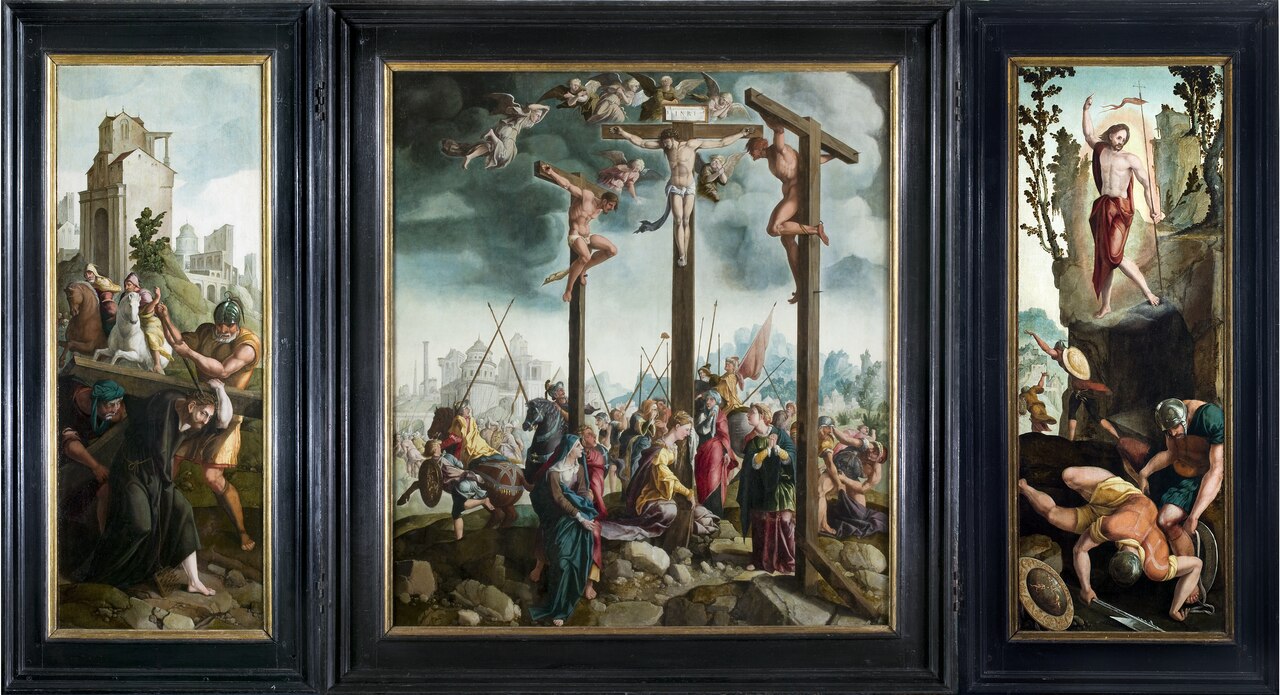
The Triptych (1535)—comprising the left wing *Carrying the Cross*, the central panel *Crucifixion*, and the right wing *Resurrection*, with shutters depicting *Agony in the Garden* and *Flagellation*—offers a comprehensive narrative of Christ’s Passion. Each panel demonstrates van Scorel’s skill in orchestrating complex theological scenes while maintaining a cohesive visual language. The central crucifixion is notable for its balanced composition and the emotive expression of the mourners, while the shutters provide intimate moments of contemplation.
In the same year, van Scorel painted Christ in the Garden of Gethsemane and two Carthusian donors, a work that integrates portraiture with sacred narrative. The donors, rendered with precise likeness, are positioned in the foreground, linking the devotional act of the patrons with the biblical episode. This blending of portrait and religious subject matter reflects a Northern tradition that van Scorel revitalised with his Italianate sensibility.
Another 1535 work, Christ on the Whipping‑post, captures a dramatic moment of physical suffering. Van Scorel’s handling of the flesh, the tension of the ropes, and the stark lighting convey both the physical pain and the spiritual significance of the scene.
Later in his career, the Frangipani Altar (1550) illustrates van Scorel’s mature synthesis of styles. The altar piece combines an elaborate architectural framework with a serene depiction of the Virgin and Child, surrounded by saints. The work’s polished surface, delicate foliage motifs, and harmonious colour scheme underscore his continued engagement with Italian classicism, even as he adapted to the evolving tastes of his Dutch patrons.
Influence and legacy Jan van Scorel’s importance lies in his role as a cultural conduit between Italy and the Low Countries. By introducing Italian compositional strategies, colour theory, and classical iconography, he helped shape the development of the Northern Renaissance. His workshop in Utrecht trained a generation of artists who continued to blend Italian and Northern elements, laying the groundwork for later masters such as Maarten van Heemskerck and Pieter Bruegel the Elder.
Moreover, his position as a court painter to Pope Adrian VI gave him a unique platform to disseminate Italian aesthetics beyond Italy’s borders. The collection of antiquities he supervised also influenced contemporary collectors, fostering a broader appreciation for classical art in the Netherlands. Though his name is less familiar to the general public than some of his contemporaries, scholars recognise van Scorel as a pivotal figure in the cross‑fertilisation of European artistic traditions during the sixteenth century.
Today, van Scorel’s paintings are housed in major museums across Europe, and his works continue to be studied for their technical brilliance and their embodiment of a transnational artistic dialogue.
Frequently asked questions
Who was Jan van Scorel?
Jan van Scorel (1495–1562) was a Dutch painter from the Habsburg Netherlands who introduced Italian Renaissance ideas into Northern art and served as court painter to Pope Adrian VI.
What style or movement is he associated with?
He is linked to the Romanist style, a blend of Italian Renaissance techniques with Northern European artistic traditions.
What are his most famous works?
Key works include *Mary Magdalene* (1530), the 1535 Passion Triptych, *Christ in the Garden of Gethsemane and two Carthusian donors*, *Christ on the Whipping‑post*, and the *Frangipani Altar* (1550).
Why is Jan van Scorel important in art history?
He acted as a conduit for Italian Renaissance ideas into Dutch and Flemish painting, influencing subsequent generations and helping to shape the Northern Renaissance.
How can I recognise a Jan van Scorel painting?
Look for a luminous Venetian palette, soft glazing on flesh tones, balanced triangular compositions, and the inclusion of classical architectural elements alongside Northern detail.