Jan van Balen
1611 – 1654
In short
Jan van Balen (1611–1654) was a Flemish Baroque painter from Antwerp, recognised for his history, allegorical, landscape and genre scenes. He worked chiefly in the Habsburg Netherlands and left a modest but influential body of work that reflects the vibrant artistic climate of 17th‑century Antwerp.
Notable works
_-_Saint_Ignatius_in_a_cartouche_with_flowers_and_cherubs.jpg)
_(attributed_to)_-_The_Marriage_Feast_of_Peleus_and_Thetis_-_75_-_Glasgow_Museums_Resource_Centre.jpg)
_(attributed_to)_-_Noah_and_the_Ark_-_BORGM_2007.94.302_-_Russell-Cotes_Art_Gallery_%5E_Museum.jpg)
Early life Jan van Balen was born in 1611 in Antwerp, a thriving commercial and artistic centre of the Habsburg Netherlands. He grew up in a family that was closely linked to the local guild of Saint Luke, the professional association for painters, which provided the framework for his artistic training. While specific records of his apprenticeship are scarce, it is highly probable that he studied under a master within the Antwerp workshop system, absorbing the techniques and compositional principles that defined the Flemish Baroque style.
Career and style By the early 1630s Jan van Balen had begun to establish himself as an independent painter. His oeuvre is characterised by a synthesis of dramatic narrative content and a refined, colour‑rich palette that mirrors the broader Baroque sensibility of the period. Van Balen favoured subjects drawn from biblical history, classical mythology and contemporary allegory, often imbuing them with a sense of theatricality through strong chiaroscuro and dynamic figure arrangements. In addition to large‑scale history paintings, he produced a number of landscapes and genre scenes that display a more intimate, observational approach to daily life and natural settings.
The artist’s style shows the influence of leading Antwerp contemporaries such as Peter Paul Rubens and Anthony van Dyck, yet he maintained a personal visual language. Van Balen’s compositions frequently employ a balanced yet lively distribution of figures, with careful attention to the interaction of light and shadow to model flesh and fabric. His colour choices tend toward warm earth tones punctuated by vivid reds and blues, creating a visual harmony that supports the narrative thrust of each work.
Signature techniques A number of technical hallmarks allow scholars to identify a Jan van Balen painting. First, his brushwork combines a smooth, almost polished finish in the rendering of faces and drapery with more expressive, textured strokes in foliage and background elements. Second, he often used a layered glazing technique, applying thin translucent layers of oil paint over an initial opaque underpainting; this produces a luminous depth, particularly in sky and water surfaces. Third, van Balen’s handling of light is distinctive: a focused source—often a divine or celestial illumination—highlights central figures while casting peripheral elements into softer shadow, reinforcing the dramatic emphasis of Baroque storytelling.
Major works Among his most frequently cited works is **The Marriage Feast of Peleus and Thetis** (1630). This large composition depicts the mythological wedding with a crowded banquet scene, where van Balen demonstrates his skill in arranging numerous figures within a coherent spatial setting. The painting is notable for its vibrant colour scheme and the subtle interplay of light that draws attention to the central couple while still allowing secondary characters to retain narrative significance.
Noah and the Ark (1637) showcases van Balen’s capacity to translate biblical narrative into a compelling visual tableau. Here, the artist captures the moment of divine instruction and the subsequent construction of the Ark, using a dramatic sky and a sense of movement among the animals and workers. The work reflects the Baroque fascination with the miraculous, rendered through a realistic treatment of anatomy and texture.
In Saint Ignatius Surrounded by a Garland of Flowers (1643), van Balen combines devotional subject matter with an ornamental natural setting. The garland of flowers frames the saint, providing a symbolic link between the sacred figure and the flourishing world. The delicate rendering of petals and foliage illustrates the artist’s meticulous attention to detail and his ability to integrate still‑life elements into a religious context.
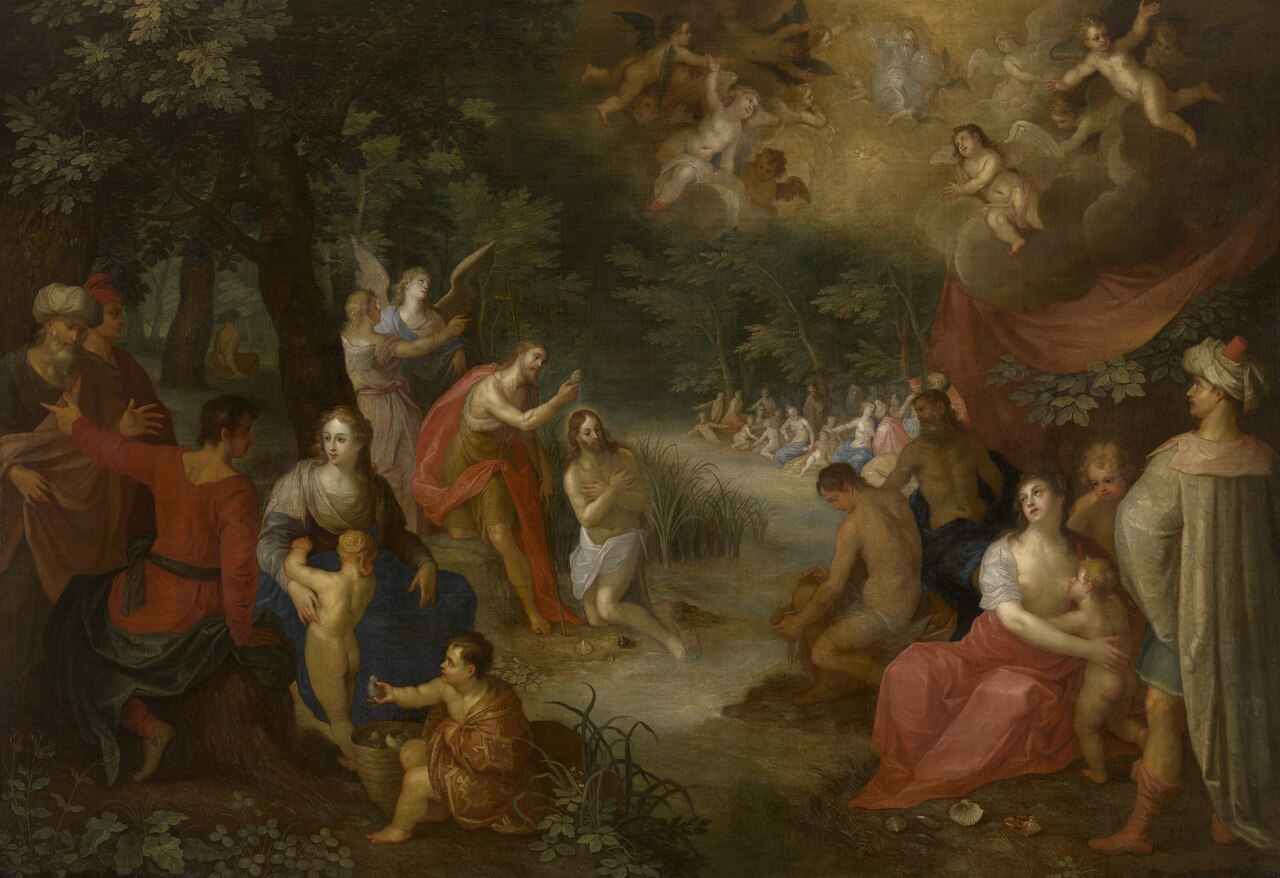
The Baptism of Christ exemplifies van Balen’s engagement with New Testament themes. Though the exact date of this work is not recorded, its composition aligns with his mid‑career period, featuring a calm river scene illuminated by a soft, celestial light that emphasizes the sacramental act.
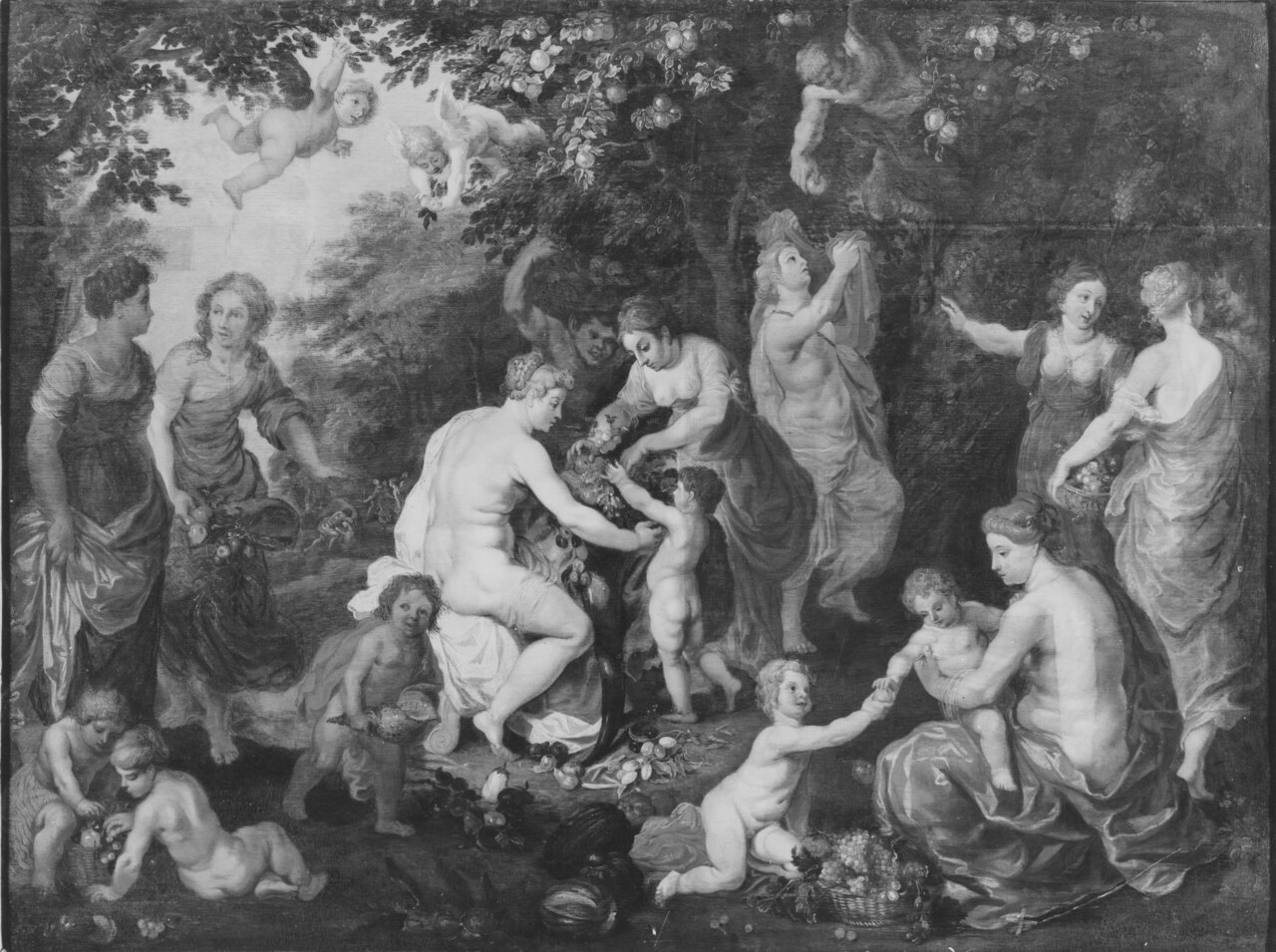
A work titled Nymphs, Satyrs and Cupids bears the date 1660, which postdates van Balen’s death in 1654. The discrepancy suggests a later copy, a workshop continuation, or a misattribution; scholars therefore treat the piece with caution, acknowledging its stylistic affinities to the artist while noting the chronological inconsistency.
Influence and legacy Jan van Balen operated within a vibrant artistic network in Antwerp, contributing to the city’s reputation as a hub of Baroque production. Although he never achieved the fame of Rubens or van Dyck, his paintings were collected by local patrons and occasionally exported to neighbouring regions, helping to disseminate the Flemish Baroque aesthetic beyond the Low Countries. His approach to integrating allegory with naturalistic detail influenced younger painters who sought to balance narrative grandeur with intimate observation.
In the centuries after his death, van Balen’s works were occasionally re‑attributed or confused with those of his more prominent contemporaries, a testament to the high quality of his technique. Modern scholarship, aided by technical analysis and archival research, has begun to clarify his catalogue, reinforcing his position as a competent, if modest, contributor to the Baroque canon. Today, his paintings are held in several European museum collections, where they are valued for their exemplary representation of 17th‑century Flemish painting and for the insight they provide into the collaborative workshop culture of Antwerp.
Overall, Jan van Balen exemplifies the productive middle tier of Baroque artists who, while not dominating the historical narrative, enriched the visual language of their era and left a legacy of technically accomplished works that continue to inform our understanding of Flemish art history.
Frequently asked questions
Who was Jan van Balen?
Jan van Balen (1611–1654) was a Flemish Baroque painter from Antwerp, known for his history, allegorical, landscape and genre paintings.
What artistic movement did he belong to?
He worked within the Baroque movement, employing dramatic lighting, dynamic composition and rich colour typical of 17th‑century Flemish art.
What are his most famous works?
Key works include *The Marriage Feast of Peleus and Thetis* (1630), *Noah and the Ark* (1637), *Saint Ignatius Surrounded by a Garland of Flowers* (1643) and *The Baptism of Christ*.
Why does Jan van Balen matter in art history?
He contributed to the flourishing Antwerp Baroque scene, helping to spread its visual language and influencing younger artists through his balanced narrative style and technical skill.
How can I recognise a Jan van Balen painting?
Look for a polished finish on faces, layered glazing that creates luminous depth, warm earth tones punctuated by vivid accents, and a dramatic light source that highlights central figures while surrounding elements recede into softer shadow.