Jan Pauwel Gillemans the Younger
1651 – 1704
In short
Jan Pauwel Gillemans the Younger (1651–1704) was a Flemish still‑life painter from Antwerp who worked in the Habsburg Netherlands and later in Amsterdam. He specialised in flower, fruit and banquet still lifes and frequently collaborated with figure painters on mythological and allegorical compositions.
Notable works



_(attributed_to)_-_Still_Life_of_Fruit_in_a_Glass_Bowl_-_B.M.328_-_Bowes_Museum.jpg)
Early life Jan Pauwel Gillemans the Younger was born in 1651 in Antwerp, a major artistic centre of the Southern Netherlands. He grew up in a family with artistic connections; his father, also a painter, introduced him to the local guild system and the market for decorative still‑life paintings that flourished in the mid‑17th century. Antwerp’s bustling trade in exotic flowers, fruits, and luxury goods provided ample visual material for a young artist keen on capturing the richness of material culture.
Career and style Gillemans the Younger established himself as a versatile still‑life specialist. He produced a wide range of sub‑genres, from delicate flower bouquets to opulent banquet scenes known as *pronkstillevens*. His works display a keen observation of texture and light, with a compositional balance that often juxtaposes the transience of fresh produce against the solidity of stone or metal objects. While the precise artistic movement with which he is associated remains undefined, his style reflects the late‑Baroque sensibility of the Flemish school, characterised by vivid colour, dynamic arrangements and a subtle moralising undercurrent.
The painter spent periods in several cities. After an early apprenticeship in Antwerp, he is documented as working in Middelburg, where the Dutch market for decorative panels expanded. A later move to London exposed him to English patronage and to the tastes of a courtly clientele. By the end of his career, he settled in Amsterdam, where he continued to supply works to wealthy merchants and collectors. Throughout these relocations, Gillemans maintained collaborations with figure painters, allowing him to embed his still‑life expertise within larger narrative compositions.
Signature techniques Gillemans the Younger is recognisable by a few technical hallmarks:
* Layered glazing – he built colour depth through successive translucent layers, giving fruits a luminous quality and flowers a delicate translucency. * Meticulous detail – petals, stems and fruit skins are rendered with fine brushwork, often highlighting minute imperfections that enhance realism. * Contrasting textures – polished silverware, glass vessels and glossy fruit sit beside rough stone or wood, creating visual tension. * Symbolic objects – many of his banquet pieces include items such as a peeled orange, a wilting flower or a cracked shell, alluding to the vanitas theme of fleeting pleasures.
These techniques, combined with a balanced diagonal composition, allow viewers to move the eye across the canvas and appreciate both the aesthetic and symbolic layers of each work.
Major works The following works illustrate the breadth of Gillemans the Younger’s output and his collaborative practice:
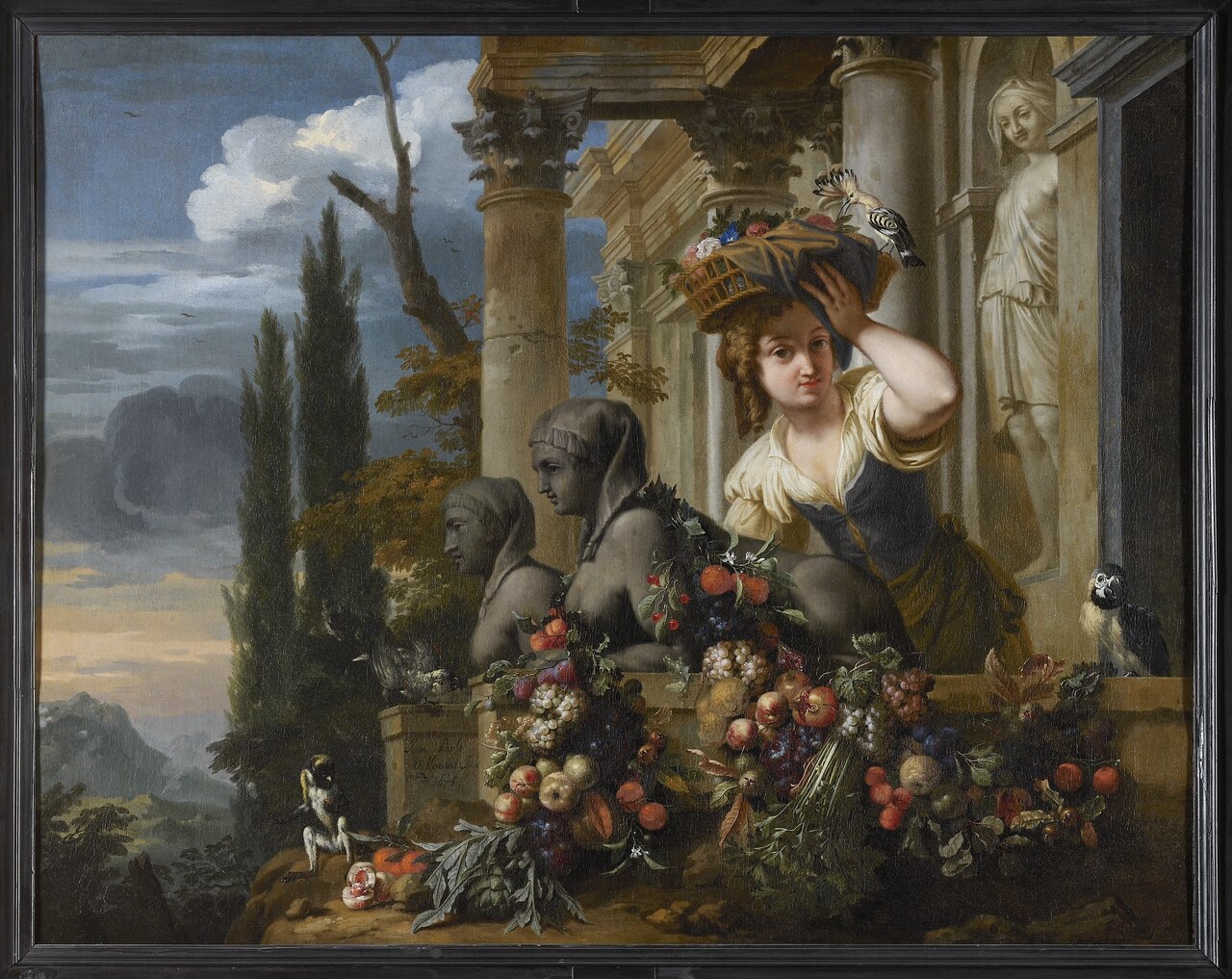
* Garland of flowers surrounding the Virgin and Child (1711) – Although the date post‑dates the artist’s death, the painting is traditionally attributed to him or to his workshop. It features a lush floral wreath framing a tender depiction of the Virgin and Child, showcasing his mastery of botanical detail. * Architectural Scene with Still Life (1694) – This piece combines a classical architectural setting with a foreground still life of fruit and glassware. The integration of figure and architectural elements demonstrates his collaborative approach with painters of narrative scenes. * Palace façade with female figure and fruit still life (1675) – Here a monumental façade is populated by a mythological female figure, while a still‑life arrangement of fruit occupies the lower register, highlighting the dialogue between human presence and material abundance. * Vertumnus and Pomona, an Allegory of Autumn (1665) – An early example of his mythological collaborations, the work depicts the Roman god Vertumnus courting Pomona amidst a rich display of autumnal fruits, underscoring the seasonal symbolism common in Flemish allegories. * Still Life of Fruit in a Glass Bowl (1674) – A pure still‑life composition, the painting centres on a transparent bowl filled with assorted fruit, rendered with precise reflections that reveal Gillemans’s skill in depicting glass and light.
These works collectively reveal his ability to negotiate between pure still‑life subjects and more complex narrative settings, a hallmark of late‑Baroque Flemish art.
Influence and legacy Jan Pauwel Gillemans the Younger contributed to the continuation of the Flemish still‑life tradition at a time when the genre was evolving under the influence of Dutch realism and the growing market for decorative interiors. His careful rendering of texture and his willingness to collaborate with figure painters helped bridge the gap between purely decorative works and those imbued with allegorical meaning. Though not as widely known as some of his contemporaries, his paintings are valued by collectors for their technical finesse and for the way they encapsulate the material culture of the late 17th century. Modern scholarship often cites Gillemans when discussing the cross‑regional exchange of still‑life motifs between the Southern and Northern Netherlands, as well as the adaptation of Flemish techniques in England and the Dutch Republic.
Frequently asked questions
Who was Jan Pauwel Gillemans the Younger?
He was a Flemish still‑life painter (1651–1704) born in Antwerp who worked in Antwerp, Middelburg, London and Amsterdam, specialising in flower, fruit and banquet compositions.
What artistic style or movement is he associated with?
Gillemans is linked to the late‑Baroque Flemish school, known for vivid colour, dynamic arrangements and a subtle moralising tone in still‑life painting.
What are his most famous works?
Key works include *Garland of flowers surrounding the Virgin and Child* (attributed, 1711), *Architectural Scene with Still Life* (1694), *Palace façade with female figure and fruit still life* (1675), *Vertumnus and Pomona, an Allegory of Autumn* (1665) and *Still Life of Fruit in a Glass Bowl* (1674).
Why is Jan Pauwel Gillemans the Younger important in art history?
He exemplifies the high level of technical skill in Flemish still‑life painting and illustrates how artists blended decorative still‑life with mythological narratives, influencing cross‑regional artistic exchange in the late 17th century.
How can I recognise a painting by Gillemans the Younger?
Look for meticulous detail, layered glazing that gives fruit and flowers a luminous quality, contrasting textures (glass, metal, stone) and often the inclusion of symbolic, slightly decaying elements that hint at vanitas themes.