Jan Josef Horemans the Elder
1682 – 1759
In short
Jan Josef Horemans the Elder (1682–1759) was a Flemish painter from Antwerp who specialised in genre scenes, with occasional portraits and historical allegories. He worked throughout the early‑mid 18th century, producing works that document everyday life in the Habsburg Netherlands.
Notable works
.jpg)
_-_Capriccio_Scene_-_WGA11732.jpg)
_-_Genrevoorstelling_-_%D0%93%D0%AD-9988_-_Hermitage_Museum.jpg)
Early life
Jan Josef Horemans the Elder was born in 1682 in Antwerp, a city that remained a vibrant centre for artistic production after the Golden Age. He grew up in a milieu where guild structures and family workshops shaped the training of young painters. Although specific details of his apprenticeship are scarce, it is highly probable that he received his foundational instruction within the local Guild of Saint Luke, as was customary for aspiring artists of his generation. Antwerp’s bustling market and its proximity to the court of the Habsburg Netherlands provided a fertile environment for a budding painter to observe both the domestic interiors of the bourgeoisie and the ceremonial life of the aristocracy.
Career and style
Horemans established himself as a genre painter in the first decades of the 18th century. His oeuvre reflects a keen interest in the quotidian moments of middle‑class households—scenes of families at leisure, artisans at work, and interior spaces filled with everyday objects. Unlike the dramatic chiaroscuro favoured by the earlier Flemish Baroque, Horemans favoured a more restrained palette, employing muted earth tones and subtle colour contrasts to convey a calm, observational mood. His compositions are often anchored by a clear linear perspective, guiding the viewer’s eye through doorways or windows onto secondary actions.
The artist also produced portraits and occasional historical allegories, though these works remain peripheral to his reputation. In portraiture he employed a modest realism, focusing on the sitter’s attire and demeanor rather than overt idealisation. His historical pieces, while fewer in number, demonstrate an ability to adapt his genre sensibility to narrative subjects, integrating the same attention to detail and domestic ambience.
Signature techniques
Horemans’ technique is characterised by a delicate handling of brushwork that balances fine detail with broader, suggestive strokes. He frequently rendered textures—such as wood grain, fabric folds, and metal gleam—through layered glazes, achieving depth without resorting to heavy impasto. Light is treated as a gentle, diffused source, often entering the scene through a window or an open door, creating soft shadows that enhance the three‑dimensionality of interior spaces. His figures are rendered with a restrained anatomical precision, prioritising the narrative gesture over heroic idealisation. The artist also employed a subtle use of colour temperature, juxtaposing warm interior tones with cooler exterior light to accentuate spatial relationships.
Major works
Among Horemans’ documented pieces, "Genre Scene" (1712) exemplifies his early mastery of domestic narrative. The painting depicts a family gathered around a table, illuminated by a window that casts a warm glow on the surrounding objects. The composition’s balance of figures and furnishings showcases his skill in arranging complex groupings without visual clutter.
"A Genre Scene" (1740) reflects a later stage in his career, where his palette becomes slightly more subdued, and his handling of light shows increased sophistication. The work portrays a modest interior where a woman is engaged in needlework while a child looks on, underscoring Horemans’ enduring interest in the quiet rhythms of daily life.
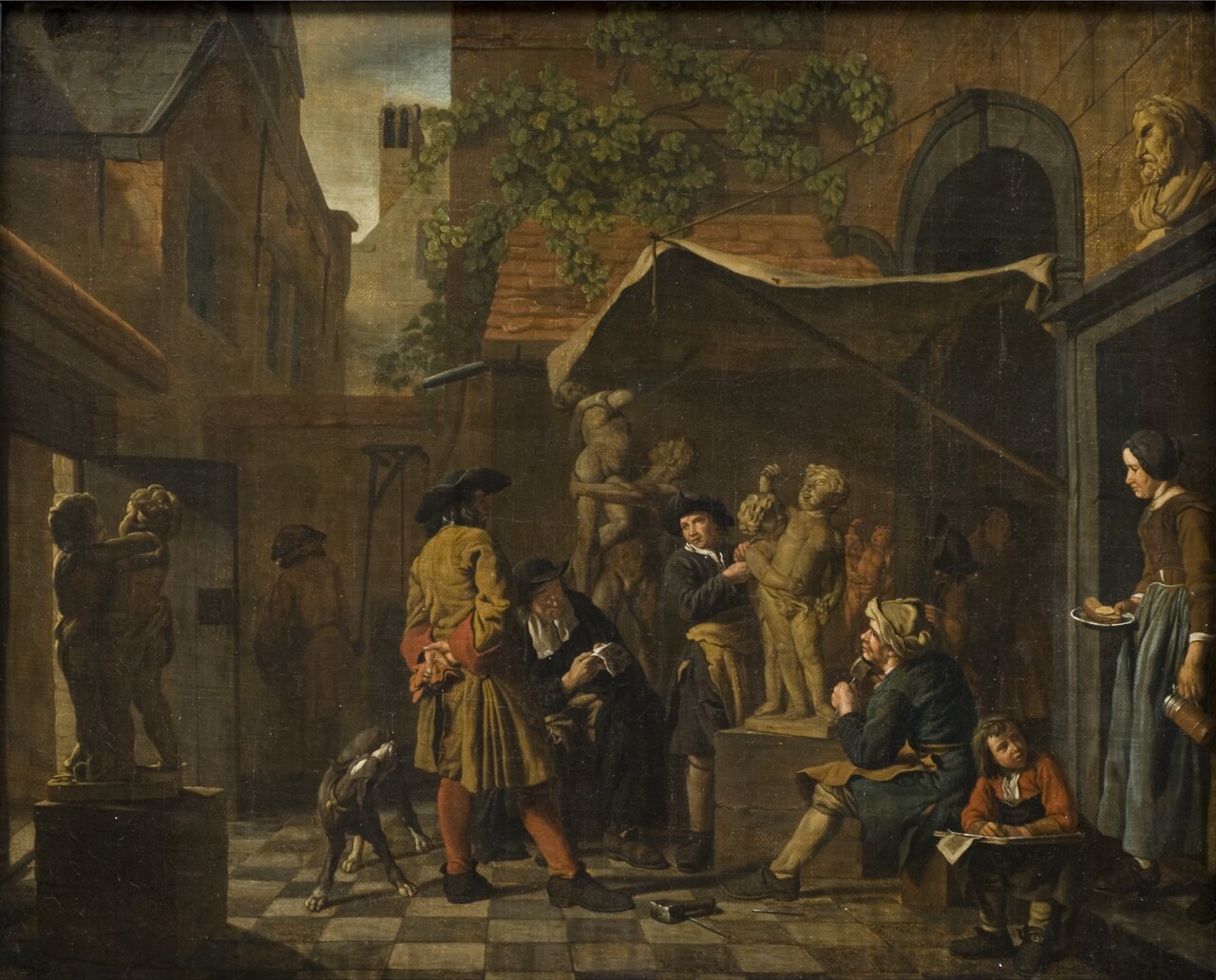
In "A Sculptor’s Studio", the artist turns his gaze to the workshop of a craftsman. Here, the viewer can observe tools, unfinished statues, and the sculptor himself absorbed in his work. The painting’s accurate depiction of studio equipment offers valuable insight into contemporary artistic practices.
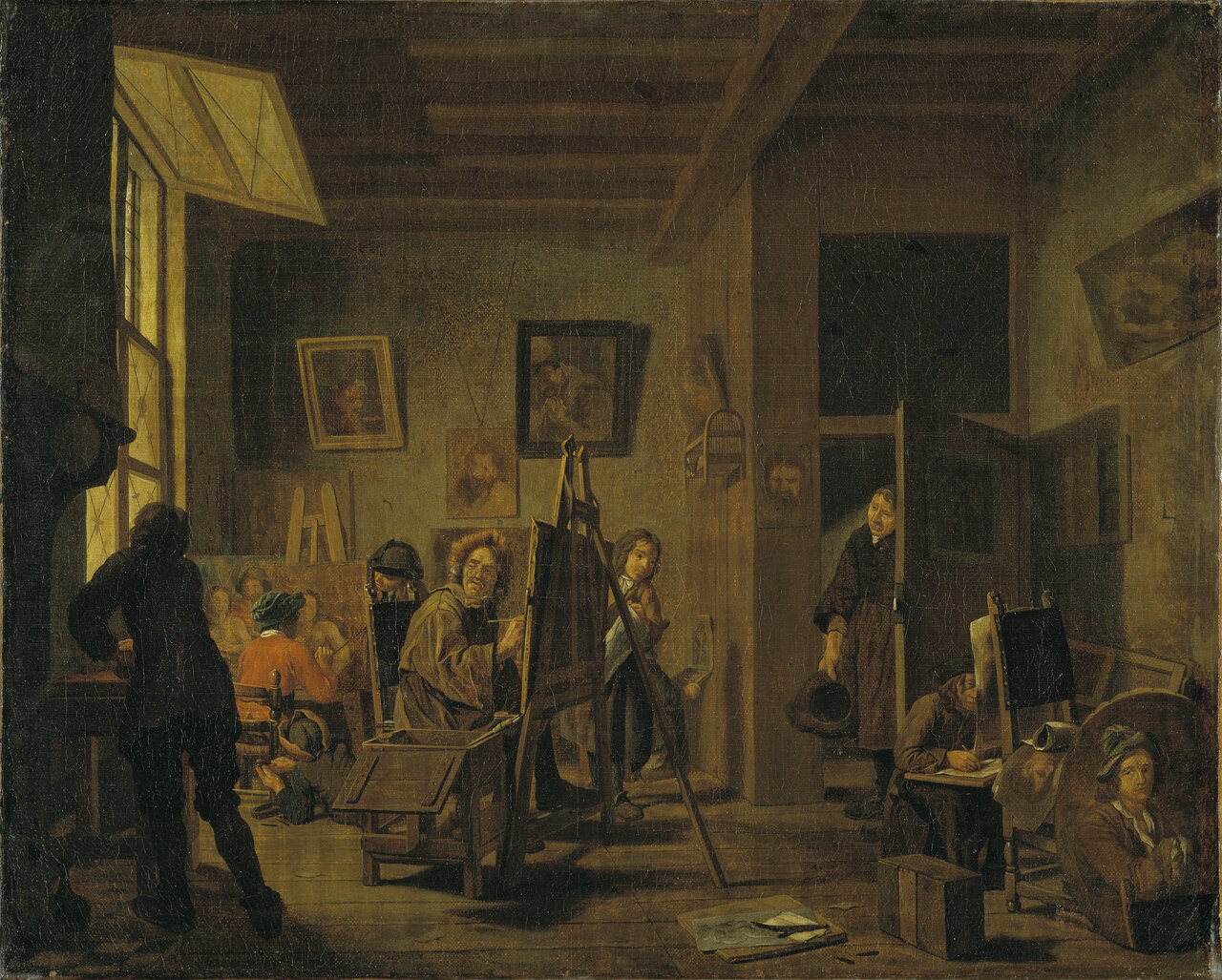
"A Painter’s Studio" follows a similar thematic line, presenting an interior filled with canvases, pigments, and a painter at his easel. The work serves as a meta‑commentary on the act of painting, highlighting the material conditions of artistic production in 18th‑century Antwerp.
Finally, "Capriccio Scene" (1750) demonstrates Horemans’ willingness to experiment with imagination. While retaining his characteristic domestic realism, this piece incorporates fanciful architectural elements and a more theatrical arrangement, suggesting a playful departure from strict genre conventions.
Influence and legacy
Jan Josef Horemans the Elder occupies a respectable niche within Flemish art history. His meticulous documentation of everyday life provides modern scholars with a visual record of 18th‑century domestic interiors, social customs, and artisanal environments in the Habsburg Netherlands. Though he never attained the fame of his Baroque predecessors, his works were collected by local patrons and occasionally circulated beyond Antwerp, influencing younger genre painters who sought to emulate his balanced composition and subdued tonal harmony. Contemporary exhibitions of Flemish genre painting often cite Horemans as a bridge between the exuberant Baroque and the more restrained, observational style that would later inform the Dutch Rococo. His legacy persists in the continued appreciation of genre scenes that celebrate the dignity of ordinary moments.
Frequently asked questions
Who was Jan Josef Horemans the Elder?
He was a Flemish painter from Antwerp (1682–1759) best known for his genre scenes that depict everyday life in the Habsburg Netherlands.
What artistic style or movement is he associated with?
Horemans worked in a restrained, observational style that bridges the Baroque tradition and the later, more subtle Rococo tendencies in Flemish genre painting.
What are his most famous works?
Key works include "Genre Scene" (1712), "A Genre Scene" (1740), "A Sculptor’s Studio", "A Painter’s Studio", and the imaginative "Capriccio Scene" (1750).
Why is Jan Josef Horemans the Elder important in art history?
His paintings offer valuable visual documentation of 18th‑century domestic interiors and artisan workshops, influencing later genre painters and enriching the understanding of everyday life in his era.
How can I recognise a painting by Horemans?
Look for modest colour palettes, soft diffused lighting, careful perspective, and detailed yet restrained depictions of interior scenes featuring ordinary people at work or leisure.