Jan Baptist van der Meiren
1664 – 1708
In short
Jan Baptist van der Meiren (1664–1708) was a Flemish painter from Antwerp who specialised in small, lively landscapes, harbour scenes and battle compositions. He worked mainly in Antwerp, with a brief period in Vienna in 1695, and is remembered for works such as Italian Market Scene and The Siege of Koblenz by Turenne.
Notable works
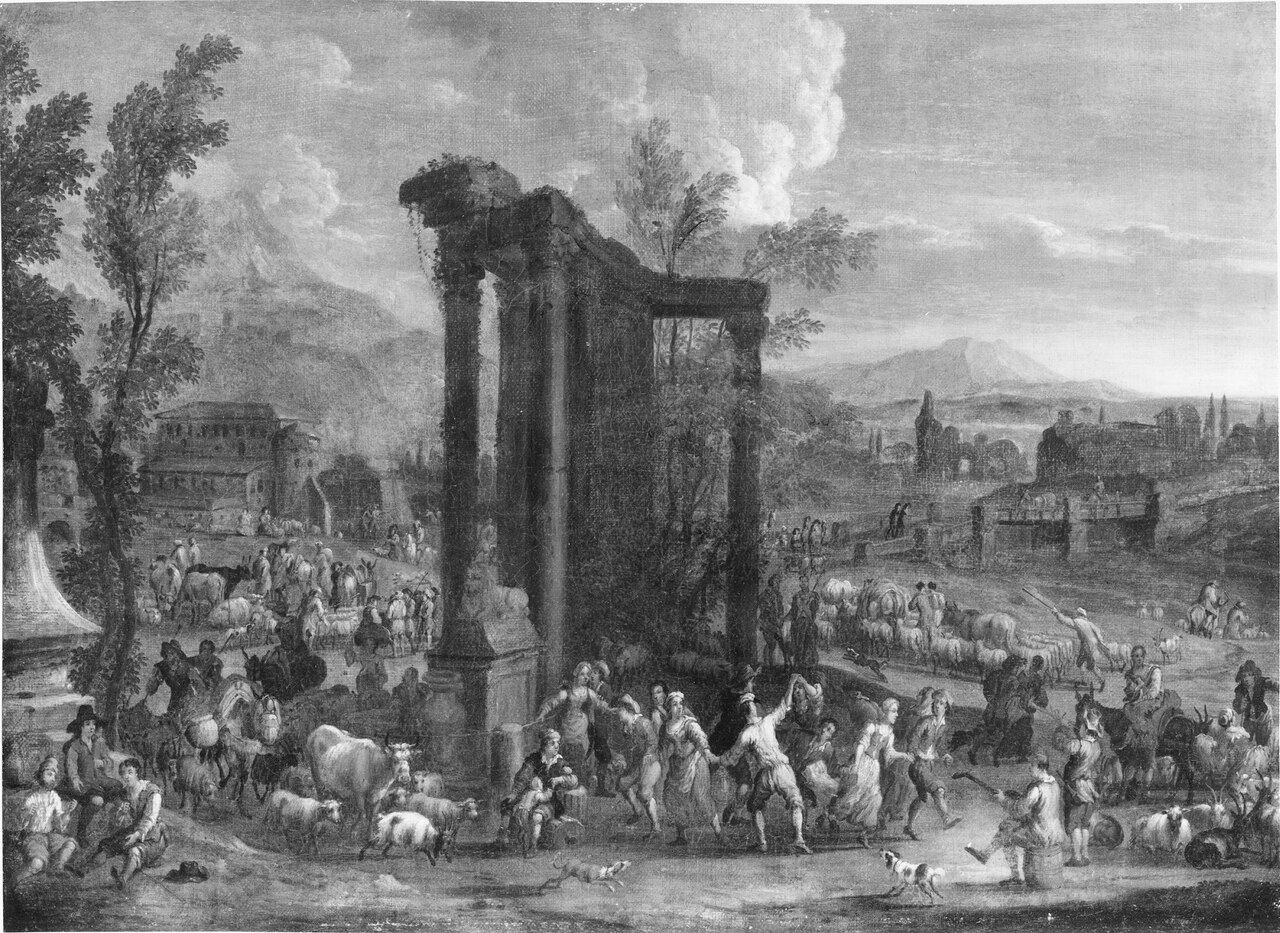


Early life Jan Baptist van der Meiren was born in Antwerp in 1664, a city that in the seventeenth century was a thriving centre for artistic production in the Habsburg Netherlands. Little is recorded about his family background or his early education, but the prevailing practice for a young artist in Antwerp involved apprenticeship to an established master within the Guild of Saint Luke. It is therefore reasonable to infer that van der Meiren received his foundational training in a workshop that emphasized the meticulous drawing of figures and the careful observation of light and atmosphere—skills that would later define his mature oeuvre.
Career and style Van der Meiren’s professional life was anchored in Antwerp, where he built a reputation for creating compact, animated scenes that combined genre subjects with a keen sense of narrative. His paintings often depict bustling market squares, crowded harbour fronts, and dynamic battlefields populated by a multitude of figures. Although he never aligned himself with a specific artistic movement, his work reflects the lingering influence of the Baroque sensibility that dominated Flemish painting in the late seventeenth century. The compositions are characterised by a balanced distribution of light, a lively palette, and a subtle play of chiaroscuro that gives depth to the crowded spaces.
Around 1695 van der Meiren spent a year in Vienna, a posting that exposed him to Central European tastes and the decorative inclinations of the Imperial court. This experience broadened his visual vocabulary, introducing a more elaborate handling of architectural elements and a heightened attention to the drama of military subjects. Upon his return to Antwerp he continued to produce works for both local patrons and foreign collectors, maintaining a studio that catered to the demand for small, finely detailed panels suitable for private display.
Signature techniques Van der Meiren’s paintings are distinguished by several recurring technical approaches:
* Miniaturised narrative – He favoured modestly sized canvases, often no larger than a foot in height, which required a compressed yet clear storytelling method. Figures are rendered with precise brushwork, allowing each individual to be discerned within the bustling crowd. * Atmospheric perspective – To convey depth in harbour and landscape scenes, van der Meiren employed a gradual diminution of colour intensity and detail, creating a sense of distance without sacrificing the overall cohesion of the scene. * Dynamic composition – Battle and market scenes are arranged along diagonal axes, guiding the viewer’s eye through the action. This compositional dynamism is reinforced by the strategic placement of light sources, which illuminate focal points such as a ship’s rigging or a merchant’s stall. * Textural contrast – The artist juxtaposed smooth, almost polished surfaces (e.g., the sheen of a ship’s hull) with more tactile elements (e.g., the roughness of stone walls or the foliage of trees), enhancing the realism of his miniature worlds.
Major works The surviving corpus of van der Meiren’s work includes several notable pieces that exemplify his thematic interests and technical skill.
* Italian Market Scene – This painting captures a lively marketplace set against a Mediterranean backdrop. Figures are engaged in trade, while the architecture hints at a Roman or Venetian influence. The work demonstrates van der Meiren’s ability to integrate genre detail with a sense of exotic location. * The Siege of Koblenz by Turenne (1707) – One of his later battle compositions, this canvas portrays the French Marshal Turenne’s assault on the fortified city of Koblenz. The scene is dense with soldiers, artillery, and smoke, illustrating the artist’s command of martial drama and his capacity to render complex military equipment with accuracy. * View of a Mediterranean port (1690) – In this harbour view, van der Meiren renders a bustling dock with ships moored along a sun‑lit quay. The composition balances the architectural solidity of the waterfront with the rippling water and the movement of figures loading and unloading cargo. * Imaginary Harbour (1686) – As the title suggests, this work is a fanciful construction rather than a specific locale. It showcases a harbour populated by a variety of vessels, from fishing boats to larger merchant ships, set against a dramatic sky. The piece highlights the artist’s imagination and his skill in rendering reflective water surfaces. * Harbour with a Caravan (1707) – Combining maritime and overland trade, this painting depicts a caravan of wagons unloading goods onto a dock. The juxtaposition of land‑based commerce with sea‑borne trade underscores van der Meiren’s interest in the interconnectedness of economic activity in the early modern world.
These works collectively reveal a consistent preoccupation with the interaction of people, commerce, and conflict in compact visual narratives.
Influence and legacy Although Jan Baptist van der Meiren did not achieve the fame of contemporaries such as Peter Paul Rubens or Jacob Jordaens, his paintings occupy a distinctive niche within Flemish art. His meticulous miniatures catered to a market of collectors who preferred intimate, portable works that could be displayed in private chambers. By focusing on animated scenes that combined genre observation with historical or military subject matter, he contributed to a broader trend in late Baroque art that sought to merge everyday life with grand narrative.
Later generations of Flemish and Dutch painters who specialised in harbour and market scenes—particularly those active in the early eighteenth century—found a precedent in van der Meiren’s balanced compositions and his nuanced handling of light. While his name does not frequently appear in mainstream art‑historical surveys, specialist studies of Flemish battle painting and of miniature genre works regularly cite his contributions as illustrative of the period’s diverse artistic production.
Jan Baptist van der Meiren died in 1708; the exact location of his death remains undocumented, though his lifelong association with Antwerp suggests he likely spent his final years in the city that shaped his artistic identity. Today his paintings are held in several European collections, where they continue to attract scholars interested in the interplay of commerce, conflict, and daily life in the visual culture of the Habsburg Netherlands.
Frequently asked questions
Who was Jan Baptist van der Meiren?
Jan Baptist van der Meiren (1664–1708) was a Flemish painter from Antwerp who specialised in small, animated landscapes, harbour views and battle scenes.
What artistic style or movement is he associated with?
He worked within the late Baroque tradition of Flemish painting, but did not belong to a specific movement; his work is noted for its compact narrative and lively composition.
What are his most famous works?
Key works include Italian Market Scene, The Siege of Koblenz by Turenne (1707), View of a Mediterranean port (1690), Imaginary Harbour (1686) and Harbour with a Caravan (1707).
Why is van der Meiren important in art history?
He provides a clear example of the miniature genre that combined everyday market activity with historic or military subjects, influencing later Flemish artists who painted similar harbour and battle scenes.
How can I recognise a van der Meiren painting?
Look for small‑scale canvases with densely populated figures, meticulous detail, balanced use of light, and subjects that blend bustling market or harbour life with narrative drama.