James Montgomery Flagg
1877 – 1960
In short
James Montgomery Flagg (1877–1960) was an American illustrator and painter best known for his iconic World War I recruitment poster featuring Uncle Sam. His prolific career spanned magazine illustration, advertising, and political propaganda, leaving a lasting visual legacy in American culture.
Notable works
.jpg)
_2001_1.jpeg)
Early life
James Montgomery Flagg was born on 12 February 1877 in Pelham Manor, a suburban community on Long Island, New York. He was the second of three children of James Montgomery Flagg Sr., a merchant, and Margaret McCormick Flagg. From an early age he showed a keen aptitude for drawing, sketching scenes of local life and copying the work of popular illustrators he saw in newspapers. After completing primary education, Flagg enrolled at the Art Students League of New York, where he received formal training in drawing, composition and the use of colour. He later attended the Drexel Institute in Philadelphia, studying under the renowned illustrator Howard Pyle, whose emphasis on narrative illustration would shape Flagg’s later career.
Career and style
Returning to New York in the late 1890s, Flagg entered the burgeoning world of commercial illustration. He secured commissions for magazines such as *Harper's Weekly*, *The Saturday Evening Post* and *Life*, producing covers and interior artwork that combined realistic portraiture with a bold, graphic sensibility. While his early work adhered to the academic traditions of the late‑nineteenth‑century American Academy, Flagg quickly embraced the visual language of the emerging advertising industry, favouring strong outlines, vivid colour blocks and a clear, persuasive narrative.
Throughout the first half of the twentieth century Flagg worked across a wide range of media. In addition to magazine illustration he produced posters, postcards, and book illustrations; he also painted portraits and landscapes in a more traditional fine‑art style. Despite this diversity, a unifying thread ran through his output: an emphasis on immediacy and emotional impact. Whether depicting a heroic soldier or a genteel society lady, Flagg’s compositions were designed to capture the viewer’s attention within seconds, a quality that made his work especially suited to propaganda and advertising.
Signature techniques
Flagg’s visual vocabulary can be identified by several recurring techniques. First, he employed a limited but striking palette, often relying on contrasting reds, blues and whites to create a sense of urgency. Second, he favoured simplified, almost caricature‑like figures that retained enough anatomical accuracy to remain believable while allowing for exaggerated gestures. Third, his use of strong diagonal lines—whether in the tilt of a hat brim or the sweep of a banner—generated dynamic movement and directed the eye toward the central message. Finally, Flagg was meticulous in his selection of models; he frequently used friends, family members and even himself as reference points, a practice that lent his work a personal resonance despite its mass‑produced appearance.
Major works
### I Want You for the U.S. Army nearest recruiting station (1917)
Perhaps Flagg’s most enduring image is the 1917 poster that shows a stern‑looking Uncle Sam pointing directly at the viewer. The composition was adapted from a 1914 British recruitment poster featuring Lord Kitchener, but Flagg’s version replaced the British figure with the American icon of Uncle Sam, a personification he had already employed in earlier illustrations. The model for the face was Flagg’s own father, whose strong features were rendered in a stark, three‑dimensional style that made the figure appear both authoritative and approachable. The poster was reproduced millions of times, appearing on billboards, train cars and newspaper inserts, and it became synonymous with the United States’ entry into the First World War.
### Be a U.S. Marine! (1918)
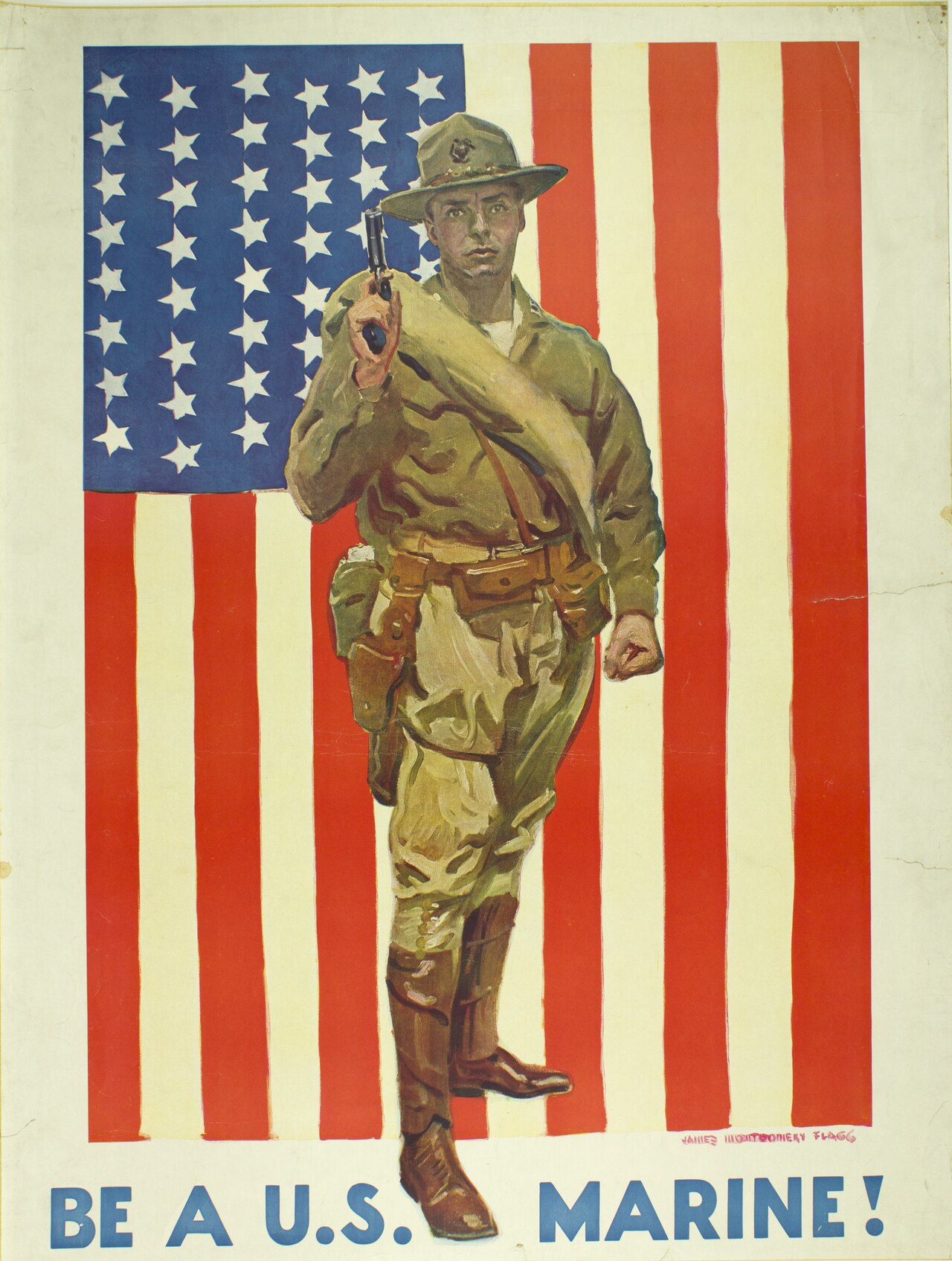
In 1918 Flagg produced a companion poster for the United States Marine Corps. The image features a muscular Marine in a distinctive uniform, his gaze fixed forward, with the caption “Be a U.S. Marine!” rendered in bold, sans‑serif lettering. The work demonstrates Flagg’s ability to tailor his graphic language to different branches of the armed forces while retaining the same persuasive intensity. The Marine’s posture, the sharply angled hat brim and the use of a deep navy background all serve to convey discipline and patriotism, reinforcing recruitment goals during the final year of the war.
### Nellie McCormick Flagg (1866–1923) (1906)
Beyond his wartime propaganda, Flagg was also a competent portraitist. In 1906 he painted a full‑length portrait of his aunt, Nellie McCormick Flagg, a respected philanthropist from New York. The work, executed in oil on canvas, showcases a more restrained palette of earth tones and a softer modelling of light compared with his poster work. The composition places Nellie in a modest interior setting, surrounded by books and a vase of flowers, hinting at her intellectual pursuits. While less widely reproduced than his posters, the portrait reveals Flagg’s capacity for subtle character study and his grounding in traditional academic techniques.
Influence and legacy
James Montgomery Flagg’s impact on visual culture extends far beyond the specific images he created. His synthesis of fine‑art training with commercial imperatives helped define the look of early twentieth‑century American illustration, influencing contemporaries such as Norman Rockwell and later advertising designers. The Uncle Sam poster, in particular, has become an archetype of patriotic propaganda; its visual language is echoed in countless political campaigns, corporate slogans and even modern internet memes.
In the decades after his death in 1960, Flagg’s work has been the subject of exhibitions at major museums, and his posters continue to be reproduced on posters, t‑shirts and postage stamps. Scholars note that his ability to distil complex ideas into single, instantly recognisable images prefigured the visual shorthand that dominates contemporary media. As a result, Flagg is routinely cited in textbooks on graphic design, advertising history and visual communication, cementing his status as a foundational figure in the development of modern visual rhetoric.
---
Through his prolific output, technical versatility and unmistakable graphic sensibility, James Montgomery Flagg remains a pivotal figure whose legacy endures in the visual language of both the United States and the broader world.
Frequently asked questions
Who was James Montgomery Flagg?
James Montgomery Flagg (1877–1960) was an American illustrator and painter best known for his World War I recruitment posters, especially the iconic Uncle Sam image.
What artistic style or movement is Flagg associated with?
Flagg worked across fine‑art painting, cartooning and commercial illustration; his style combined academic realism with bold, graphic elements typical of early twentieth‑century advertising.
What are Flagg's most famous works?
His most famous works are the 1917 "I Want You for the U.S. Army" poster, the 1918 "Be a U.S. Marine!" poster, and his 1906 portrait of Nellie McCormick Flagg.
Why does Flagg matter in art history?
Flagg pioneered the use of striking, persuasive imagery for mass communication, influencing later illustrators, advertisers and the visual language of political propaganda.
How can I recognise a work by James Montgomery Flagg?
Look for bold, limited colour palettes, strong outlines, dynamic diagonal composition, and often a single, clearly defined figure delivering a direct message.