Jacomart
1410 – 1461
In short
Jacomart (1410–1461) was a Valencian painter of the Crown of Aragon, known for his devotional panels that blend late Gothic elegance with early Renaissance realism. His surviving works, such as the Virgin Intercessor and the Virgin of the Porziuncola, illustrate a refined approach to sacred imagery in mid‑15th‑century Spain.
Notable works


_-_The_Virgin,_Adoring_the_Child_-_1403_-_Gem%C3%A4ldegalerie.jpg)

Early life Jacomart, also recorded as Jaume Baçó, was born in 1410 in the port city of Valencia, a flourishing centre of Mediterranean trade and culture within the Crown of Aragon. Little is documented about his family background or artistic training, but the vibrant artistic milieu of Valencia—where Italian merchants, Flemish textiles and local ecclesiastical patronage intersected—provided a fertile environment for aspiring painters. It is probable that Jacomart began his apprenticeship in a local workshop, absorbing the prevailing International Gothic visual language while also encountering early influences from the Italian Quattrocento, which were beginning to circulate in the region through imported artworks and itinerant craftsmen.
Career and style By the mid‑1430s Jacomart had established himself as a professional painter, receiving commissions from both religious institutions and private patrons. His oeuvre reflects a transitional style: the graceful linearity and delicate colour palette of the late Gothic are combined with a nascent concern for spatial depth and naturalistic modelling that anticipates Renaissance sensibilities. This synthesis is evident in his handling of drapery, where flowing folds are rendered with a subtle chiaroscuro that suggests three‑dimensional form without abandoning the decorative elegance of earlier conventions.
Jacomart’s career coincided with a period of artistic exchange across the western Mediterranean. While he never travelled extensively, the influx of imported panels and illuminated manuscripts exposed him to the works of Northern European masters and the emerging Italian pictorial tradition. Rather than adopting any single foreign style, he integrated these influences into a distinctive visual language that remained rooted in the devotional needs of his Spanish clientele.
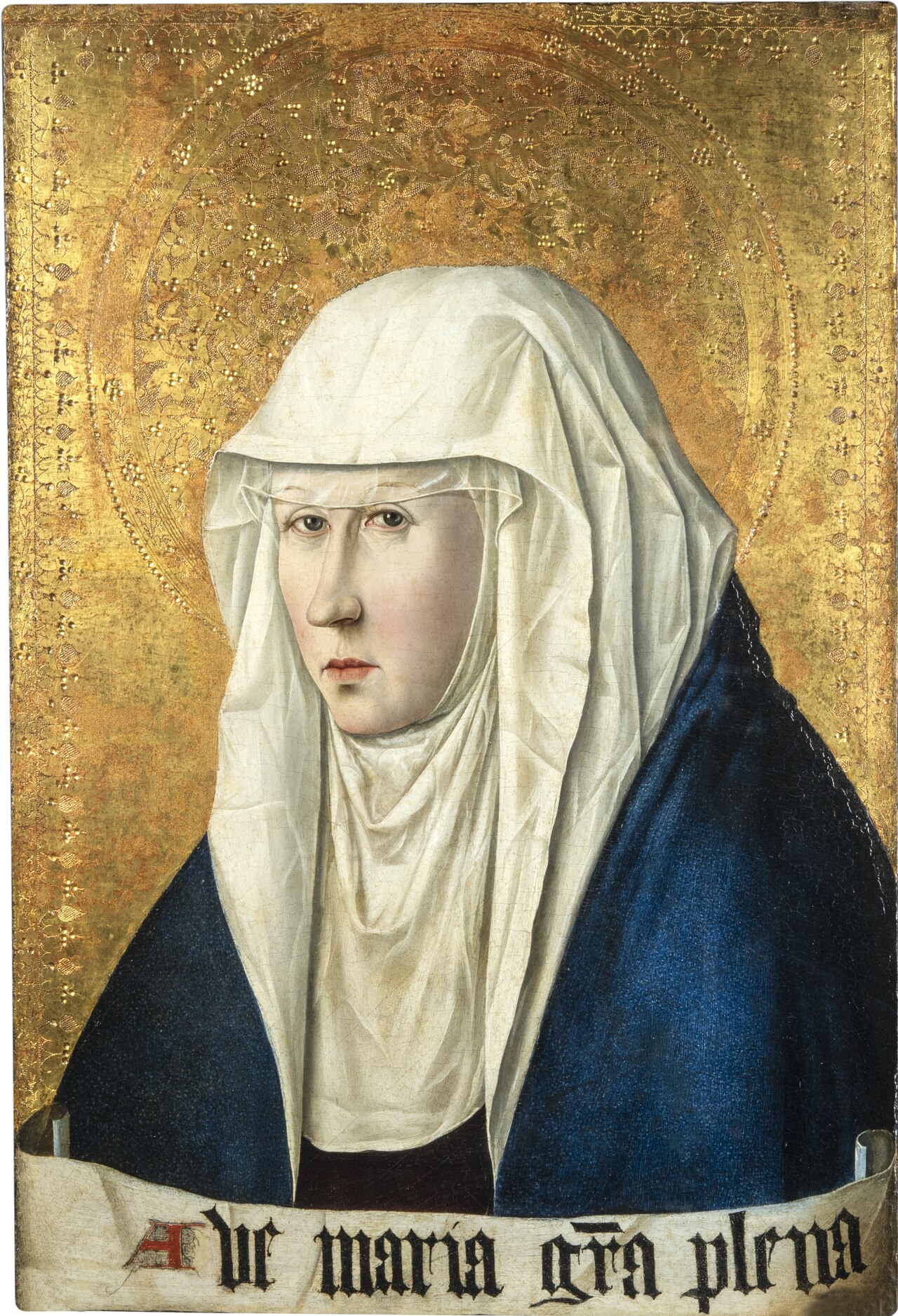
Signature techniques Several technical hallmarks identify a Jacomart panel. First, his use of tempera on wood supports, applied in thin, luminous layers, creates a refined surface that captures delicate light effects. Second, the painter favours a restrained yet vivid colour scheme—predominantly ultramarine blues, deep reds and gold leaf accents—that heightens the spiritual aura of his subjects. Third, his figures display elongated necks and slightly idealised facial features, a nod to the International Gothic ideal of graceful beauty. Finally, he often incorporates intricate gold leaf backgrounds or gilded halos, a practice that underscores the sacred status of the depicted saints while linking his work to the liturgical art of the period.
Major works Jacomart’s surviving panels provide a clear window into his artistic priorities. The **Virgin Intercessor (1450)** portrays the Virgin Mary seated on a throne, her hands raised in a pleading gesture toward the Christ Child. The composition balances a solemn verticality with a subtle suggestion of depth, achieved through the careful placement of architectural arches behind the figure.
In the Virgin of the Porziuncola (1450), Jacomart presents the Madonna in a more intimate setting, her gaze directed toward the infant with a tender immediacy. The delicate treatment of the infant’s veil and the soft modelling of the Virgin’s cheek reveal the painter’s growing interest in naturalistic detail.
The Three Virgin Martyrs series—though the exact titles of the individual panels vary—depicts three saintly women, each bearing the attributes of martyrdom. Here Jacomart employs a restrained narrative, allowing each figure’s expression and posture to convey the gravity of sacrifice without resorting to overt dramatics.
The Virgin, Adoring the Child (1489) is attributed to his workshop, as the date post‑dates his death. It illustrates the continuation of his stylistic legacy through apprentices who preserved his compositional formulas and colour preferences. The panel maintains the characteristic serenity and devotional focus that define his mature output.
Lastly, the St James and St Giles Abad (1450) showcases two male saints rendered with dignified poise. The saints are positioned against a gilded backdrop, their garments rendered in meticulously detailed brocades. The work demonstrates Jacomart’s skill in rendering varied textures—metallic armor, soft fabrics and illuminated gold—within a unified visual framework.
Influence and legacy Jacomart’s impact on Valencian painting extended well beyond his lifetime. His blend of Gothic elegance with emerging naturalism set a precedent for subsequent generations of Spanish artists, particularly those working in the eastern Mediterranean region. The workshop he headed continued to produce panels that adhered to his compositional conventions, ensuring that his aesthetic persisted into the late 15th century.
Art historians regard him as a pivotal figure in the gradual shift from medieval iconography toward a more humanised, spatially aware representation of sacred subjects in Spain. While he never achieved the fame of contemporaries such as Juan de Flandes, his surviving works are valued for their technical finesse and their role in bridging two major artistic epochs. Modern exhibitions of early Spanish painting frequently include Jacomart’s panels as exemplars of the regional adaptation of broader European trends, underscoring his importance as a conduit between local tradition and international artistic currents.
In contemporary scholarship, Jacomart is often cited as a case study in the diffusion of artistic ideas across the Crown of Aragon’s network of ports and courts. His ability to synthesize diverse influences while maintaining a coherent visual identity illustrates the dynamic cultural exchanges that characterised the Iberian Peninsula in the mid‑15th century. As such, his oeuvre remains a vital reference point for understanding the evolution of Spanish devotional art on the cusp of the Renaissance.
Frequently asked questions
Who was Jacomart?
Jacomart (1410–1461) was a Valencian painter of the Crown of Aragon, known for his devotional panels that combine late Gothic elegance with early Renaissance realism.
What artistic style or movement is Jacomart associated with?
His work reflects a transitional style, merging International Gothic decorative qualities with emerging naturalistic techniques that anticipate the Renaissance.
What are Jacomart's most famous works?
Key surviving panels include the Virgin Intercessor (1450), Virgin of the Porziuncola (1450), Three Virgin Martyrs, The Virgin, Adoring the Child (attributed to his workshop, 1489), and St James and St Giles Abad (1450).
Why is Jacomart important in art history?
He serves as a bridge between medieval Gothic iconography and the early Renaissance in Spain, influencing later Valencian painters and illustrating the cross‑cultural artistic exchanges of the 15th‑century Mediterranean.
How can I recognise a painting by Jacomart?
Look for tempera on wood, a restrained yet vivid palette, delicate gold leaf backgrounds, elongated yet graceful figures, and a subtle modelling of drapery that suggests depth while retaining Gothic elegance.