Jacob van Huysum
1687 – 1740
In short
Jacob van Huysum (1687–1740) was a Dutch botanical painter who relocated to London in the early 18th century. He specialised in detailed flower still‑lifes, producing series such as the Twelve Months of Flowers, and is noted for his precise naturalistic style.
Notable works
_-_Twelve_Months_of_Flowers,_January_-_PD.66-1973_-_Fitzwilliam_Museum.jpg)
_-_Twelve_Months_of_Flowers,_February_-_PD.67-1973_-_Fitzwilliam_Museum.jpg)
_-_Twelve_Months_of_Flowers,_March_-_PD.68-1973_-_Fitzwilliam_Museum.jpg)
_-_Twelve_Months_of_Flowers,_April_-_PD.69-1973_-_Fitzwilliam_Museum.jpg)
Early life Jacob van Huysum was born in Amsterdam in 1687, into a family with artistic connections in the Dutch Republic. Little is recorded about his formal training, but the vibrant Dutch tradition of still‑life painting and the growing interest in scientific illustration would have provided a rich environment for his development. By the turn of the century he was already practising as a painter of flowers and other botanical subjects, a genre that combined artistic skill with the emerging demands of natural history.
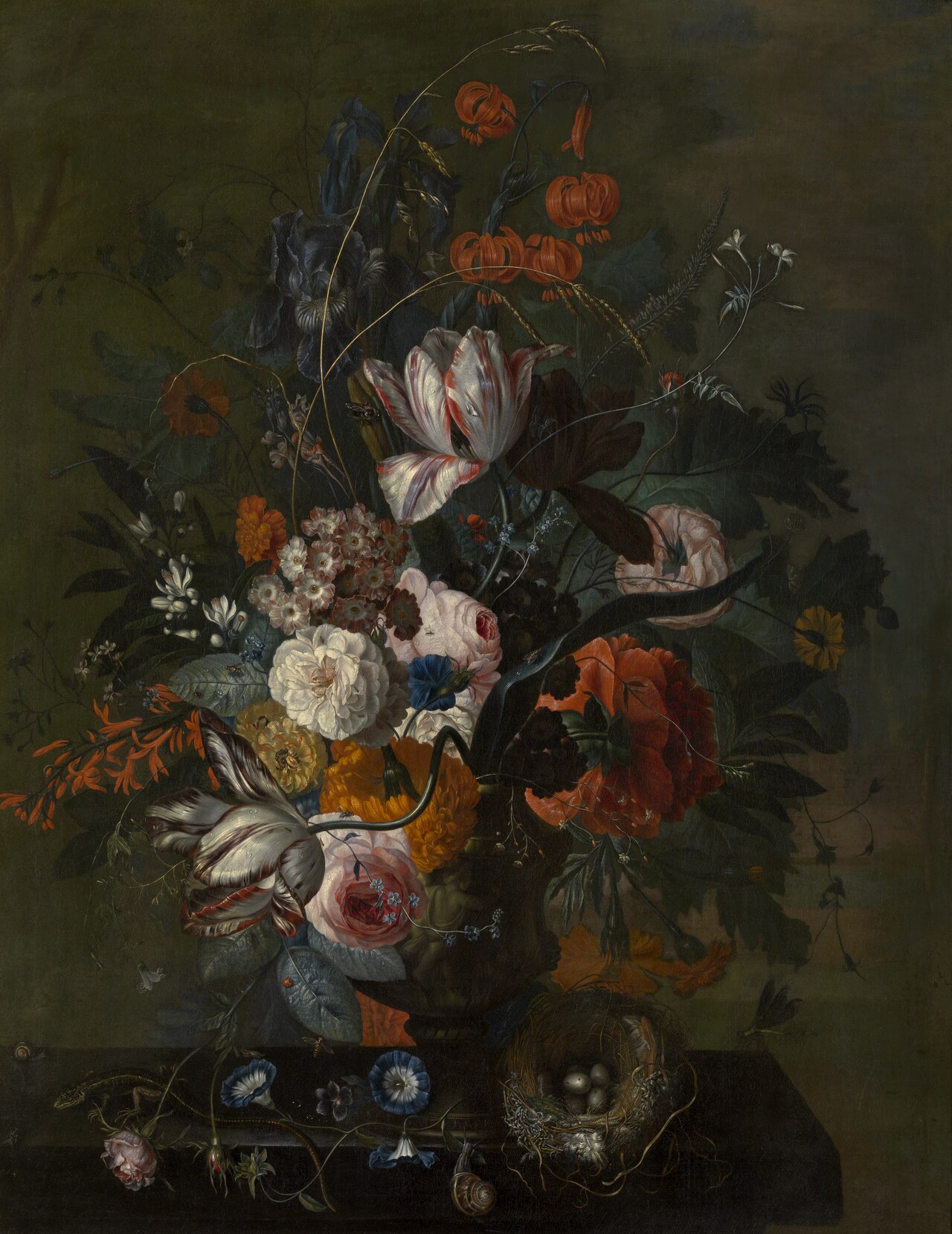
Career and style In 1721 van Huysum moved to the Kingdom of Great Britain, settling in London where a market for exotic plants and detailed botanical art was expanding. The city’s horticultural societies, plant collectors and wealthy patrons commissioned works that could document new species and adorn fashionable interiors. Van Huysum’s paintings are characterised by a meticulous observation of colour, texture and form. He favoured a realistic, almost scientific approach to rendering petals, leaves and stems, while still arranging his compositions with the decorative elegance expected of a decorative painter.
His palette often employed saturated reds, deep blues and vivid greens, balanced by delicate whites and pastel tones. The background treatment varied from simple drapery to subtle stone or earth tones, allowing the botanical subjects to dominate the visual field. Though the broader art historical record does not assign him to a specific movement, his work aligns closely with the Dutch Golden Age still‑life tradition and the English flowering‑plant craze of the early 18th century.
Signature techniques Van Huysum’s technique combined fine brushwork with layered glazing to achieve depth and translucency in petals. He typically prepared his panels or canvases with a smooth gesso ground, then sketched the composition in charcoal before applying a thin underpainting of muted tones. Over this base he built up colour in successive layers, allowing each glaze to dry before adding the next. This method produced the luminous quality for which his flower depictions are renowned.
He paid particular attention to the rendering of light on delicate surfaces, using fine, almost hair‑like strokes to suggest the sheen of wet petals. The use of a fine sable brush for the smallest details enabled him to capture the intricate veining of leaves and the subtle variations in petal edges. Van Huysum also employed a restrained compositional geometry, often arranging flowers in a loose fan or triangular shape that guided the viewer’s eye across the canvas.
Major works Among van Huysum’s surviving pieces are several that exemplify his botanical focus. The *Still Life of flowers in a terracotta vase on a stone plinth* (attributed to 1750) demonstrates his mature style: a richly coloured bouquet of roses, tulips and lilies rests in a terracotta container, set upon a stone base that provides a solid, almost sculptural anchor. The work’s date post‑dates his death, suggesting either a later attribution or a misreading of the original inscription; scholars therefore treat the piece as representative rather than chronologically definitive.
The *Twelve Months of Flowers* series, painted in 1732, consists of individual canvases each representing a month through a selection of seasonal blooms. The January panel features winter‑flowering species such as snowdrops and cyclamen, rendered against a muted background that emphasizes their delicate colour. February’s composition introduces early crocuses and primroses, while March and April continue the progression with daffodils, tulips and early roses. Each canvas balances scientific accuracy with an aesthetic arrangement, allowing the viewer to appreciate both the botanical diversity and the decorative harmony.
These works, together with other unsigned still‑lifes attributed to him, illustrate van Huysum’s consistent approach: precise botanical rendering combined with a decorative sensibility suited to the tastes of his London clientele.
Influence and legacy Jacob van Huysum’s relocation to London contributed to the cross‑fertilisation of Dutch still‑life techniques with English horticultural interests. His detailed flower studies offered a visual reference for botanists and collectors, aiding the identification and classification of exotic species. Although he did not achieve the fame of his contemporary Jan van Huysum, his works remain valuable for scholars studying the transmission of Dutch artistic practice to Britain.
Later British botanical illustrators, such as William Hooker and the painters of the Royal Society’s *Botanical Magazine*, inherited the emphasis on accuracy and decorative composition that van Huysum exemplified. Contemporary museums and galleries that hold his paintings cite them as exemplars of early 18th‑century botanical art, and they continue to appear in exhibitions exploring the intersection of art, science and trade in the Enlightenment era.
In sum, Jacob van Huysum occupies a niche within art history as a diligent recorder of flora, bridging Dutch artistic heritage and the burgeoning British interest in natural history. His surviving canvases provide both aesthetic pleasure and historical insight into the ways plants were celebrated and documented in the early modern world.
Frequently asked questions
Who was Jacob van Huysum?
Jacob van Huysum (1687–1740) was a Dutch botanical painter who worked in London from 1721, known for detailed flower still‑lifes.
What style or movement is he associated with?
He is linked to the Dutch still‑life tradition and the early‑18th‑century English flower‑painting craze, though no formal movement claims him.
What are his most famous works?
Key works include the *Still Life of flowers in a terracotta vase on a stone plinth* and the 1732 *Twelve Months of Flowers* series (January–April).
Why does he matter in art history?
Van Huysum helped transmit Dutch botanical painting techniques to Britain, influencing later British illustrators and contributing to scientific documentation of plants.
How can I recognise a Jacob van Huysum painting?
Look for finely glazed, highly detailed flower arrangements, a smooth gesso ground, subtle stone or drapery backgrounds, and a luminous colour palette typical of his work.