Jacob Savery
1560 – 1603
In short
Jacob Savery (1560–1603) was a Flemish-born painter, etcher and draughtsman who worked in the Dutch Republic. He is noted for his versatile subjects—still lifes, animal studies, landscapes and genre scenes—and for works such as “St. Sebastian Fair in a Flemish Village” (1598) and “Landscape with Village: ‘Autumn’” (1600).
Notable works


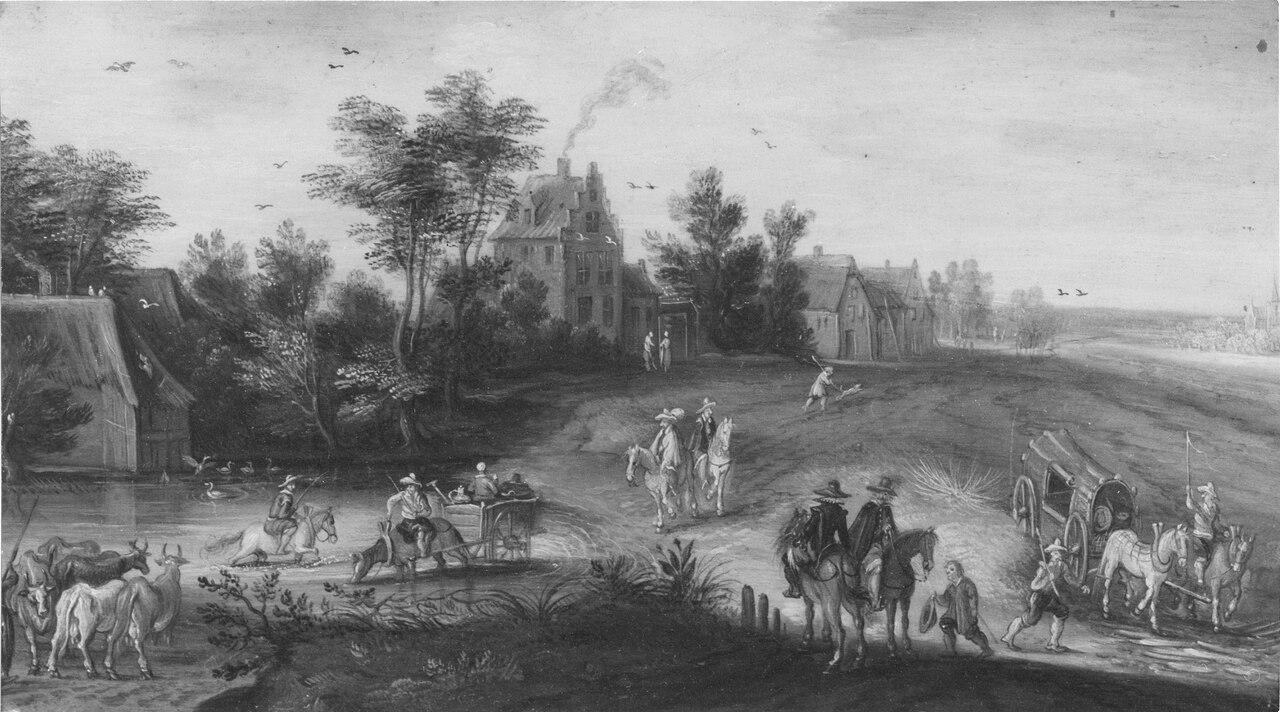
_-_Landscape_with_a_village,_Allegory_of_Autumn.jpg)

Early life Jacob Savery was born in 1560 in the city of Kortrijk, which lay within the Habsburg‑ruled Southern Netherlands. Little is known of his family background, but the artistic environment of the region—renowned for its guilds and workshops—provided a fertile ground for his early training. By his teens he had moved to Antwerp, the principal artistic centre of the Low Countries, where he entered the workshop system that shaped many of his contemporaries. In Antwerp he would have been exposed to the vibrant market for paintings, prints and decorative arts, and he likely began learning the fundamentals of drawing, composition and the handling of oil paint.
Career and style Around the early 1580s Savery established himself as a competent painter and draughtsman. The political turmoil of the Dutch Revolt prompted many artists to relocate, and after 1584 Savery moved north to the Dutch Republic, ultimately settling in Amsterdam. This move coincided with a shift in artistic demand: Dutch patrons favoured more naturalistic and domestic subjects compared with the grand religious commissions that dominated the Southern Netherlands. Savery responded by diversifying his output, producing still lifes that displayed meticulous attention to texture, animal studies that captured the vitality of domestic and wild creatures, and landscapes that combined topographical detail with atmospheric mood.
His style reflects a synthesis of Flemish realism and the emerging Dutch penchant for genre painting. He employed a balanced palette, often using earth tones punctuated by brighter hues to highlight focal points. The composition of his works typically follows a clear foreground‑middle‑background structure, guiding the viewer’s eye through narrative elements. While Savery never aligned himself with a formal movement, his oeuvre anticipates the later Dutch Golden Age emphasis on everyday life and the natural world.
Signature techniques Savery’s technique is distinguished by several recurring approaches. First, his handling of light is subtle yet effective; he often used a soft, diffused illumination to model forms, creating a sense of depth without dramatic chiaroscuro. Second, his brushwork varies according to subject: fine, almost stippled strokes render fur and feathers, whereas broader, smoother passages convey foliage and sky. Third, his etchings reveal a precise line quality, with cross‑hatching used to suggest texture and shadow. Finally, Savery frequently incorporated small narrative details—such as a distant figure or a stray animal—that enrich the scene without detracting from the main focus.
Major works Among Savery’s surviving pieces, several stand out for their compositional complexity and thematic range. **“St. Sebastian Fair in a Flemish Village” (1598)** presents a bustling market scene framed by a rural backdrop, where the martyrdom of Saint Sebastian is hinted at through symbolic iconography rather than explicit violence. The work showcases Savery’s ability to blend religious narrative with genre observation. **“Landscape with the story of Jephthah’s daughter” (1580)** merges biblical storytelling with a detailed natural setting; the tragic moment is rendered with restraint, emphasising the surrounding countryside as a silent witness. **“Rural Scene”** (date unknown) exemplifies his skill in depicting agrarian life, with careful attention to the textures of thatch, stone and livestock. **“Landscape with Village: ‘Autumn’” (1600)** captures the seasonal transition through a warm colour scheme and the depiction of harvest activity, illustrating Savery’s sensitivity to atmospheric change. Finally, **“Belägring av en stad”** (title translated as “Siege of a City”) demonstrates his capacity for larger historical subjects, employing a panoramic view to convey the drama of conflict while maintaining the same meticulous detail found in his smaller works.
Influence and legacy Jacob Savery’s career bridges the late Renaissance traditions of the Southern Netherlands and the burgeoning naturalism of the Dutch Golden Age. Though he did not achieve the fame of contemporaries such as Pieter Bruegel the Elder, his versatile output contributed to the diversification of subject matter that would become a hallmark of Dutch art in the seventeenth century. His son, Roelant Savery, later became a celebrated painter of animals and landscapes, suggesting a familial transmission of skill and aesthetic values. Modern scholars regard Jacob Savery as a competent practitioner whose works provide insight into the transitional period of late sixteenth‑century Netherlandish painting, particularly in the way they negotiate religious, historical and everyday themes within a unified visual language.
Frequently asked questions
Who was Jacob Savery?
Jacob Savery (1560–1603) was a Flemish‑born painter, etcher and draughtsman who worked mainly in Amsterdam after moving to the Dutch Republic.
What artistic style or movement is he associated with?
He is not linked to a specific movement, but his work blends Flemish realism with the emerging Dutch naturalism and genre painting of the late 16th century.
What are his most famous works?
Key works include “St. Sebastian Fair in a Flemish Village” (1598), “Landscape with the story of Jephthah’s daughter” (1580), “Landscape with Village: ‘Autumn’” (1600) and the genre piece “Rural Scene.”
Why does Jacob Savery matter in art history?
He exemplifies the transitional phase between Southern Netherlandish Renaissance art and the Dutch Golden Age, helping to broaden subject matter and influencing later artists, notably his son Roelant Savery.
How can I recognise a Jacob Savery painting?
Look for balanced compositions with clear foreground‑middle‑background layers, subtle diffused lighting, meticulous texture rendering—especially in animal fur and foliage—and occasional narrative details that subtly reference religious or historical stories.