Iwasa Matabē
1578 – 1650
In short
Iwasa Matabē (1578–1650) was a Japanese painter of the early Tokugawa period, known for genre scenes, literary illustrations and portraiture. Born in Itami and later active in Edo, he worked in a style that bridged courtly Yamato-e conventions and the emerging popular visual culture of the Edo era.
Notable works



Early life Iwasa Matabē was born in 1578 in the town of Itami, in what is now Hyōgo Prefecture. He was originally named Araki Katsumochi, the son of the Sengoku‑period daimyō Araki Murashige. After his father's forced suicide, Matabē was raised by his mother’s family and took the surname Iwasa. The turbulent political climate of late‑16th‑century Japan meant that his formative years were marked by the transition from the warring states to the stability of the Tokugawa shogunate. Little is recorded about his early education, but the prevailing practice for aspiring painters of his class was apprenticeship within a workshop, where he would have learned both court painting techniques and the practical skills needed for commercial commissions.
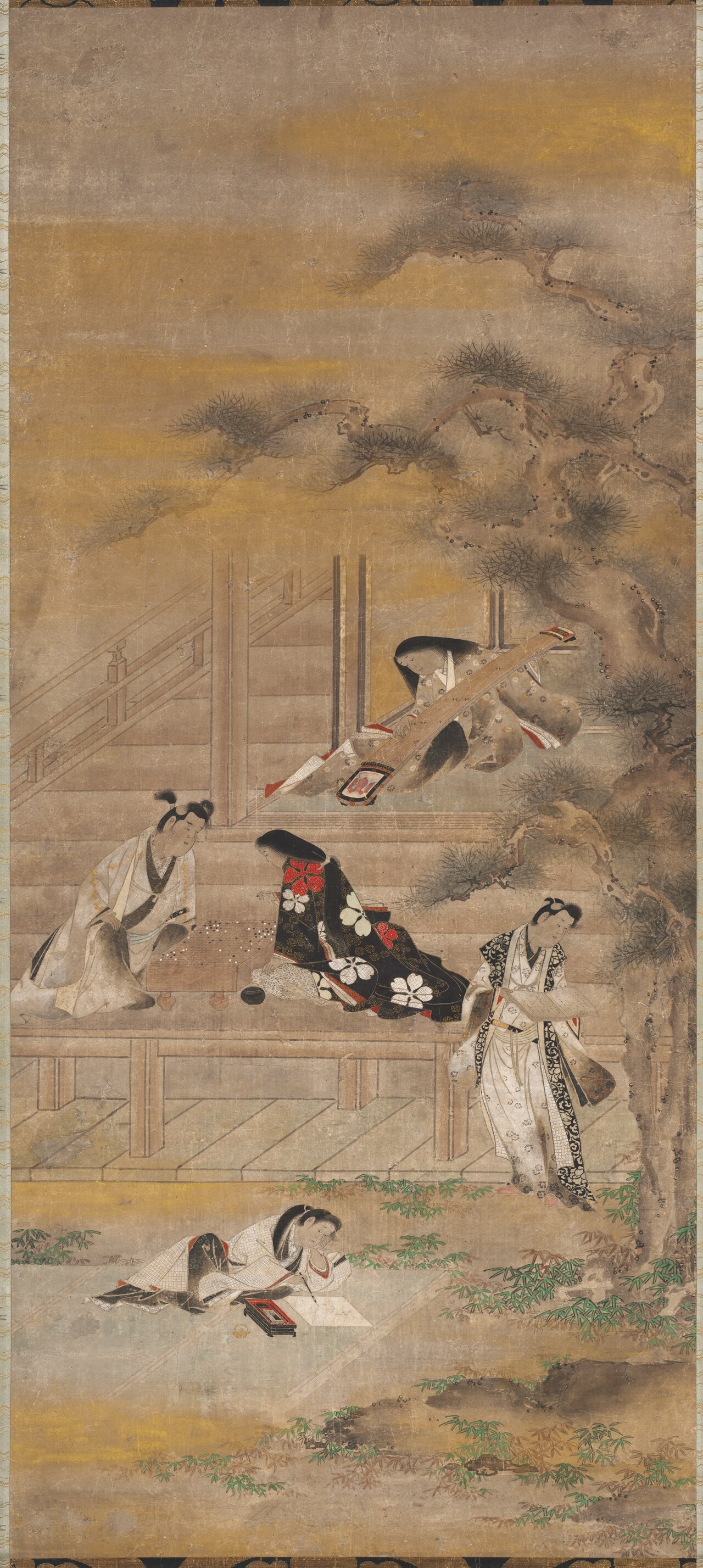
Career and style Matabē established his career in the new capital of Edo, where the growing merchant class created demand for visual narratives that could be displayed in private homes and tea houses. He specialised in genre scenes that depicted historical episodes, literary subjects from the Chinese canon, and portraits of celebrated poets. His work does not fit neatly into a single named movement; rather, it reflects a synthesis of traditional Yamato‑e court painting—characterised by delicate lines and restrained colour—and the more populist, narrative‑driven aesthetics that would later crystallise as ukiyo‑e. Matabē’s paintings are noted for their compositional clarity, a balanced use of space, and an emphasis on the human figure as a vehicle for storytelling.
Signature techniques Matabē’s technique combined fine brushwork with a muted palette of mineral pigments and ink washes. He often employed a layered approach: an initial ink sketch defined the outlines, followed by delicate colour washes that added depth without overwhelming the line work. His handling of silk and paper supports allowed for subtle gradations of tone, while his use of gold and mica highlights lent a modest decorative quality to select elements. In portraiture, he rendered facial features with restrained realism, favouring soft shading to suggest individuality rather than caricature. The compositional structure frequently uses a diagonal axis that guides the viewer’s eye across the scene, a device that enhances narrative flow.
Major works - **Rakuchū rakugai zu (Funaki) (1615)** – This hand‑scroll illustrates the bustling streets of Edo, juxtaposing the orderly interiors of aristocratic residences with the lively activities of merchants and townspeople. The work demonstrates Matabē’s skill in rendering architectural detail and crowd dynamics, offering a valuable visual record of early Edo urban life. - **The Four Pleasures (1625)** – A multi‑panel composition that celebrates the traditional Japanese pleasures of music, poetry, tea, and travel. Each panel presents a distinct vignette, rendered with graceful figures and elegant accessories, reflecting Matabē’s ability to integrate literary symbolism with visual elegance. - **The Poet Mibu no Tadamine (1616)** – Part of a set illustrating the Thirty‑six Poetic Immortals, this album leaf portrays the poet Mibu no Tadamine in a contemplative pose, surrounded by calligraphic excerpts of his verse. The delicate balance between text and image exemplifies Matabē’s expertise in literary illustration. - **Two Women** – Though the exact date is uncertain, this work depicts a pair of elegantly dressed women engaged in a private conversation. The subtle interaction of gestures and the careful rendering of textiles reveal Matabē’s attention to social nuance and his capacity to convey intimacy within a formal composition. - **Portrait of the Poet Kakimoto no Hitomaro** – In this portrait, Matabē renders the revered poet with a dignified bearing, using restrained colour and fine line work to suggest both reverence and the timeless quality of the poet’s legacy.
Influence and legacy Iwasa Matabē’s oeuvre occupies a transitional space in Japanese art history. By blending courtly aesthetics with emerging popular subjects, he laid groundwork for the later flourishing of ukiyo‑e, particularly in the way narrative content was visualised. Scholars have noted his influence on early Edo‑period painters who sought to balance elite taste with commercial appeal. Although his name was sometimes conflated with the later 18th‑century painter Iwasa Matabei, modern research distinguishes him as a distinct figure whose contributions are integral to understanding the visual culture of early Tokugawa Japan. Today, his works are held in major museum collections in Japan and abroad, and they continue to be cited in studies of genre painting, literary illustration, and the development of portraiture in pre‑modern Japan.
Frequently asked questions
Who was Iwasa Matabē?
Iwasa Matabē (1578–1650) was a Japanese painter of the early Tokugawa period, known for genre scenes, literary illustrations and portraiture.
What artistic style or movement is he associated with?
He worked in a hybrid style that combined traditional Yamato‑e court painting with the emerging narrative aesthetics that later evolved into ukiyo‑e.
What are his most famous works?
Key works include *Rakuchū rakugai zu* (1615), *The Four Pleasures* (1625), the portrait of poet Kakimoto no Hitomaro, and his illustration of the poet Mibu no Tadamine from the Thirty‑six Poetic Immortals series (1616).
Why is Iwasa Matabē important in art history?
He bridges the courtly art of the late Sengoku era with the popular visual culture of early Edo, influencing the development of narrative painting and the later ukiyo‑e tradition.
How can I recognise a work by Iwasa Matabē?
Look for finely drawn figures, muted mineral pigments, a balanced composition with a subtle diagonal flow, and a combination of literary inscription with delicate visual storytelling.