Isaac van Duynen
1628 – 1679
In short
Isaac van Duynen (1628–1679) was a Dutch Republic painter renowned for his highly detailed still‑life compositions of fish and other marine subjects. Working mainly in Dordrecht and The Hague, he contributed to the Dutch Golden Age tradition of naturalistic banquet and kitchen scenes.
Notable works


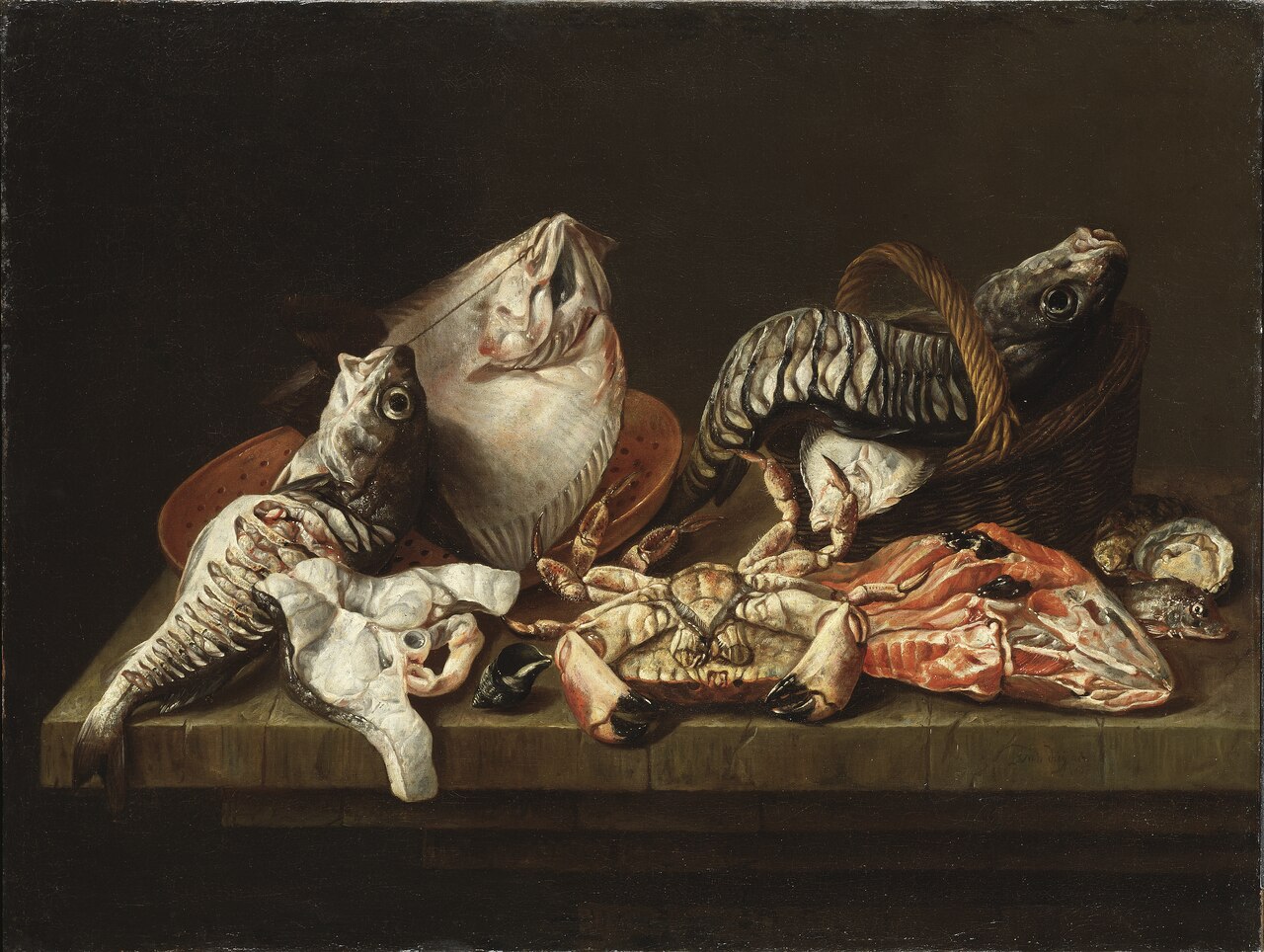

_-_Fischstillleben_-_3266_-_F%C3%BChrermuseum.jpg)
Early life Isaac van Duynen was born in 1628 in the city of Dordrecht, a thriving commercial centre in the Dutch Republic. Little is recorded about his family background or formal artistic training, but the city’s vibrant market life and proximity to the river and sea would have offered abundant visual material for a future painter of marine subjects. Dordrecht’s artistic community in the mid‑17th century was influenced by the broader Dutch Golden Age, where genre and still‑life painting were highly prized.
Career and style Van Duyenen appears to have begun his professional career in the 1650s, a period when Dutch still‑life painting was reaching a high point of technical mastery. He specialised in depictions of dead fish, crustaceans, oysters and other sea life, often arranged on simple wooden tables or stone slabs. His works reflect the typical Dutch still‑life concerns with texture, surface detail and the fleeting qualities of light. While the exact market for his paintings is not documented, the inclusion of luxury items such as silverware or glassware in some compositions suggests that his clientele included affluent merchants and collectors who appreciated the realism and subtle moral undertones of his subjects.
The artist’s style aligns with the naturalistic tradition of contemporaries such as Jan Davidsz. de Heem and Willem van Aelst, yet van Duyenen’s focus on marine fauna gives his oeuvre a distinctive niche. His compositions are generally sober, avoiding the elaborate allegorical symbolism sometimes found in fruit or flower still lifes. Instead, he emphasised the tactile qualities of scales, shells and flesh, inviting the viewer to contemplate the materiality of the objects rendered.
Signature techniques Van Duyenen’s paintings are characterised by a meticulous rendering of surface texture. He achieved the sheen of fish scales through fine, layered brushwork, often using a limited palette of muted blues, greys and earthy browns to model form. Light is typically introduced from a single, slightly elevated source, creating a gentle chiaroscuro that highlights the gloss of wet surfaces while casting soft shadows on the underlying table. This handling of light enhances the three‑dimensional illusion of the objects.
Another hallmark of his technique is the careful placement of supporting objects—such as a cracked shell, a piece of cloth or a simple stone—that provide visual balance and prevent the composition from appearing flat. The background is usually neutral, allowing the fish and marine elements to dominate the visual field. Van Duyenen also employed a subtle glazing method, applying thin translucent layers of paint to deepen colour and achieve a realistic depth, particularly in the eyes of the fish and the inner surfaces of shells.
Major works - **A fish still life (1650)** – This early work demonstrates van Duyenen’s emerging command of texture. A solitary fish lies on a stone slab, its silvery scales rendered with fine, overlapping strokes. The restrained background and modest lighting focus attention on the subject’s physicality. - **Still Life with Fish (1650)** – Created in the same year, this composition expands the subject matter to include multiple fish of varying sizes, arranged in a diagonal line. The inclusion of a small crustacean and a shell adds interest and showcases the artist’s ability to handle diverse marine textures. - **Still Life with Fishes, a Crab and Oysters** – Though the exact date is unknown, this painting illustrates van Duyenen’s mature phase. The work combines several fish, a bright red crab and a cluster of oysters, each rendered with distinct surface qualities. The subtle interplay of light across the wet surfaces creates a lively yet controlled tableau. - **Fish (Still Life) (1673)** – One of his later dated works, this painting reflects a refined compositional balance. A single large fish is positioned centrally, flanked by a peeled citrus fruit and a glass bottle, hinting at the banquet genre. The use of a darker background heightens the luminous quality of the fish’s flesh. - **Stillife with fishes (1659)** – This piece shows a more complex arrangement, with three fish, a piece of bread, and a small metal kettle. The inclusion of everyday objects alongside the marine subjects suggests a narrative of a kitchen setting, linking van Duyenen’s work to the broader Dutch kitchen‑still‑life tradition.
Each of these works underscores van Duyenen’s consistent focus on realistic depiction, careful composition and restrained colour palette, marking him as a specialist within the Dutch still‑life genre.
Influence and legacy Isaac van Duyenen did not achieve the fame of some of his contemporaries, and his name remains relatively obscure outside specialist circles. Nevertheless, his paintings provide valuable insight into the niche of marine still life that flourished in the mid‑17th‑century Dutch Republic. His meticulous technique and dedication to depicting the materiality of fish and shells contributed to the broader appreciation of everyday subjects as worthy of fine art.
Later Dutch and Flemish still‑life painters continued to explore similar themes, and van Duyenen’s works are occasionally referenced in scholarly discussions of the period’s genre diversity. Modern collectors and museums value his paintings for their technical excellence and for the way they encapsulate the Dutch fascination with realism and the fleeting nature of foodstuffs. Though few in number, his surviving works are preserved in both private collections and public institutions, ensuring that his contribution to Dutch still‑life painting remains accessible to scholars and art lovers alike.
Frequently asked questions
Who was Isaac van Duynen?
Isaac van Duynen (1628–1679) was a Dutch painter known for highly detailed still‑life paintings of fish and other marine subjects, active mainly in Dordrecht and The Hague.
What artistic style or movement is he associated with?
He worked within the Dutch Golden Age still‑life tradition, focusing on naturalistic, highly detailed depictions of marine life and banquet scenes.
What are his most famous works?
Key works include *A fish still life* (1650), *Still Life with Fish* (1650), *Still Life with Fishes, a Crab and Oysters*, *Fish (Still Life)* (1673) and *Stillife with fishes* (1659).
Why is Isaac van Duynen important in art history?
He exemplifies a specialised niche of Dutch still‑life painting, demonstrating exceptional skill in rendering texture and light on fish and shells, and enriching the genre’s diversity.
How can I recognise a painting by Isaac van Duynen?
Look for meticulous, almost scientific rendering of fish scales, subtle single‑source lighting, a restrained colour palette, and simple backgrounds that highlight the marine subjects.