Hubert Goltzius
1526 – 1583
In short
Hubert Goltzius (1526–1583) was a Flemish Renaissance painter, engraver, publisher and pioneering numismatist from the Habsburg Netherlands, known for his religious paintings and for producing one of the earliest illustrated series of Roman imperial coins. He is remembered chiefly for his contributions to the study of ancient coinage and as the great‑uncle of the celebrated engraver Hendrik Goltzius.
Notable works

_-_Vanderbilt_Fine_Arts_Gallery_-_1999.174a.med.jpg)
Early life Hubert Goltzius was born in 1526 in the town of Venlo, then part of the Habsburg Netherlands. Little is recorded about his family background, but the Goltz name was already associated with artistic activity in the region. He grew up during a period when the Low Countries were a vibrant centre of trade, humanist learning and artistic exchange. Goltzius likely received his first training in drawing and painting within a local workshop, as was customary for aspiring artists of the time, and he would have been exposed to the flourishing Netherlandish painting traditions of the early sixteenth century.
Career and style Goltzius established himself in the mid‑1500s as a versatile creative professional. He worked as a painter, producing altarpieces and devotional images for churches and private patrons, and as an engraver, producing prints that circulated widely in the burgeoning market for portable art. His style reflects the broader currents of the Northern Renaissance: a careful observation of human anatomy, a balanced composition, and an interest in narrative detail. Unlike some of his contemporaries, Goltzius did not align himself with a single artistic movement; instead, his work displays a synthesis of local Netherlandish realism with the classical motifs that were re‑introduced by humanist scholars.
In addition to his visual art, Goltzius cultivated a reputation as a learned antiquarian. He collected, studied and published images of ancient Roman coins, a pursuit that placed him at the forefront of early modern numismatics. His activities as a printer and publisher allowed him to disseminate his own scholarly illustrations, as well as to act as a dealer in artworks and antiquities for a clientele that spanned the Low Countries and the Holy Roman Empire.
Signature techniques Goltzius’s engravings are distinguished by a precise, fine‑line incision that renders both texture and volume with a restrained hand. He employed cross‑hatching to model drapery and facial features, a technique that gave his figures a subtle three‑dimensionality while maintaining the crispness required for print reproduction. In his numismatic works, he combined artistic skill with scholarly rigour: each coin was drawn from life, often after careful examination of museum or private collections, and accompanied by concise historical commentary. This blend of aesthetic and academic concerns became a hallmark of his printed plates and set a standard for later numismatic publications.
Major works Among Goltzius’s painted works, **The Last Judgment (1557)** stands out as a large‑scale religious composition intended for a church altar. The work demonstrates his command of dramatic narrative, with figures arranged in a vertical hierarchy that guides the viewer’s eye from the condemned below to the saved above. Its treatment of light and shadow reflects the influence of Italian models, while the detailed rendering of the crowd reveals his Netherlandish roots.
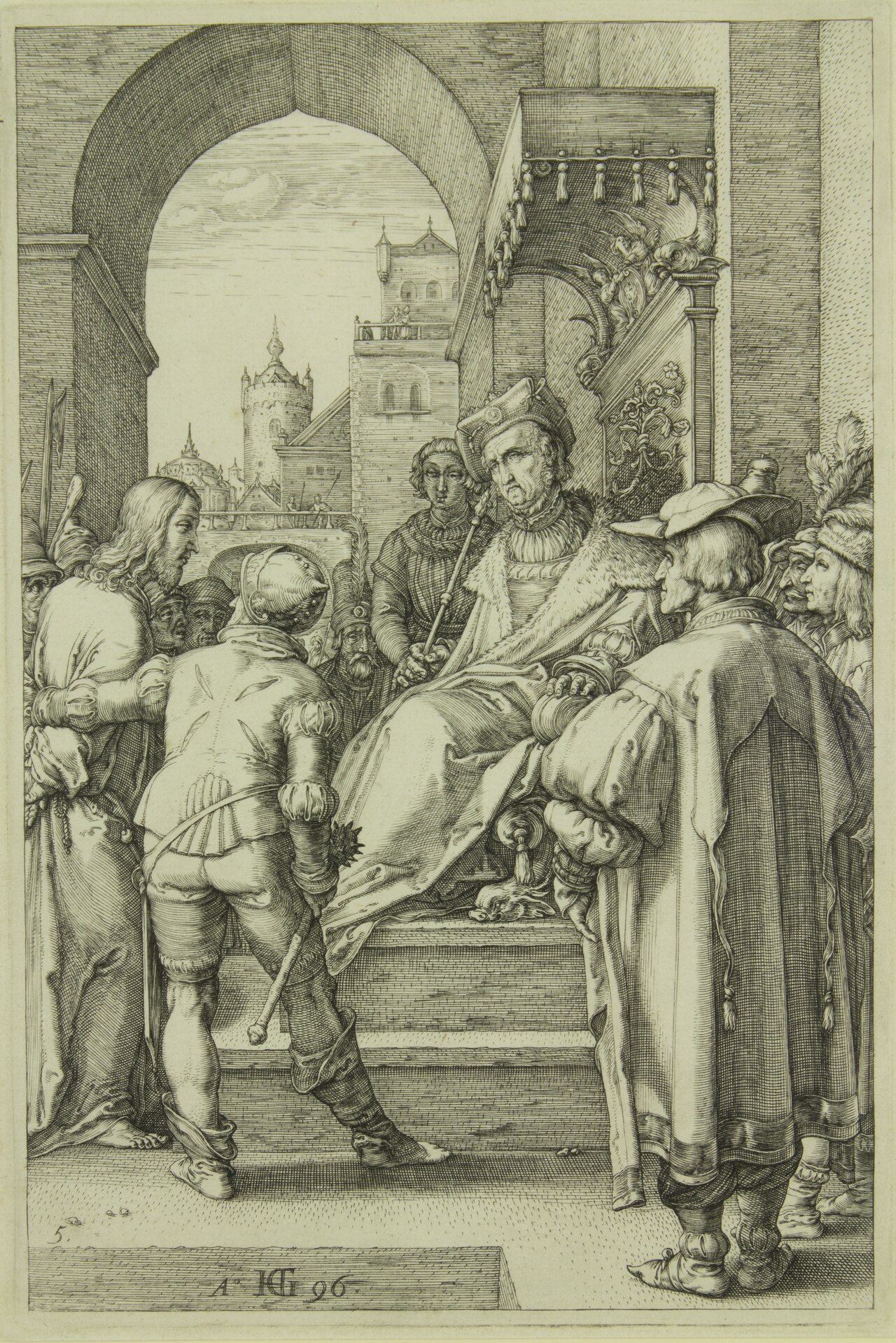
Another notable painting, Christ Before Pilate, presents a more intimate moment from the Passion. Goltzius captures the tension between authority and vulnerability through a restrained colour palette and careful placement of gestures. Although the exact date of this work is not documented, stylistic analysis situates it in the middle of his career, when his religious subjects were in demand.
Goltzius’s most enduring contribution to scholarship is the series Portraits of the Roman Emperors (titled *Icones imperatorum romanorum, ex priscis numismatibus ad vivum delineatae, & brevi narratione historica illustratae*). The plates were first issued in the 1640s, well after his death, as part of a posthumous edition that drew on his original drawings and notes. The work presents life‑size, meticulously rendered portraits of imperial coinage, each accompanied by a brief historical note. This publication is recognised as one of the earliest systematic attempts to illustrate and describe ancient Roman coinage for a scholarly audience, establishing Goltzius as a pioneer of modern numismatics.
Influence and legacy Hubert Goltzius’s legacy rests on two pillars: his artistic production and his scholarly impact on the study of ancient coins. While his paintings and prints are respected examples of mid‑sixteenth‑century Netherlandish art, it is his numismatic oeuvre that has secured his lasting reputation. Contemporary scholars refer to him as the ‘father of ancient numismatics’, acknowledging his role in transforming coin collecting from a hobby into a disciplined field of historical inquiry.
His influence extended to his great‑nephew, Hendrik Goltzius, who became one of the most celebrated engravers of the Dutch Golden Age. The younger Goltzius inherited both a family workshop and a corpus of prints that bore the elder’s stylistic imprint, illustrating how Hubert’s technical expertise and entrepreneurial spirit were transmitted across generations.
In modern art‑historical and archaeological research, Hubert Goltzius is cited for his methodological approach: the careful observation of artefacts, the integration of visual reproduction with textual commentary, and the dissemination of knowledge through printed media. His work paved the way for later scholars such as Joseph Hilarius Eckhel and contributed to the establishment of numismatics as a recognised academic discipline.
Overall, Hubert Goltzius exemplifies the Renaissance ideal of the artist‑scholar, bridging the worlds of visual creation and scientific study, and leaving a dual heritage that continues to inform both art history and the study of antiquities.
Frequently asked questions
Who was Hubert Goltzius?
Hubert Goltzius (1526–1583) was a Flemish Renaissance painter, engraver, publisher and pioneering numismatist from the Habsburg Netherlands.
What artistic style or movement is he associated with?
He worked within the Northern Renaissance tradition, blending Netherlandish realism with classical humanist motifs, but did not belong to a single defined movement.
What are his most famous works?
His notable works include the altarpiece *The Last Judgment* (1557), the painting *Christ Before Pilate*, and the illustrated series *Portraits of the Roman Emperors* (published posthumously in 1645).
Why is Hubert Goltzius important in art history?
He is recognised as a founder of modern numismatics and for his high‑quality engravings that combined artistic skill with scholarly documentation, influencing both the study of ancient coins and later artists such as his great‑nephew Hendrik Goltzius.
How can I recognise a work by Hubert Goltzius?
Look for fine‑line engraving with meticulous cross‑hatching, balanced compositions in his paintings, and, in his numismatic plates, life‑size portraits of coins rendered with precise detail and accompanied by concise historical notes.