Howard Chandler Christy
1873 – 1952
In short
Howard Chandler Christy (1873–1952) was an American painter and illustrator best known for his idealised “Christy Girl” images and his large‑scale historical murals, notably the 1940 Scene at the Signing of the Constitution in the U.S. Capitol. He also produced iconic World War I recruitment posters and portrait commissions for prominent figures of his era.
Notable works


_1951_421.jpeg)
_-_Ritratto_di_Filippo_d%27Assia_-_R_8097_-_Castle_of_Racconigi.jpg)
Early life Howard Chandler Christy was born on March 31, 1873 in Zanesville, Ohio, into a family that encouraged artistic pursuits. His father, John William Christy, ran a modest printing business, giving young Howard early exposure to graphic design and illustration. Demonstrating talent for drawing from a young age, Christy attended the Art Students League of New York in the early 1890s, where he studied under the guidance of established American illustrators. The rigorous training he received there, combined with a growing interest in the visual culture of the United States, set the foundation for his later career as both a commercial illustrator and a fine‑art painter.
Career and style Christy’s professional life began in the bustling world of magazine illustration. By the turn of the century he was contributing regularly to publications such as *Harper's Weekly*, *Collier's*, and *The Saturday Evening Post*. His work reflected the popular aesthetic of the period, characterised by crisp line work, vivid colour, and a narrative quality that appealed to a broad readership. Over time, Christy developed a distinctive style that blended realism with an idealised, often romanticised, vision of his subjects. This approach reached its zenith in the series of images known as the “Christy Girl”, a modern, confident counterpart to the earlier “Gibson Girl”. The Christy Girl embodied the emerging aspirations of American women in the 1910s and 1920s, presenting them as elegant, independent, and subtly sensual.
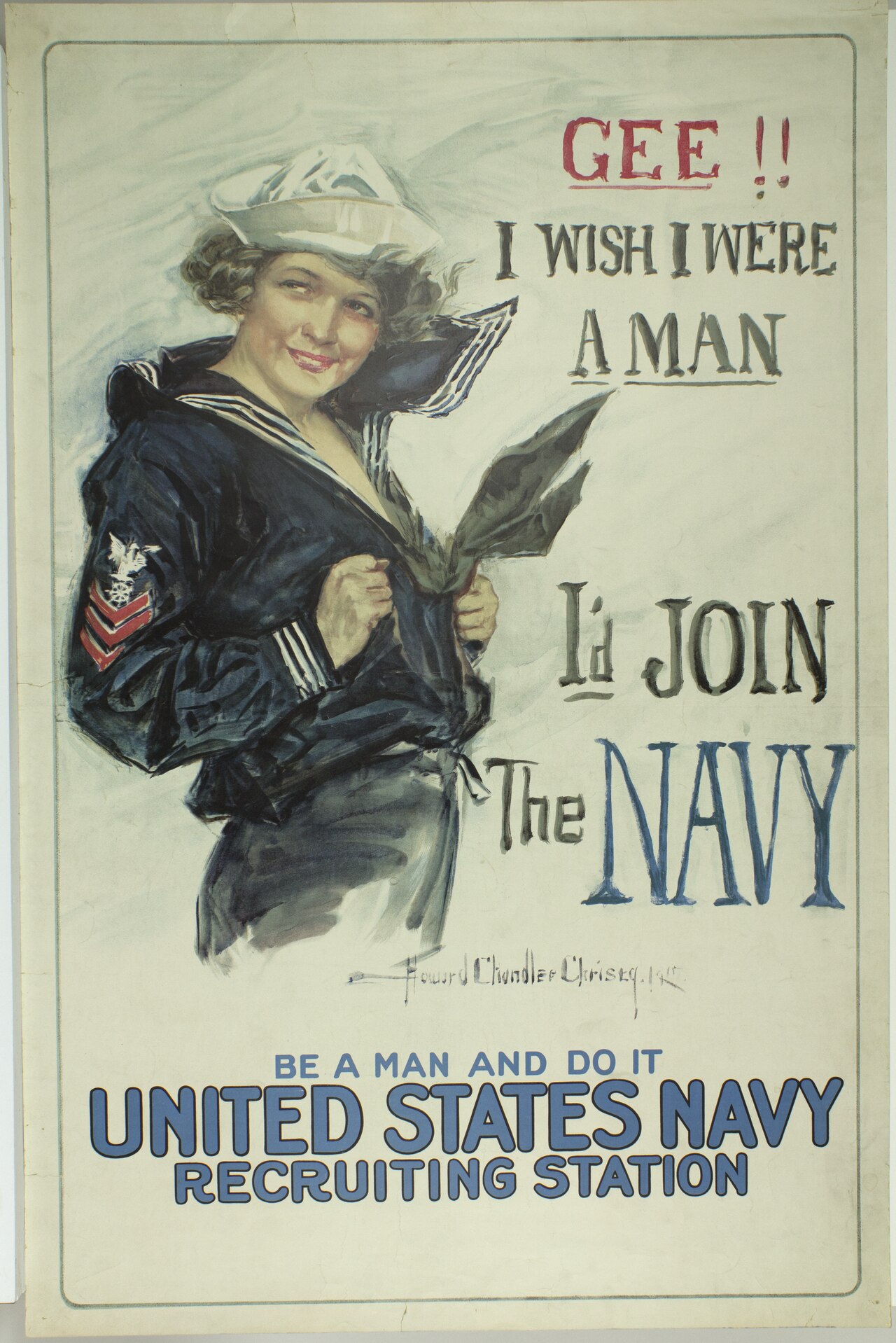
During the First World War, Christy’s reputation expanded beyond magazine pages. He was commissioned by the U.S. government to create recruitment and Liberty Loan posters, most famously the 1917 image titled *Gee!! I Wish I Were a Man I'd Join the Navy*. The poster’s bold composition, bright palette and patriotic message made it an effective tool for encouraging enlistment, and it remains a classic example of wartime propaganda art.
Christy’s career evolved further in the 1930s and 1940s as he turned to large‑scale historical mural painting. His most celebrated work from this period is the monumental *Scene at the Signing of the Constitution of the United States* (1940), commissioned for the United States Capitol. The painting, positioned in the east stairwell, captures the dramatic moment of the Constitutional Convention with meticulous attention to period detail and a composition that balances individual portraiture with a sense of collective purpose. This work cemented Christy’s reputation as a painter capable of handling both intimate portraiture and grand historical narrative.
Signature techniques Christy’s technique was characterised by a mastery of oil painting combined with a commercial illustrator’s sense of composition. He often employed a layered approach: an underpainting to establish tonal values, followed by successive glazes to achieve luminous skin tones and atmospheric depth. In his portraits, Christy paid particular attention to the rendering of fabrics and accessories, using fine brushwork to suggest texture while maintaining a smooth overall surface. Light was a central element in his work; he frequently used a single, directional light source to model forms and to draw the viewer’s eye to focal points, such as a subject’s face or a symbolic object. In his mural pieces, Christy scaled up these techniques, relying on preliminary sketches and maquettes to resolve complex groupings before committing to the full‑size canvas.
Major works - **Scene at the Signing of the Constitution of the United States (1940)** – Located in the United States Capitol, this expansive oil painting depicts delegates gathered around a table as the Constitution is signed. Christy’s composition balances individual likenesses with the overarching theme of nation‑building, and his meticulous rendering of period costumes and architectural details underscores his commitment to historical accuracy. - **Gee!! I Wish I Were a Man I'd Join the Navy (1917)** – An iconic World War I recruitment poster, the image shows a determined young woman in a navy uniform, encouraging women to support the war effort. Its bold colours, dynamic pose and clear message exemplify Christy’s ability to fuse artistic skill with persuasive propaganda. - **Grace Goodhue Coolidge (Mrs. Calvin Coolidge) (1924)** – A formal portrait of the First Lady, this work showcases Christy’s talent for dignified portraiture. The composition highlights Mrs. Coolidge’s poise and elegance, rendered with subtle lighting that accentuates the delicate modelling of her face and attire. - **Frank Andrew Munsey (1854‑1925) (1926)** – This portrait of the publishing magnate captures Munsey’s authoritative presence. Christy employs a restrained palette and careful attention to the subject’s attire, reflecting both the sitter’s status and the artist’s capacity for nuanced character study. - **Portrait of Prince Philipp of Hesse (1927)** – In this aristocratic portrait, Christy combines regal formality with his signature soft rendering of skin and fabric. The work demonstrates his international commissions and his ability to adapt his American style to European court portraiture.
Influence and legacy Howard Chandler Christy left a multifaceted legacy that bridges commercial illustration, portraiture, and historical mural painting. His “Christy Girl” series contributed to the visual language of early twentieth‑century American femininity, influencing fashion, advertising and popular culture. The recruitment posters he produced during World War I are studied as prime examples of effective visual persuasion, illustrating how art can serve national policy.
Christy’s historical murals, particularly the Capitol painting, continue to be referenced by scholars examining the role of art in shaping collective memory. By portraying foundational moments in American history with both accuracy and artistic flair, he helped embed those narratives within the public imagination. Moreover, his meticulous technique and emphasis on light and texture have informed subsequent generations of portrait painters who seek to balance realism with idealisation.
Although Christy’s name may not be as widely recognised today as that of some contemporaries, his contributions remain integral to the development of American visual culture. Institutions such as the Smithsonian American Art Museum hold several of his works, and academic texts on illustration frequently cite his career as a model of how an artist can successfully navigate both commercial and fine‑art domains. In the broader context of art history, Christy exemplifies the early twentieth‑century American artist who merged popular appeal with a commitment to craftsmanship, leaving a body of work that continues to be studied and appreciated.
Frequently asked questions
Who was Howard Chandler Christy?
Howard Chandler Christy (1873–1952) was an American painter and illustrator known for his idealised "Christy Girl" images, World War I recruitment posters, and large historical murals such as the 1940 Scene at the Signing of the Constitution in the U.S. Capitol.
What artistic style or movement is Christy associated with?
Christy worked primarily in a realist‑illustrative style that blended commercial illustration with fine‑art portraiture, creating polished, narrative‑driven images rather than aligning with a specific avant‑garde movement.
What are Christy’s most famous works?
His best‑known pieces include the 1940 mural Scene at the Signing of the Constitution of the United States, the 1917 recruitment poster Gee!! I Wish I Were a Man I'd Join the Navy, and the series of "Christy Girl" illustrations.
Why does Christy matter in art history?
Christy shaped early twentieth‑century American visual culture by defining a new ideal of female beauty, influencing wartime propaganda, and producing historically significant murals that reinforced national narratives.
How can I recognise a Christy painting?
Look for smooth, luminous flesh tones, meticulous rendering of clothing, a clear, often single light source, and a composition that balances realistic detail with an idealised, slightly romanticised presentation of the subject.