Henry Perronet Briggs
1793 – 1844
In short
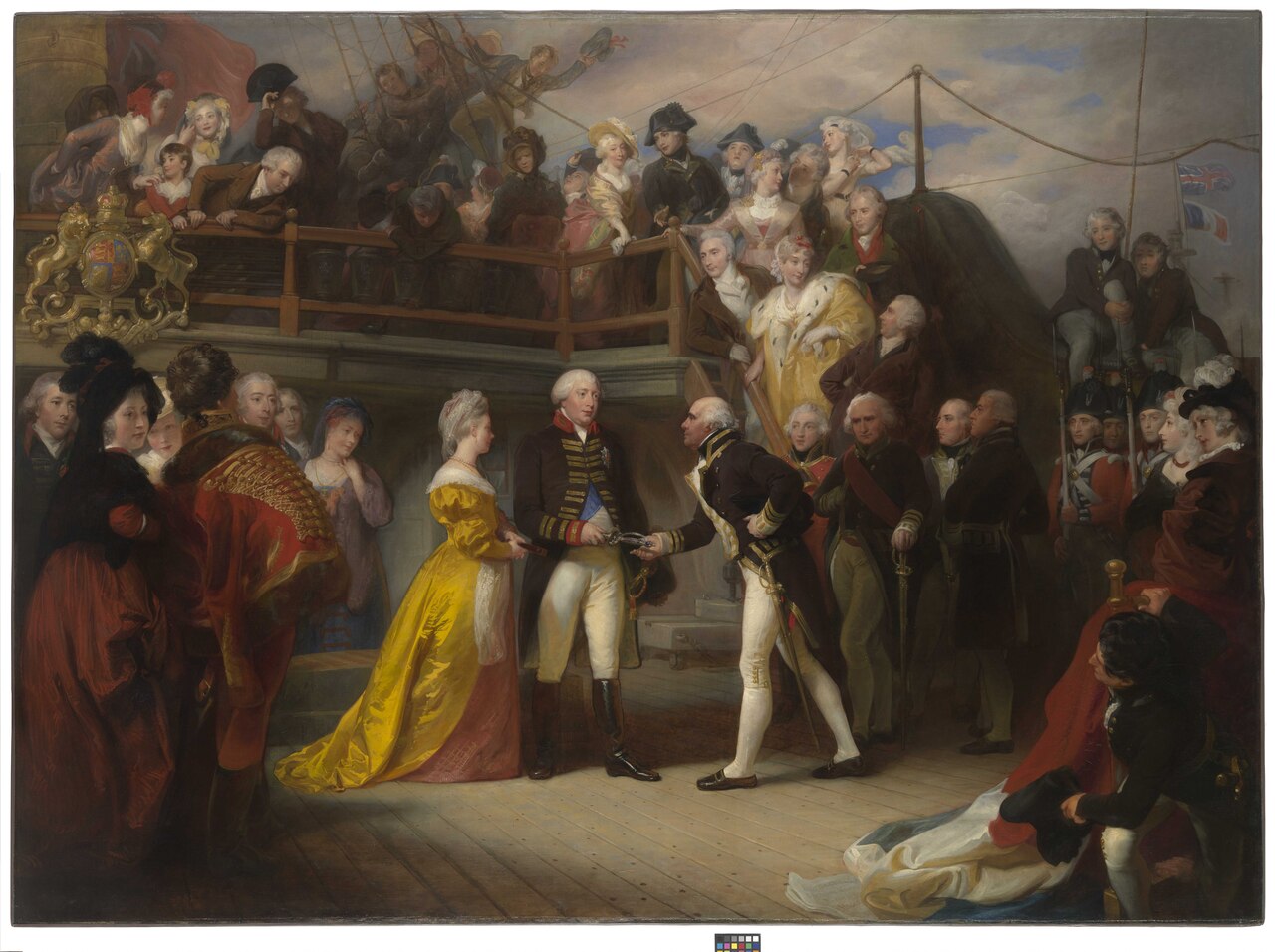
Henry Perronet Briggs (1793–1844) was a British painter noted for his portraits and historical canvases. He worked mainly in London, exhibiting at the Royal Academy, and is remembered for dramatic narrative scenes such as the Gunpowder Plot and the meeting of George III with Howe’s flagship.
Notable works
_-_The_Discovery_of_the_Gunpowder_Plot_and_the_Taking_of_Guy_Fawkes_-_TWCMS_,_B8115_-_Laing_Art_Gallery.jpg)
_-_The_First_Interview_between_the_Spaniards_and_the_Peruvians_-_N00375_-_National_Gallery.jpg)
_-_Colonel_Blood_Stealing_the_Crown_Jewels_-_03-1325_-_Royal_Academy_of_Arts.jpg)

Early life Henry Perronet Briggs was born in London in 1793, the son of a modest family. Little is known about his childhood, but his early exposure to the bustling artistic life of the capital gave him access to the Royal Academy Schools, where he began formal training. By his late teens he was attending life‑drawing classes and copying Old Master works, a standard route for aspiring British artists of the period.
Career and style Briggs first entered the public eye with a debut at the Royal Academy exhibition in the early 1820s. The Academy, then the premier venue for British painters, welcomed his large‑scale historical subjects, which combined the academic rigor of the Neoclassical tradition with a growing Romantic interest in dramatic storytelling. Though he never aligned himself with a specific avant‑garde movement, his work reflects the transitional aesthetic of early‑Victorian Britain: clear draftsmanship, careful modelling of form, and an emphasis on narrative clarity.
Throughout his career Briggs balanced portrait commissions with history paintings. Portraiture provided a reliable income and allowed him to capture the likenesses of notable figures, while his larger canvases—often commissioned for public institutions or private patrons—explored moments from English history, classical mythology, and contemporary events. His paintings were praised for their compositional balance, the vigor of their figures, and an ability to render the tension of a story without sacrificing technical precision.
Signature techniques Briggs employed a restrained palette dominated by earth tones, ochres, and muted blues, reserving brighter colours for focal points such as a flag, a weapon, or a piece of jewellery. He favored a tight underdrawing, evident in the crisp outlines of his figures, which he refined with layered glazes to achieve depth and a subtle sheen. Light is often introduced from a single source, casting dramatic shadows that heighten the emotional stakes of the scene. In portrait work, he used a softer modelling of skin to convey personality, while his historical canvases display a more sculptural treatment of drapery and anatomy.
Another hallmark of Briggs’s technique is his handling of narrative detail. He populated his scenes with historically accurate props—uniforms, weapons, and architectural elements—drawn from contemporary sources or antiquarian studies. This attention to verisimilitude helped his works function as visual history lessons for an audience that relied on paintings for a glimpse of the past.
Major works - **The Discovery of the Gunpowder Plot and the Taking of Guy Fawkes (1823)** – This large oil painting captures the moment when the conspirators behind the 1605 Gunpowder Plot were apprehended. Briggs places the central figure of Guy Fawkes at the composition’s heart, illuminated by a shaft of light that underscores his doomed fate. The work was exhibited at the Royal Academy and praised for its dramatic tension and accurate depiction of early‑17th‑century attire.
- Colonel Blood Stealing the Crown Jewels (1824) – In this narrative piece Briggs dramatizes the infamous 1671 attempt by Thomas Blood to steal the Crown Jewels from the Tower of London. The painting shows Blood and his accomplices in the act of removal, their faces contorted with a mix of greed and fear. The meticulous rendering of the jeweled regalia and the Tower’s stonework demonstrates Briggs’s skill in marrying historical detail with theatrical composition.
- The First Interview between the Spaniards and the Peruvians (1827) – Here Briggs turns his attention to a cross‑cultural encounter, depicting Spanish explorers meeting indigenous leaders in the New World. The work juxtaposes the richly coloured textiles of the Peruvian elite against the more subdued, dark‑tuned uniforms of the Spaniards, highlighting both cultural exchange and the power dynamics of the encounter.
- Visit of George III to Howe’s Flagship, the ‘Queen Charlotte’, on 26 June 1794 (1828) – This maritime scene celebrates a royal visit to a naval vessel. Briggs captures the regal presence of George III aboard the flagship, with the ship’s rigging and sea rendered in precise detail. The painting was commissioned to commemorate the event and reflects the patriotic enthusiasm of the period.
- Charles Kemble (1832) – One of Briggs’s most acclaimed portraits, this work depicts the celebrated actor Charles Kemble in a thoughtful pose. The portrait demonstrates Briggs’s ability to convey character through subtle facial expression and the careful rendering of clothing texture, cementing his reputation as a capable portraitist.
Influence and legacy While Henry Perronet Briggs never achieved the fame of contemporaries such as Sir Thomas Lawrence or J. M. W. Turner, his contribution to British historical painting remains significant. His works served as visual records of national myths and events at a time when the United Kingdom was forging a distinct cultural identity. By combining rigorous academic technique with a narrative sensibility, Briggs helped shape the visual language of history painting that would influence later Victorian artists.
Briggs’s paintings are held in several public collections, including the National Portrait Gallery and regional museums, where they continue to be studied for their compositional craft and historical accuracy. Art historians regard his oeuvre as illustrative of the transitional period between the strict classicism of the late 18th century and the more emotive Romanticism that dominated the mid‑19th century. Though not a household name today, his works provide valuable insight into the tastes, patronage, and historiography of early‑Victorian Britain.
In recent decades, renewed scholarly interest in lesser‑known British painters has led to exhibitions and publications that re‑examine Briggs’s output. Curators note that his paintings, with their clear storytelling and meticulous detail, are well suited to digital display and educational programming, ensuring that his visual narratives remain accessible to contemporary audiences.
Frequently asked questions
Who was Henry Perronet Briggs?
Henry Perronet Briggs (1793–1844) was a British painter known for portraits and large‑scale historical scenes, active in London and regular exhibitor at the Royal Academy.
What style or movement is he associated with?
He worked within the academic tradition of early‑19th‑century Britain, blending Neoclassical draftsmanship with Romantic narrative drama, without aligning to a specific avant‑garde movement.
What are his most famous works?
His best‑known paintings include *The Discovery of the Gunpowder Plot and the Taking of Guy Fawkes* (1823), *Colonel Blood Stealing the Crown Jewels* (1824), and the portrait *Charles Kemble* (1832).
Why does he matter in art history?
Briggs exemplifies the transitional period of British historical painting, providing visual records of national myths and influencing later Victorian artists through his blend of technical skill and storytelling.
How can I recognise a Henry Perronet Briggs painting?
Look for precise underdrawings, a restrained earth‑tone palette, dramatic single‑source lighting, and meticulous historical detail that together create a clear, narrative‑driven composition.