Hendrick van der Burgh
1627 – 1664
In short
Hendrick van der Burgh (1627–1664) was a Dutch Golden Age painter from Delft, associated with the Delft School and known for genre scenes, portraits and prints signed with the monogram HVB. He produced a modest body of work that includes domestic interiors and narrative scenes, and was a step‑brother of Pieter de Hooch.
Notable works


Early life Hendrick van der Burgh was born in Delft in 1627, a city that was emerging as a centre of artistic activity in the Dutch Republic. His family was modestly prosperous, affording him a basic education and exposure to the flourishing local art market. The young Hendrick grew up in a milieu dominated by genre painters who depicted everyday life with a quiet realism. A familial link to the better‑known Pieter de Hooch was established when his sister, Jannetge, married de Hooch, making Hendrick his step‑brother. This connection provided Hendrick with informal access to the techniques and themes favoured by the Delft School.
Career and style Van der Burgh began his professional career in the early 1650s, a period when the Dutch art market was saturated with demand for genre scenes, portraiture and small‑scale prints. He worked primarily in Delft, where he absorbed the clear lighting, restrained colour palette and meticulous compositional balance that characterised the Delft School. Although his oeuvre is comparatively small, his paintings display a calm domesticity, often set in interiors illuminated by natural light from a window or a hearth. The subjects—drinking men, a shepherdess in a landscape, university ceremonies—reflect the middle‑class interests of his patrons. Unlike some of his contemporaries, van der Burgh did not join a formal guild; he appears to have operated as an independent painter and printmaker.
Signature techniques Van der Burgh’s technique is distinguished by a careful handling of light and texture. He employed a muted palette of ochres, umbers and soft blues, allowing the play of light on surfaces to become the primary visual focus. In interior scenes, he rendered wooden beams, tiled floors and iron hearths with a subtle chiaroscuro that gives depth without dramatic contrast. His brushwork is smooth and controlled, especially in the rendering of fabrics and skin, which contributes to a sense of calm realism. In his prints, he used fine line engraving, often signing works with the monogram "HVB" placed discreetly in a corner, a practice that helped identify his output in the absence of extensive documentation.
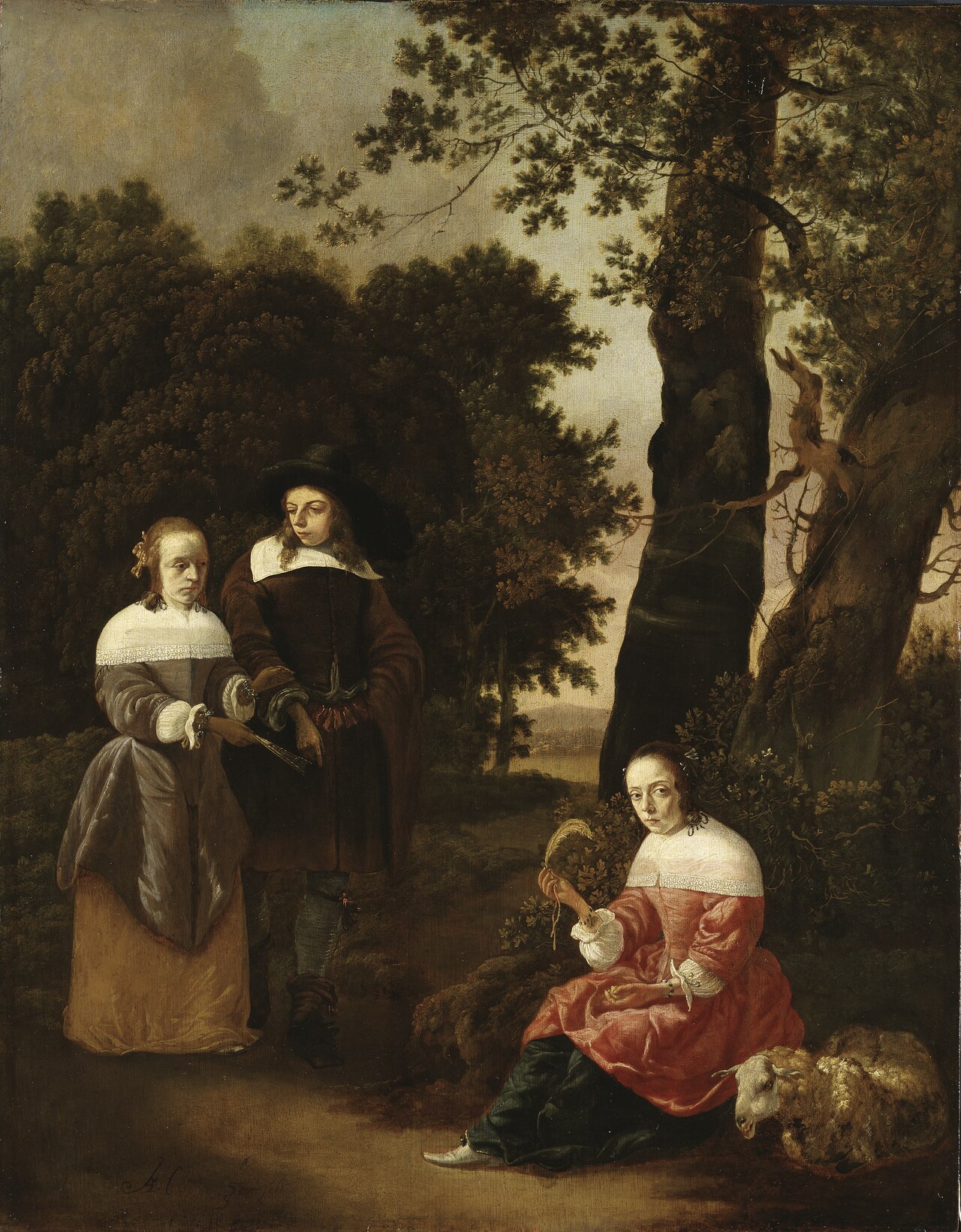
Major works Among the few works that can be confidently attributed to van der Burgh, several stand out. *A Couple and a Shepherdess in a Landscape* (1661) depicts a pastoral scene where a young couple watches a shepherdess, the composition balanced between figures and open countryside, showcasing his ability to blend genre narrative with landscape.
*The dentist and the angry dog* is a humorous genre piece that captures a moment of tension between a dental practitioner and an aggressive canine, illustrating van der Burgh’s interest in everyday drama and his skill at rendering animal anatomy.
*The conferring of a degree at the University of Leiden around 1650* (dated 1650) records an academic ceremony, a rare subject for Dutch genre painters. The work documents the academic regalia and the solemn atmosphere of the occasion, offering valuable visual evidence of 17th‑century university life.
*Drinkers before the Fireplace* portrays three men sharing a drink beside a glowing hearth, a classic Delft interior that emphasizes the warm light reflected on faces and glassware. The scene is intimate, with a maidservant subtly included in the background, hinting at the social hierarchy within domestic spaces.
*Interior with three men and a maidservant before a hearth* (1655) expands on the same motif, adding a sense of narrative tension as the men converse while the maid tends to the fire. The careful placement of objects—casks, candlesticks and a tiled floor—demonstrates van der Burgh’s compositional precision.
These works collectively illustrate his thematic focus on domestic interiors, academic ceremonies and occasional pastoral or comic subjects. Though relatively few, they provide a coherent picture of his artistic concerns and technical competence.
Influence and legacy Hendrick van der Burgh remains a modest figure in the broader narrative of Dutch Golden Age painting, largely because his output was limited and documentation scarce. Nevertheless, his connections to Pieter de Hooch and his participation in the Delft School place him within an important artistic network. Later collectors and scholars have recognised his works for their quiet realism and subtle humour, and his prints have been valued for their fine engraving technique.
In recent decades, art historians have re‑examined lesser‑known genre painters to broaden the understanding of Dutch visual culture. Van der Burgh’s paintings are now cited in studies of domestic interior representation, particularly for their depiction of middle‑class life and the role of servants. While he did not found a distinct movement, his works contribute to the rich tapestry of 17th‑century Dutch genre painting and continue to be exhibited in specialised exhibitions on Delft artists. His monogram "HVB" aids curators in attributing unsigned works, ensuring that his modest yet distinct contribution is not lost to history.
Overall, Hendrick van der Burgh exemplifies the skilled, if understated, practitioner whose work offers insight into everyday Dutch life during the Golden Age, complementing the more celebrated achievements of his contemporaries.
Frequently asked questions
Who was Hendrick van der Burgh?
He was a Dutch Golden Age painter (1627–1664) from Delft, known for genre scenes, portraits and prints signed with the monogram HVB.
What artistic style or movement is he associated with?
Van der Burgh is linked to the Delft School, characterised by clear lighting, restrained colour and domestic interior subjects.
What are his most famous works?
Key works include *A Couple and a Shepherdess in a Landscape* (1661), *The dentist and the angry dog*, *The conferring of a degree at the University of Leiden* (1650), *Drinkers before the Fireplace*, and *Interior with three men and a maidservant before a hearth* (1655).
Why is Hendrick van der Burgh important in art history?
He provides a nuanced view of middle‑class Dutch life, contributes to the genre tradition of the Delft School, and his prints demonstrate fine engraving technique.
How can I recognise a van der Burgh painting?
Look for calm domestic interiors illuminated by soft, natural light, a muted palette, smooth brushwork, and the discreet "HVB" monogram in the lower corner.