Hendrick van Anthonissen
1605 – 1655
In short
Hendrick van Anthonissen (1605–1655) was a Dutch marine painter from Amsterdam, active during the Dutch Golden Age. He specialised in seascapes and naval scenes, producing works that document 17th‑century maritime activity in the Netherlands and abroad.
Notable works



_-_Shipping_in_a_Gale_-_BHC0790_-_Royal_Museums_Greenwich.jpg)
Early life Hendrick van Anthonissen was born in Amsterdam in 1605, into a family already linked to the visual arts. His father, Jan Anthonisz. van Ravesteyn, was a painter who worked in the flourishing market for genre and landscape images that characterised the early Dutch Republic. Growing up in Amsterdam, Hendrick would have been exposed to the bustling harbour, the ship‑yards of the Zuiderzee, and the vibrant trade routes that made the city a centre of maritime commerce. This environment provided both the visual material and the commercial demand that shaped his later career as a marine painter.
Career and style Van Anthonissen began his professional activity in the 1620s, at a time when marine painting was emerging as a distinct genre within Dutch art. The Dutch Republic’s naval successes and expanding trade created a market for depictions of ships, harbours and sea battles. Van Anthonissen’s work aligns with this trend, focusing on realistic, topographically accurate representations of maritime scenes. His palette often combined muted earth tones for the sky and water with brighter accents for flags, sails and lanterns, a balance that conveyed both the atmosphere of the sea and the drama of human activity upon it.
Although contemporary records do not assign him to a formal artistic movement, his output shares characteristics with the Dutch Golden Age marine painters such as Jan Porcellis and Willem van de Velde the Elder. Like his peers, van Anthonissen favoured a somewhat restrained approach to composition, allowing the sea and sky to dominate the picture plane while ships serve as narrative anchors. His works typically avoid overt allegory, instead presenting a documentary quality that appealed to merchants, ship‑owners and civic authorities who commissioned or purchased such pieces.
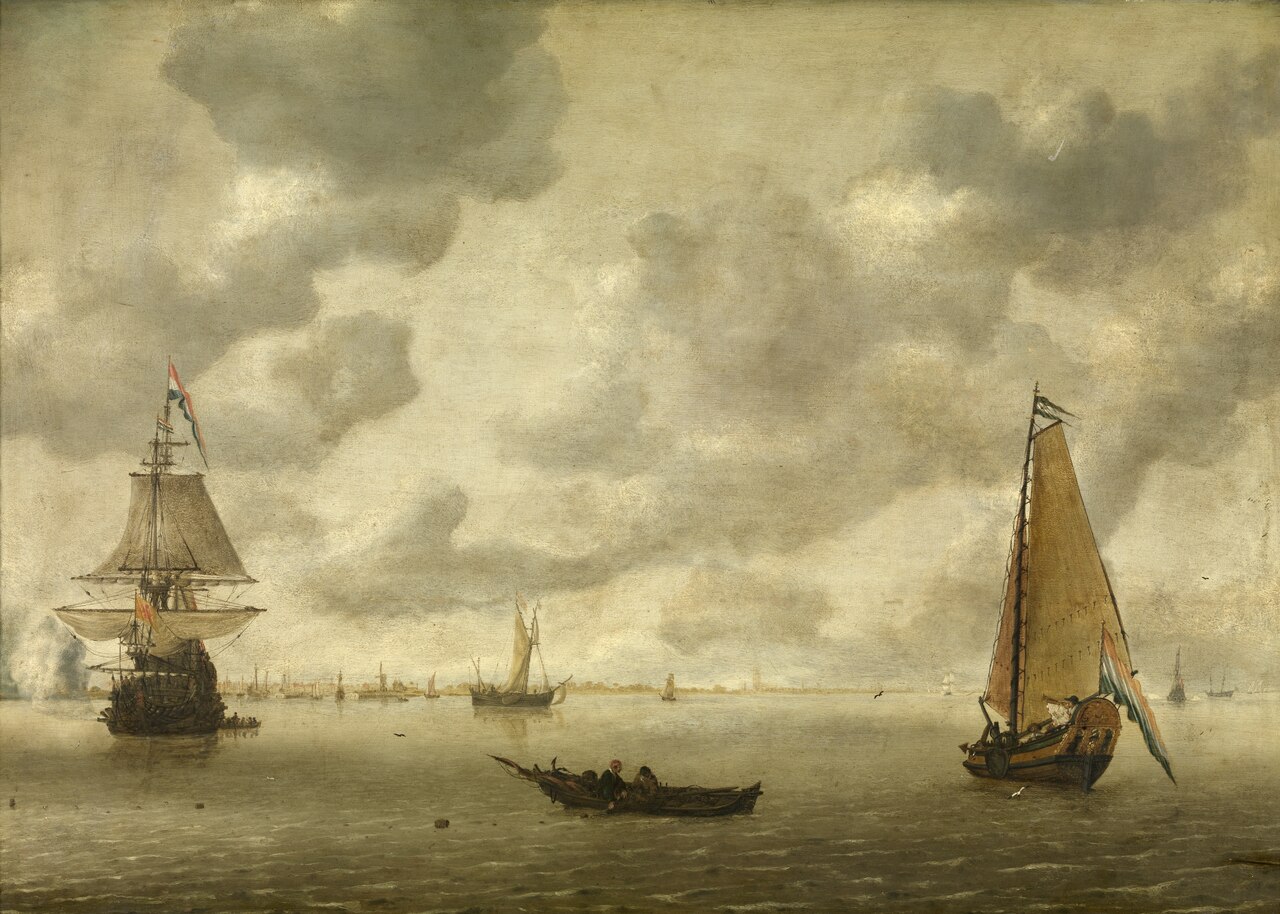
Signature techniques Van Anthonissen’s paintings are distinguished by several technical hallmarks. First, he employed a careful handling of light to suggest the time of day and atmospheric conditions; the reflection of sunlight on water surfaces is rendered with fine, horizontal brushstrokes that convey movement. Second, his rendering of ships demonstrates an attention to hull form, rigging and sail layout, suggesting that he consulted ship‑builders’ plans or observed vessels directly. Third, he often used a limited but nuanced colour range for the sea, employing layered glazes to achieve depth and a sense of translucency. Finally, his compositions frequently incorporate a low horizon line, a device that expands the sky and gives the viewer a sense of vastness, while still allowing sufficient detail in the foreground to depict bustling harbours or storm‑tossed vessels.
Major works - **Surprise attack on three Portuguese galleons in the Bay of Goa, 30 September 1639 (1653)** – This large canvas depicts a dramatic naval engagement far from Dutch waters, reflecting the global reach of the Dutch East India Company. Van Anthonissen captures the chaos of battle with a storm‑lit sky and splintering masts, while maintaining meticulous detail in the ships’ hulls and flags. - **Shipping on the east Schelde near the Zuidhavenpoort, Zierikzee (1650)** – A quieter scene showing merchant vessels navigating the Schelde river. The work demonstrates the painter’s ability to render calm water, gentle light, and the architectural elements of the Zuidhavenpoort, offering a valuable record of local infrastructure. - **Dutch ships in a harbour firing salute (1645)** – In this composition, a fleet lines the harbour, their cannons raised in salute. The painting combines a sense of civic pride with a precise depiction of ship types used by the Dutch navy, underscoring van Anthonissen’s role as a chronicler of national maritime power. - **View of Scheveningen Sands (1630)** – An early work that focuses on the shoreline rather than vessels, showing the expansive sands of Scheveningen under a cloudy sky. The piece illustrates his skill in rendering coastal geography and the atmospheric effects of wind‑blown dunes. - **Shipping in a Gale (1656)** – Although dated after his death, this work is often attributed to his workshop or followers. It portrays a fleet struggling against a fierce storm, with towering waves and dark clouds, highlighting the dramatic potential of the marine genre.
These paintings collectively demonstrate van Anthonissen’s range—from tranquil riverine scenes to violent sea battles—and his dedication to documenting the maritime world of the 17th‑century Dutch Republic.
Influence and legacy Hendrick van Anthonissen contributed to the solidification of marine painting as a respected genre within Dutch art. His meticulous approach to ship depiction influenced younger marine painters who sought accuracy alongside atmospheric effect. While he never achieved the fame of contemporaries such as Willem van de Velde the Elder, his works remain valuable to historians for the visual information they provide about Dutch naval vessels, harbour architecture and the broader maritime economy.
Modern scholarship recognises van Anthonissen as a representative figure of the Dutch marine tradition, whose paintings are held in several European museum collections. His legacy persists in the way marine art balances documentary precision with aesthetic composition—a model that continues to inform contemporary seascape painters and illustrators of nautical history.
Frequently asked questions
Who was Hendrick van Anthonissen?
He was a Dutch marine painter born in Amsterdam in 1605 who specialised in seascapes and naval scenes until his death in 1655.
What artistic style or movement is he associated with?
Van Anthonissen worked within the Dutch Golden Age marine painting tradition, emphasizing realistic ship detail and atmospheric sea conditions.
Which of his works are most famous?
His best‑known paintings include ‘Surprise attack on three Portuguese galleons in the Bay of Goa’ (1653), ‘Shipping on the east Schelde near the Zuidhavenpoort, Zierikzee’ (1650) and ‘Dutch ships in a harbour firing salute’ (1645).
Why is Hendrick van Anthonissen important in art history?
He helped establish marine painting as a serious genre, providing accurate visual records of 17th‑century Dutch naval and commercial activity.
How can I recognise a Hendrick van Anthonissen painting?
Look for a low horizon line, detailed ship rigging, muted colour washes for sea and sky, and a focus on light that highlights atmospheric conditions.