Hendrick Berckman
1629 – 1679
In short
Hendrick Berckman (1629–1679) was a Dutch Baroque painter from the Golden Age, noted for his formal portraiture of naval and civic figures, especially admirals of the United Provinces.
Notable works
,_luitenant-admiraal_van_Zeeland,_SK-A-36.jpg)
._Predikant_te_Vlissingen._Rijksmuseum_SK-A-1643.jpeg)
._Luitenant-admiraal_van_Zeeland,_SK-A-1644.jpg)
_-_C1765_-_Cultural_Heritage_Agency_of_the_Netherlands_Art_Collection.jpg)
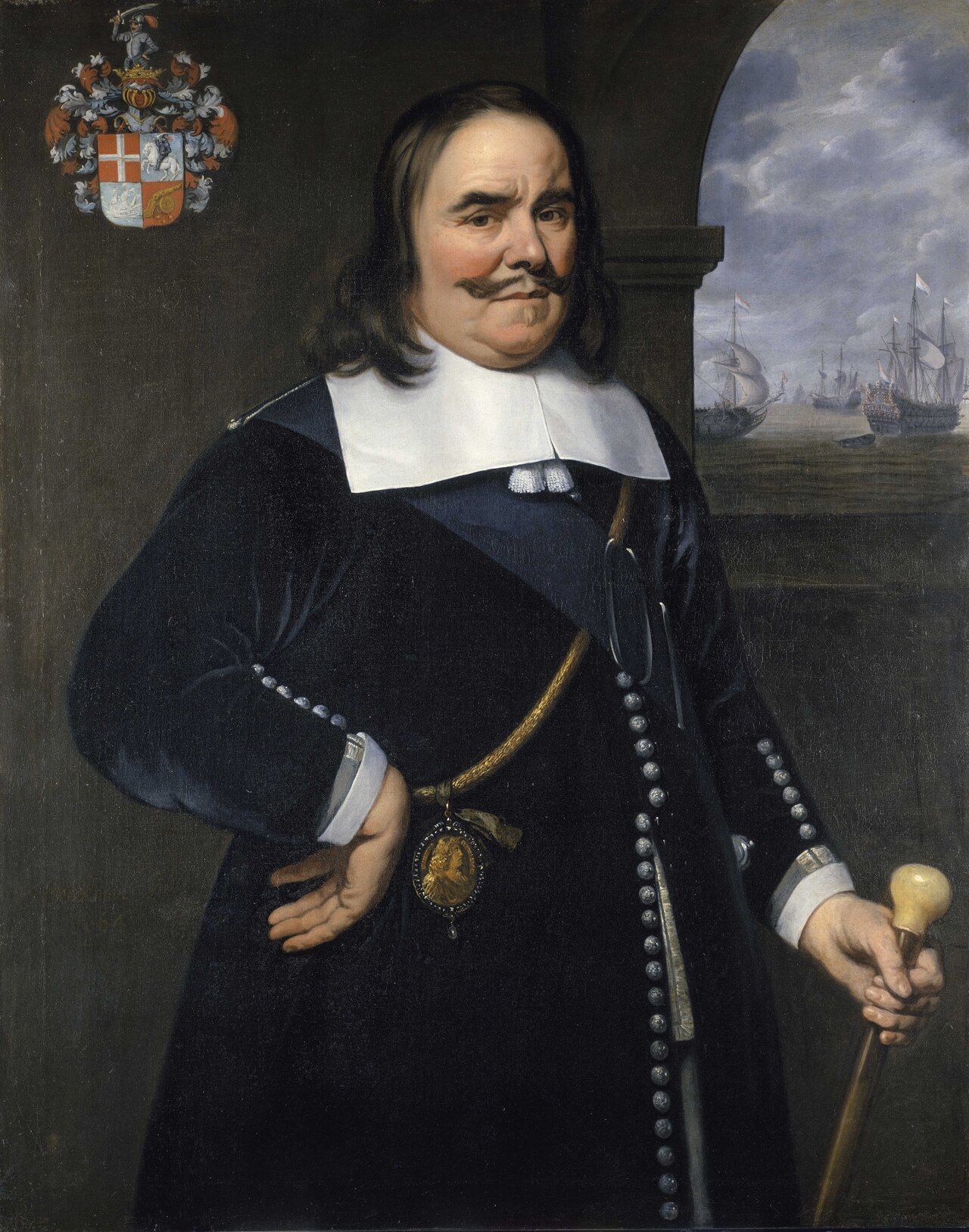
Early life Hendrick Berckman was born in 1629 in the small town of Klundert, located in the southern part of the Dutch Republic. Little is documented about his family background, but the region’s thriving mercantile activity and proximity to major artistic centres such as Rotterdam and Antwerp would have provided early exposure to the visual culture of the Dutch Golden Age. Apprenticeship was the typical route into the profession, and it is probable that Berckman trained under a local master before moving to a larger city to refine his skills. By the mid‑1650s he had established himself in Middelburg, a prosperous port city with a vibrant artistic community that attracted patrons from the naval and commercial sectors.
Career and style Berckman’s career unfolded during the height of Dutch Baroque portraiture, a period characterised by a blend of realism, dramatic lighting, and a heightened sense of status. Working primarily for the elite of Zeeland—admirals, ministers, and wealthy merchants—he produced formal, life‑size portraits that combined sober realism with the subtle grandeur expected by his patrons. His compositions often place the sitter against a dark, neutral background, allowing the figure’s attire and insignia to dominate the visual field. The colour palette is restrained, favouring deep blacks, muted blues, and the warm ochres of flesh tones, reflecting the sober aesthetic of Dutch civic portraiture.
Berckman’s style shows the influence of contemporaries such as Pieter Cornelisz van Rijck and the broader Dutch tradition of portraiture pioneered by Rembrandt and Frans Hals, yet he retains a distinctive clarity of line and a meticulous attention to the details of clothing, insignia, and facial features. This precision made his works particularly valuable to patrons who wanted accurate visual records of their rank and achievements.
Signature techniques Berckman’s technique is marked by several recurring elements:
* Chiaroscuro modelling – He employs a controlled contrast of light and shadow to model the face and hands, creating a three‑dimensional effect while keeping the background uniformly dark. * Fine brushwork on fabrics – The textures of silk, velvet, and lace are rendered with delicate, layered brushstrokes that convey the sheen and weight of the garments. * Meticulous rendering of insignia – Rank badges, swords, and naval decorations are painted with exacting detail, underscoring the sitter’s status. * Limited colour harmonies – A restrained palette of earth tones and deep blues keeps the focus on the sitter’s expression and attire, rather than on decorative background elements. * Subtle glazes – Thin layers of translucent paint are applied over flesh tones to achieve a luminous quality, especially in the depiction of skin and hair.
These techniques together give his portraits a dignified realism that was prized by the civic and military elite of the Dutch Republic.
Major works Berckman’s surviving oeuvre is dominated by portraiture of prominent naval figures, reflecting the maritime power of the United Provinces in the 17th century.
* Adriaen Banckert, Vice Admiral of Zeeland (1673) – This portrait presents the admiral in full dress, his tricorn hat and gilded epaulettes rendered with precise brushwork. The dark backdrop heightens the contrast of his white lace cuffs and the deep reds of his coat, emphasizing both rank and personal gravitas.
* Adriaen Banckert (c. 1620‑1684), Vice Admiral of Zeeland (1700) – A later version, likely commissioned post‑humously, repeats the compositional formula of the 1673 portrait but introduces a more pronounced chiaroscuro, giving the admiral a slightly more heroic, almost mythic presence.
* Thomas Pots (1618‑1689), Minister at Vlissingen (1661) – In this civic portrait, Berckman captures the minister in sober attire, his hands folded on a table that bears a subtle hint of official documents. The work reflects the restrained elegance expected of a public servant, with a focus on the sitter’s dignified expression.
* Portrait of Michiel Adriaensz. de Ruyter (1672) – Perhaps the most celebrated of Berckman’s works, this portrait of the famed Dutch admiral shows de Ruyter in a dark naval coat, his gaze directed slightly off‑canvas, conveying both authority and contemplation. The painting’s careful rendering of the admiral’s facial features and the intricate detailing of his medals make it a valuable historical record.
* Michiel Adriaenszoon de Ruyter, Lieutenant‑Admiral‑General of the United Provinces (1664) – An earlier portrait of de Ruyter, this piece emphasizes his youthful vigor, with a brighter palette and a more open posture. The contrast between the 1664 and 1672 portraits illustrates Berckman’s ability to adapt his style to the evolving status of his subjects.
These works collectively demonstrate Berckman’s role as a chronicler of the Dutch naval elite, preserving the visual identity of the Republic’s maritime heroes for posterity.
Influence and legacy While Hendrick Berckman never achieved the fame of Rembrandt or Vermeer, his contributions to Dutch portraiture are significant for several reasons. First, his portraits provide a reliable visual archive of the political and military leaders who shaped the Dutch Republic’s golden era. Second, his disciplined approach to rendering uniforms and insignia set a standard for later portraitists tasked with documenting official figures. Finally, his work exemplifies the Baroque synthesis of realism and dignified presentation that characterised Dutch civic art, influencing subsequent generations of portrait painters in Zeeland and beyond.
Berckman’s paintings are held in regional museums, such as the Zeeuws Museum in Middelburg, and continue to be studied for their technical finesse and historical relevance. Modern scholars view his oeuvre as a bridge between the high drama of Baroque portraiture and the restrained naturalism that defined much of Dutch Golden Age art. Through his meticulous depictions of naval heroes, Berckman contributed to the visual mythology of the Dutch Republic, a legacy that endures in the collective memory of maritime history.
Frequently asked questions
Who was Hendrick Berckman?
Hendrick Berckman (1629–1679) was a Dutch Baroque painter known for his formal portraiture of naval and civic leaders during the Dutch Golden Age.
What artistic movement did he belong to?
He worked within the Baroque style, combining realistic detail with dramatic lighting typical of 17th‑century Dutch portraiture.
What are his most famous works?
His most celebrated works include portraits of Admiral Michiel de Ruyter (1664 and 1672) and Vice Admiral Adriaen Banckert (1673 and a later 1700 version), as well as a portrait of Minister Thomas Pots.
Why is Berckman important in art history?
Berckman provides a vital visual record of the Dutch Republic’s naval elite, and his precise rendering of uniforms and insignia set a standard for official portraiture in the Netherlands.
How can I recognise a painting by Hendrick Berckman?
Look for a dark, neutral background, meticulous detailing of military dress and medals, restrained colour palettes, and a subtle chiaroscuro that models the sitter’s face and hands.