Hans Olde
1855 – 1917
In short
Hans Olde (1855–1917) was a German painter associated with Impressionism, known for his depictions of rural life and motherhood. He also served as an art school administrator, influencing a generation of German artists.
Notable works



Early life Hans Olde was born in 1855 in the small town of Süderau, located in the northern part of what was then the German Empire. Little is recorded about his family background, but the rural environment of his youth left a lasting imprint on his artistic sensibility. From an early age he showed an aptitude for drawing, sketching the countryside and its seasonal rhythms. By his late teens he had moved to larger cultural centres to pursue formal training, enrolling in regional art academies where he was introduced to the emerging trends of European painting.
Career and style After completing his studies, Olde established himself as a professional painter in the 1880s. He quickly aligned with the Impressionist movement, which had begun to spread beyond France into Germany’s artistic circles. Olde’s work reflected the core tenets of Impressionism: an emphasis on capturing fleeting light, a loose handling of brushstrokes, and a preference for everyday subjects over historical or mythological themes. His palette softened into pastel tones, often dominated by muted greens, blues, and earth colours that evoked the quiet atmosphere of northern German landscapes.
In addition to his studio practice, Olde took on an administrative role in art education. He was appointed to a senior position at a notable German art school, where he helped shape curricula that integrated modern techniques with traditional drawing instruction. His dual identity as both practitioner and educator positioned him as a conduit between the avant‑garde impulses of Impressionism and the more conservative expectations of German art institutions.
Signature techniques Olde’s paintings are recognisable for several recurring technical features. He favoured rapid, fluid brushwork that suggested form without detailing every edge, a hallmark of the Impressionist approach. Light was treated as a mutable element; he often painted en plein air to record the specific quality of daylight, whether the golden glow of a harvest afternoon or the crisp pallor of a winter morning. Colour modulation was achieved through thin layers of pigment, allowing underlying tones to shine through and create a luminous effect. In his figure work, Olde employed a restrained palette that highlighted the emotional tone of the scene rather than the precise anatomy of his subjects.
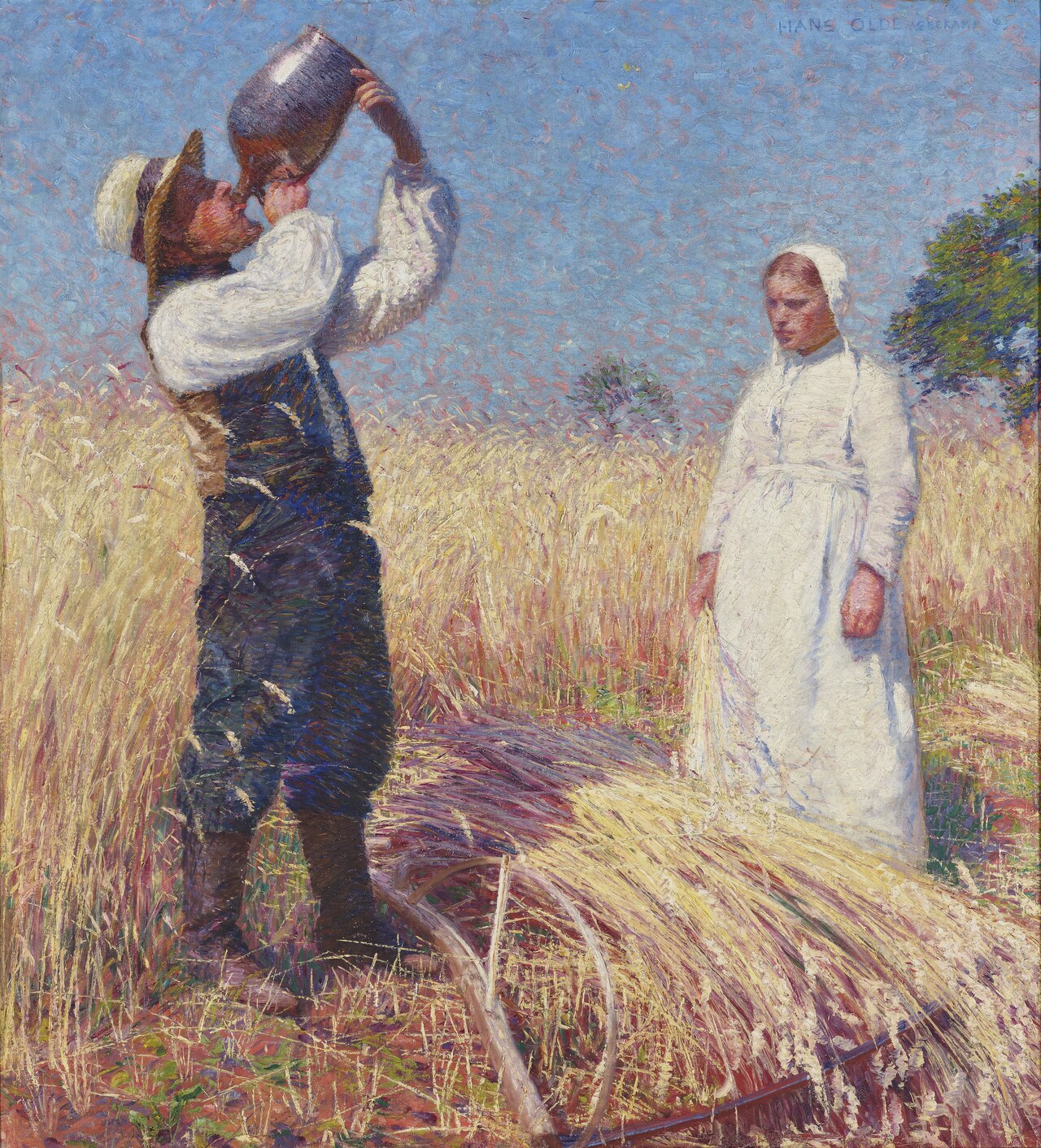
Major works **Der Schnitter (1893)** – This canvas portrays a solitary reaper in the midst of a golden field. The figure is rendered with minimal detail, the focus being the play of sunlight on the wheat and the rhythmic sweep of the scythe. The work exemplifies Olde’s ability to merge landscape and labour, using loose brushstrokes to convey movement and the transient quality of the harvest season.
Harvesting (1893) – Similar in theme to *Der Schnitter*, this piece expands the composition to include multiple workers. The artist captures a bustling yet harmonious scene, where the collective effort is suggested through overlapping strokes rather than precise delineation. The colour scheme shifts from warm ochres to cooler greens, reflecting the varied tones of a ripening field.
Woman with children under the apple tree (Motherhood) (1895) – In this intimate genre painting, Olde turns his attention to domestic affection. A mother seated beneath an apple tree cradles her children, the foliage providing dappled shade. The soft handling of light on the figures and the subtle green‑brown backdrop underscore the tenderness of the moment, while the impressionistic style keeps the focus on atmosphere rather than narrative detail.
Winter in Seekamp (1895) – This winter landscape captures a snow‑blanketed village with muted blues and greys. Olde’s technique of layering thin washes of colour creates a sense of depth beneath the surface of the snow. The composition includes faint outlines of houses and distant trees, allowing the viewer to feel the stillness and chill of a German winter.
Influence and legacy Hans Olde’s contribution to German Impressionism lies both in his own paintings and in his role as an educator. By applying the principles of Impressionism to distinctly German subjects—rural labour, family life, and regional landscapes—he helped localise an international movement, making it resonant for German audiences. His administrative tenure at an art school meant that he mentored younger artists, encouraging them to experiment with light and colour while maintaining a solid grounding in drawing skills.
Although Olde never achieved the fame of his French counterparts, his works remain valuable records of late‑19th‑century northern German life. Museums in Kassel and surrounding cities hold several of his canvases, and his paintings are frequently cited in studies of German Impressionism for their authentic representation of everyday labour and domesticity. Modern scholars view Olde as a bridge figure: one who preserved the technical rigour of academic training while embracing the liberating visual language of Impressionism.
Today, Olde’s paintings continue to be exhibited in retrospectives that explore the diffusion of Impressionist aesthetics beyond France. His legacy persists in the teaching methods he championed—particularly the emphasis on observing natural light—a principle that still underpins contemporary art curricula in Germany.
Frequently asked questions
Who was Hans Olde?
Hans Olde (1855–1917) was a German painter and art school administrator associated with the Impressionist movement.
What artistic style or movement is he linked to?
He worked within Impressionism, focusing on light, colour, and everyday rural subjects.
What are his most famous works?
His best‑known paintings include *Der Schnitter* (1893), *Harvesting* (1893), *Woman with children under the apple tree (Motherhood)* (1895), and *Winter in Seekamp* (1895).
Why is Hans Olde important in art history?
Olde helped localise Impressionism in Germany and, as an art school administrator, influenced a generation of artists by promoting modern techniques alongside traditional training.
How can I recognise a painting by Hans Olde?
Look for loose, fluid brushwork, a muted pastel palette, and subjects that depict rural labour or domestic scenes bathed in natural light.