Hans Knieper
? – 1587
In short
Hans Knieper was a Flemish painter and draughtsman from Antwerp who worked as court painter and tapestry designer for the Danish royal family in the late 16th century, dying in Helsingør in 1587.
Notable works


Early life Hans Knieper was born in Antwerp, a major artistic centre of the Habsburg Netherlands, sometime in the early half of the 16th century. The exact year of his birth is not recorded, but his formative years would have been spent amid the vibrant workshop culture that characterised Flemish art at the time. Antwerp’s guild system provided rigorous training for apprentices, and Knieper likely completed a traditional apprenticeship in a local painter’s workshop, gaining proficiency in both panel painting and the intricate design work required for tapestries.
Career and style Around the 1570s, Knieper’s reputation as a capable draughtsman attracted the attention of foreign patrons. In the early 1580s he entered the service of the Danish court, becoming the principal painter and tapestry cartoon designer for King Frederik II. The court’s ambition to modernise its visual culture coincided with a broader European trend of importing Flemish artistic expertise, and Knieper’s arrival in Denmark reflected that exchange.
Knieper’s style blended the detailed naturalism of the Northern Renaissance with a courtly elegance suited to royal commissions. His compositions often feature precise anatomical rendering, careful modelling of drapery, and a restrained colour palette that highlights the dignity of his subjects. While he did not align himself with a specific movement, his work demonstrates the influence of late‑Renaissance Flemish masters such as Pieter Coecke van Aelst and the broader Mannerist currents that were spreading across Europe.
Signature techniques Knieper’s dual practice as painter and tapestry designer gave him a distinctive technical vocabulary. In his paintings he employed a layered glazing technique, building depth through successive thin oil layers—a method common among Antwerp artists. For tapestry cartoons he produced full‑scale, highly detailed drawings that served as templates for weavers. These cartoons displayed a meticulous attention to line, with clear delineation of folds and textures that translated effectively into the woven medium. His ability to render complex spatial arrangements on a flat surface made his designs especially prized for large‑scale court commissions.
Major works Among Knieper’s most notable projects is the **Frederik II’s canopy** (1585). This ceremonial canopy, intended for royal processions, combined painted panels with richly woven textile elements, showcasing his skill in integrating painted and woven materials. The design features allegorical figures that celebrate the monarch’s virtues, framed by a sumptuous border of gold‑threaded tapestry.
The Kronborg Tapestries (1581) constitute another landmark achievement. Commissioned for the newly‑completed Kronborg Castle, the series depicts scenes from classical mythology and contemporary naval triumphs. Knieper supplied the full‑size cartoons, which were then executed by a Danish weaving workshop under his supervision. The tapestries remain celebrated for their narrative clarity and the subtle interplay of colour that evokes the sea‑lit atmosphere of the castle’s harbour.
Knieper also painted a Portrait of Frederik II, a formal likeness that emphasises the king’s regal bearing through a restrained background and careful rendering of fabric and insignia. Though the original panel has been lost, copies and later references indicate a composition that aligns with the conventions of Northern court portraiture, balancing realism with symbolic representation.
A lesser‑documented Painting (1580) attributed to Knieper shows his early adoption of Mannerist pose and elongated figures, suggesting an experimental phase before his court appointment. The work’s subject is unknown, but stylistic analysis points to his Flemish training and his willingness to explore dramatic chiaroscuro.
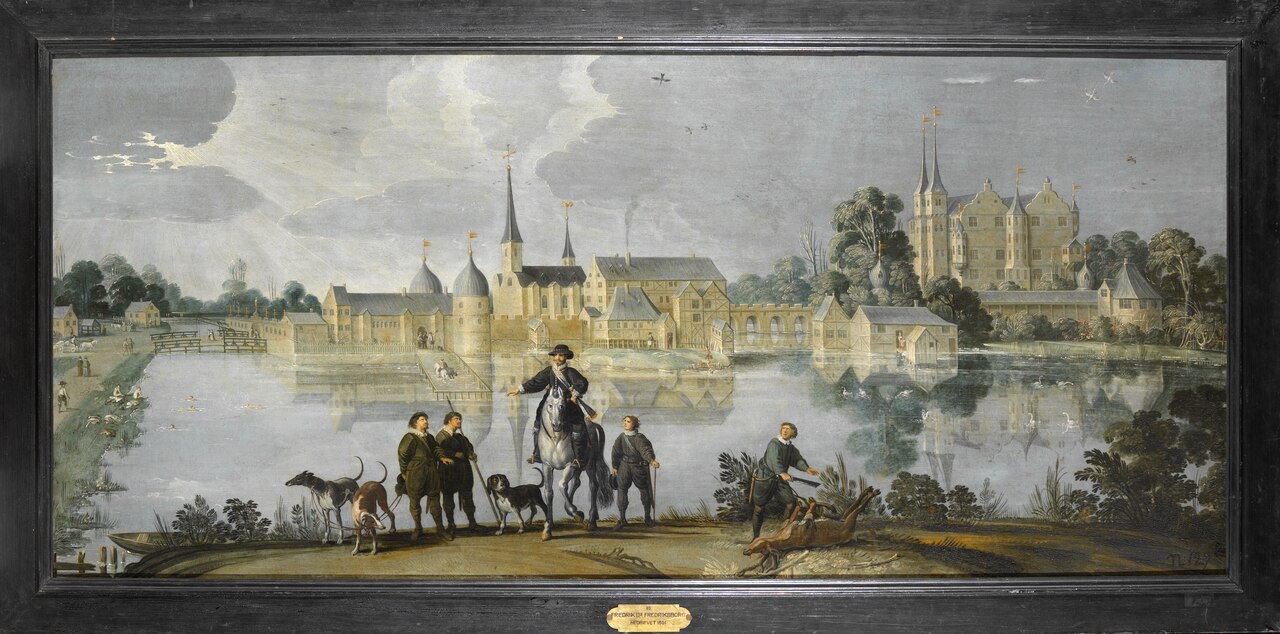
Finally, the Frederiksborgs slott i Danmark (1600), a posthumous depiction of Frederiksborg Castle, demonstrates how later Danish artists used Knieper’s designs as a visual reference for royal architecture. While Knieper did not live to see the building’s completion, his earlier tapestries and cartoons provided a visual vocabulary that influenced the castle’s decorative programme.
Influence and legacy Hans Knieper’s impact on Danish art lies chiefly in his introduction of high‑quality Flemish tapestry design to the Scandinavian court. By establishing a workshop that produced both cartoons and finished tapestries, he helped raise the standards of textile art in Denmark, fostering a local tradition that persisted well into the 17th century. His integration of painted and woven media also encouraged subsequent Danish artists to experiment across disciplines, blurring the boundaries between fine art and decorative craft.
Although few of his original panels survive, documentary evidence and surviving tapestries confirm his role as a cultural conduit between the Low Countries and the Nordic kingdoms. Modern scholarship recognises Knieper as a key figure in the diffusion of Northern Renaissance aesthetics north of the Alps, and his surviving works are prized by museums for their technical excellence and historical significance. Today, his oeuvre provides valuable insight into the collaborative processes of courtly art production, illustrating how artists, patrons, and craftsmen co‑created visual narratives that reinforced royal authority during a period of burgeoning national identity.
Frequently asked questions
Who was Hans Knieper?
Hans Knieper was a Flemish painter and draughtsman from Antwerp who became the court painter and tapestry designer for the Danish royal family in the late 16th century.
What artistic style or movement is he associated with?
Knieper did not belong to a formal movement, but his work reflects the detailed naturalism of the Northern Renaissance combined with emerging Mannerist influences.
What are his most famous works?
His best‑known projects include Frederik II’s canopy (1585), the Kronborg Tapestries (1581), a portrait of Frederik II, a 1580 painting, and the posthumous depiction of Frederiksborg Castle (1600).
Why is Hans Knieper important in art history?
He introduced high‑quality Flemish tapestry design to Denmark, elevating the country’s decorative arts and serving as a cultural bridge between the Low Countries and the Nordic courts.
How can I recognise a work by Hans Knieper?
Look for meticulous line work, finely rendered drapery, a restrained colour palette, and the integration of painted detail with tapestry‑style textures that typify his court commissions.