Hanabusa Itchō
1652 – 1724
In short
Hanabusa Itchō (1652–1724) was a Japanese painter, calligrapher and haiku poet from Osaka who trained in the Kanō school before turning to a literati style. He is noted for works such as the Seven Gods of Good Fortune and the Hiyoshi‑Sannō Festival, and for his contribution to the development of a more personal, expressive Japanese painting tradition.
Notable works


Early life Hanabusa Itchō was born in 1652 in Osaka, a bustling commercial centre in the province of Settsu. Little is recorded about his family background, but contemporary sources indicate that he received an early education in the arts, learning both the fundamentals of Chinese‑style calligraphy and the basics of painting. Osaka’s vibrant merchant culture exposed him to a wide range of visual and literary influences, fostering an early appreciation for poetry, tea ceremony and the emerging urban aesthetic that would later inform his work.
Career and style Itchō’s formal artistic training began under the auspices of the Kanō school, the dominant official painting workshop of the Tokugawa shogunate. He studied with Kanō Yasunobu, a senior master whose workshop emphasised disciplined brushwork, precise composition and the use of gold leaf for decorative effect. During this apprenticeship Itchō acquired the technical proficiency that underpinned his later, more experimental practice.
By his late twenties Itchō had become disillusioned with the rigid conventions of the Kanō establishment. He gravitated instead towards the bunjin (literati) tradition, a movement inspired by Chinese scholar‑artists that prized personal expression, spontaneity and the integration of poetry, calligraphy and painting. Adopting the art‑name Hishikawa Waō among others, he began to produce works that blended the disciplined brush technique of his Kanō training with the freer, more emotive strokes associated with the literati. This synthesis gave rise to a distinctive style that was both technically assured and emotionally resonant.
Signature techniques Hanabusa Itchō is recognised for several recurring technical approaches:
* Dynamic brushwork – He employed varying pressure and speed to create fluid lines that suggested movement, particularly in depictions of foliage, birds and human figures. * Ink‑wash layering – By applying multiple washes of ink, often of differing tonal values, he achieved depth and atmospheric effects that enhanced the poetic mood of his scenes. * Integration of poetry – Itchō frequently inscribed his own haiku or classical Chinese verses directly onto the painting surface, allowing the textual element to interact with the visual composition. * Selective use of colour – While the majority of his works are monochrome, he introduced restrained touches of colour—typically vermilion or deep indigo—to highlight focal points such as blossoms or ceremonial garments.
These techniques collectively convey a sense of immediacy, as if the artist were capturing a fleeting moment of contemplation.
Major works The surviving corpus attributed to Itchō includes a handful of celebrated pieces:
1. Seven Gods of Good Fortune – A series of panels portraying the Shichifukujin, the traditional deities of prosperity. Itchō rendered each figure with a blend of formal composition and lively brushstroke, emphasizing their individual characteristics while maintaining a harmonious overall rhythm.
2. Hiyoshi‑Sannō Festival – This work depicts a bustling seasonal celebration in Kyoto, populated by musicians, dancers and participants in traditional costume. The painting’s bustling energy reflects Itchō’s interest in urban life and his ability to convey movement through swift, gestural lines.
3. Bird and plum blossoms (1650) – Although the date predates Itchō’s mature style, the piece is often cited as an early example of his fascination with nature. A solitary crane is rendered against a backdrop of delicate plum blossoms, the contrast between the bird’s stark silhouette and the soft petals illustrating his skill in balancing boldness with subtlety.
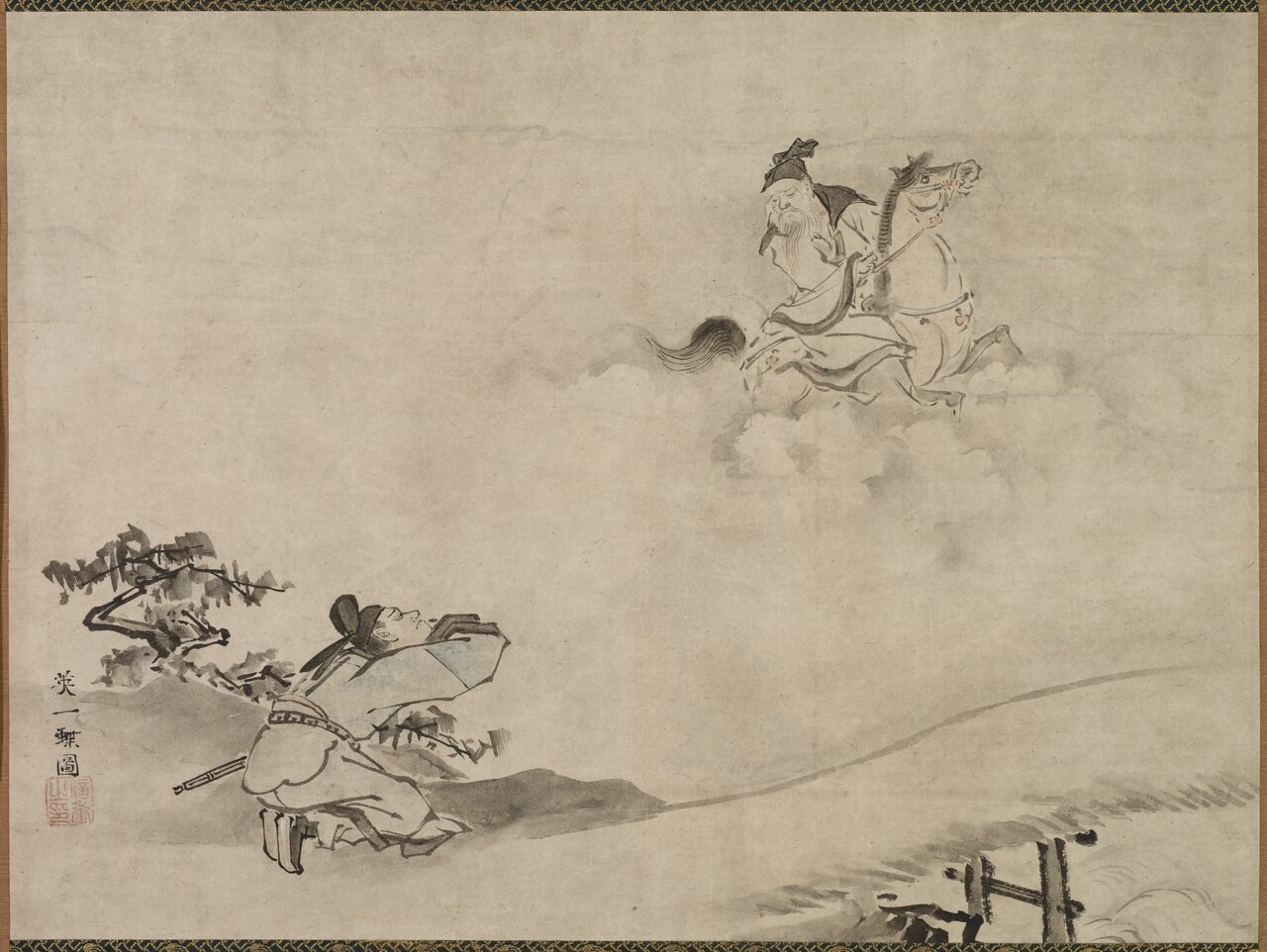
4. Ki no Tsurayuki Passing Aritoshi Shrine – This narrative painting illustrates the renowned Heian poet Ki no Tsurayuki on a pilgrimage. Itchō’s composition uses a restrained palette to focus attention on the poet’s contemplative posture, while the surrounding architecture is suggested with minimal brush marks.
5. Daoist Immortal (1741) – The date inscribed on this work post‑dates Itchō’s death in 1724, leading scholars to regard it as a later copy or attribution rather than an original. Nevertheless, the piece is consistent with his known style, featuring a serene immortal figure rendered in delicate ink washes.
These works collectively demonstrate Itchō’s versatility, ranging from mythological subjects to quotidian scenes, and his capacity to fuse literary content with visual expression.
Influence and legacy Hanabusa Itchō occupies a transitional position in Japanese art history. By moving away from the official Kanō aesthetic and embracing the literati spirit, he helped to broaden the scope of Edo‑period painting, encouraging subsequent artists to explore personal expression within a traditionally disciplined framework. His integration of haiku and calligraphy anticipates later developments in the nanga (Southern School) movement, which would further cement the relationship between poetry and painting.
Although Itchō’s name is not as widely recognised as that of his contemporary, Hishikawa Moronobu, his works continue to be studied for their technical mastery and their role in the evolution of Japanese brush painting. Collections in the Tokyo National Museum and several private holdings preserve his paintings, and modern exhibitions often include his pieces to illustrate the shift from rigid courtly art to a more individualistic, literati‑inspired approach.
In scholarly discourse, Itchō is frequently cited as an exemplar of the “artist‑poet” ideal, a figure who melded visual, literary and philosophical pursuits into a single creative identity. His legacy endures in the way contemporary Japanese artists reference his fluid brushwork and his willingness to interrogate the boundaries of established artistic conventions.
Frequently asked questions
Who was Hanabura Itchō?
Hanabusa Itchō (1652–1724) was a Japanese painter, calligrapher and haiku poet from Osaka who trained in the Kanō school before adopting a more personal literati style.
What artistic style or movement is he associated with?
He is associated with the Japanese literati (bunjin) tradition, blending disciplined Kanō techniques with the freer, expressive brushwork of Chinese scholar‑artist painting.
What are his most famous works?
His best‑known pieces include the Seven Gods of Good Fortune, the Hiyoshi‑Sannō Festival, Bird and plum blossoms (1650), Ki no Tsurayuki Passing Aritoshi Shrine, and the attributed Daoist Immortal.
Why is Hanabusa Itchō important in art history?
He helped bridge the formal Kanō school and the emerging literati aesthetic in Edo‑period Japan, influencing later artists to combine poetry, calligraphy and painting in a more personal, expressive manner.
How can I recognise a painting by Hanabusa Itchō?
Look for dynamic brushstrokes, subtle ink‑wash layering, occasional touches of colour, and the inclusion of poetic inscriptions that together convey a spontaneous, contemplative mood.