Guidoccio Cozzarelli
1450 – 1517
In short
Guidoccio Cozzarelli (1450–1517) was an Italian painter and miniaturist of the Sienese school. He worked mainly in Siena, producing religious and narrative panels that combine the decorative richness of the Gothic tradition with emerging Renaissance naturalism.
Notable works

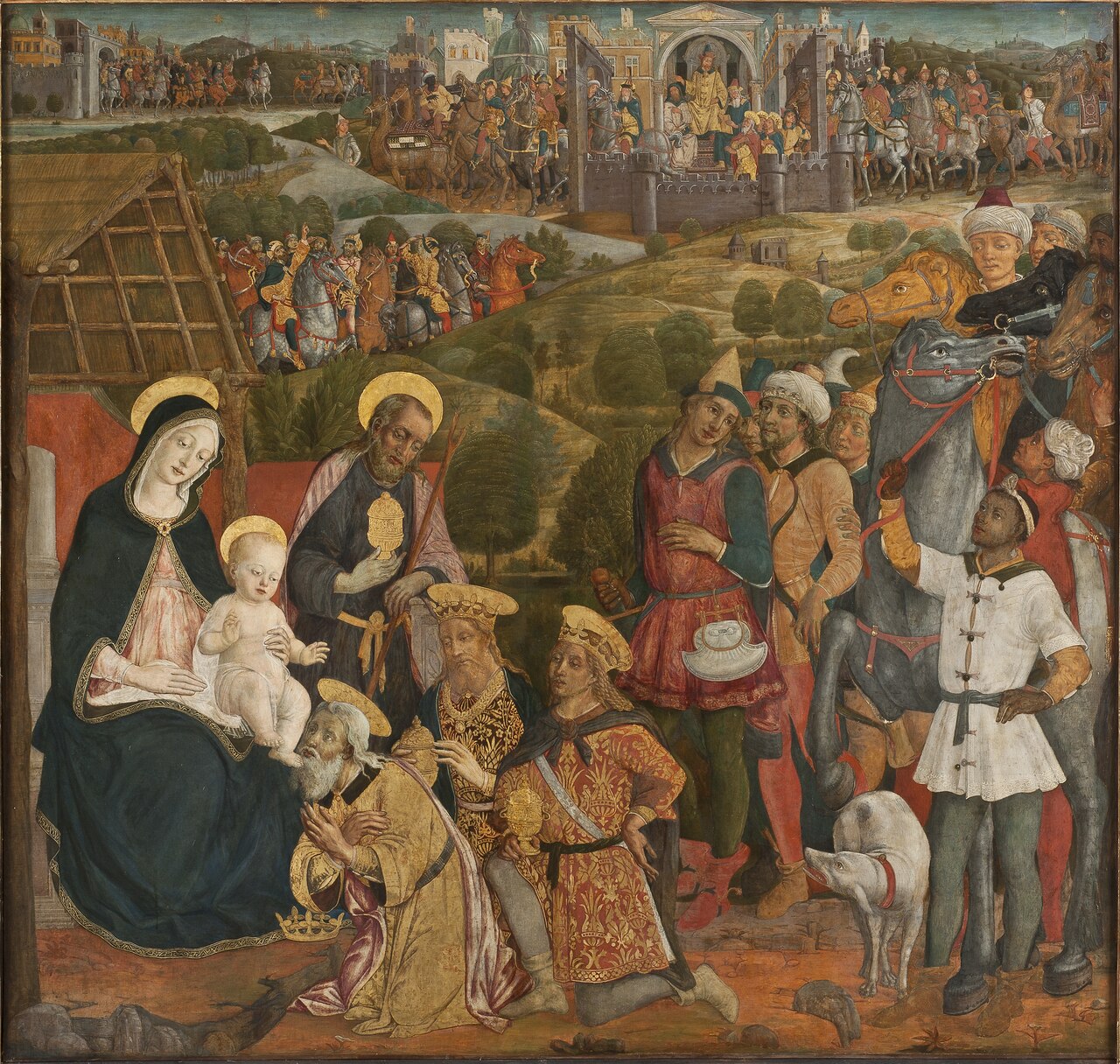

_-_Museum_Boijmans_Van_Beuningen.jpg)

Early life Guidoccio Cozzarelli was born in Siena in 1450, a city that retained a strong artistic identity despite the rise of Florence as the dominant centre of the Italian Renaissance. Little is known about his family background, but the civic records indicate that he grew up in a milieu of workshops that specialised in both panel painting and manuscript illumination. Siena’s artistic community at the time was characterised by close ties between painters, goldsmiths and tapestry makers, providing a fertile ground for a young artist to acquire a broad technical repertoire. Cozzarelli is believed to have begun his training in the studio of a local master, absorbing the distinctive colour palette and compositional conventions of the Sienese tradition.
Career and style Cozzarelli’s professional activity spanned the latter half of the 15th century and the early years of the 16th. He worked primarily for religious institutions, private patrons and the civic authorities of Siena. His oeuvre includes altarpieces, devotional panels and a series of narrative works that illustrate historical or mythological subjects. Stylistically, Cozzarelli remained faithful to the Sienese school’s emphasis on elegant line, refined surface treatment and a heightened sense of decorative harmony. At the same time, he incorporated a nascent interest in spatial depth and anatomical observation that reflected broader Renaissance currents. This synthesis resulted in paintings that retain the lyrical quality of earlier Sienese art while subtly engaging with the naturalistic concerns of his Florentine contemporaries.
Signature techniques Cozzarelli’s technique is recognisable through several recurring features. He favoured tempera on wood panels, a medium that allowed for fine, luminous layers of colour and precise detailing. Gold leaf is frequently applied to backgrounds, halos and decorative borders, echoing the city’s Gothic heritage. His brushwork is characterised by delicate, almost calligraphic lines that delineate drapery, foliage and facial features. In miniature work, Cozzarelli employed a meticulous approach to narrative sequencing, arranging figures in compact yet clearly legible groupings. The use of subtle chiaroscuro—light and shade—enhances the three‑dimensionality of his figures without abandoning the flat, decorative surface that defines much of Sienese painting.
Major works - **Return of the Noveschi to Sienne (1488)** – This panel depicts the celebrated return of the Noveschi, a governing body that had been exiled during the mid‑15th century. Cozzarelli renders the civic procession with a careful balance of portraiture and symbolic detail, employing a rich gold background to underscore the event’s ceremonial importance. The composition showcases his ability to integrate historical narrative with the ornamental style of Siena. - **Adoration of the Magi** – Though the exact date is uncertain, this work aligns with Cozzarelli’s mature period. The scene presents the biblical magi presenting gifts to the infant Christ, set against an architectural framework that hints at a nascent perspective. The figures are rendered with graceful gestures and vibrant garments, while the use of gold leaf on the star and the magi’s crowns reinforces the work’s devotional function. - **The Legend of Cloelia (1480)** – This narrative panel illustrates the Roman heroine Cloelia’s daring escape from captivity. Cozzarelli captures the drama of the moment through dynamic poses and a carefully constructed landscape that recedes into a muted horizon. The work demonstrates his skill in portraying mythological subjects while maintaining the decorative elegance typical of Sienese painting. - **Martyrdom of the Saints Simon and Thaddeus (1486)** – In this religious composition, the two apostles are shown undergoing martyrdom, a theme popular in Siena’s churches. Cozzarelli’s handling of the violent moment is tempered by a refined colour scheme and a composed arrangement of the saints’ expressions, reflecting the city’s preference for spiritual contemplation over graphic realism. - **Virgin and Child with Two Angels (1480)** – This intimate devotional panel features the Virgin Mary holding the Christ Child, flanked by two angels. The composition is centred, with the figures framed by a golden aureola that emphasizes their sanctity. The delicate modelling of the faces and the soft modelling of the drapery illustrate Cozzarelli’s mastery of tempera and his capacity for creating a serene, contemplative atmosphere.
Influence and legacy Guidoccio Cozzarelli occupies a distinctive niche within the late Gothic‑early Renaissance transition in central Italy. By maintaining the ornamental qualities of the Sienese school while subtly incorporating the naturalistic impulses of the broader Renaissance, he helped preserve a regional artistic identity that might otherwise have been eclipsed by Florentine dominance. His miniaturist techniques influenced subsequent generations of manuscript painters in Siena, who emulated his precise line work and balanced colour schemes. Moreover, his narrative panels demonstrate an early engagement with historical and mythological subjects that prefigured the more humanist themes adopted by later Sienese artists. Modern scholars regard Cozzarelli’s work as a valuable testament to the diversity of artistic practice in 15th‑century Italy, offering insight into how local traditions negotiated the sweeping changes of the Renaissance.
Frequently asked questions
Who was Guidoccio Cozzarelli?
Guidoccio Cozzarelli (1450–1517) was an Italian painter and miniaturist from Siena, known for his work within the Sienese school during the late 15th and early 16th centuries.
What artistic style or movement is he associated with?
He is associated with the Sienese school, a regional style that blended Gothic decorative elegance with emerging Renaissance naturalism.
What are his most famous works?
His most notable works include *Return of the Noveschi to Sienne* (1488), *Adoration of the Magi*, *The Legend of Cloelia* (1480), *Martyrdom of the Saints Simon and Thaddeus* (1486) and *Virgin and Child with Two Angels* (1480).
Why is Cozzarelli important in art history?
Cozzarelli exemplifies how local artistic traditions in Siena adapted to Renaissance ideas, preserving a distinctive decorative language while introducing subtle naturalistic elements.
How can I recognise a painting by Cozzarelli?
Look for tempera panels with fine, calligraphic line work, extensive use of gold leaf, elegant drapery, and a harmonious balance between decorative detail and modest spatial depth.