Giuseppe Nogari
1699 – 1766
In short
Giuseppe Nogari (1699–1766) was a Venetian Rococo painter renowned for intimate half‑body portraits of ordinary and historical figures, distinguished by subdued colour, emotional depth and dark backgrounds.
Notable works


_-_Paolo_Veronese_(1528-88)_-_RCIN_402787_-_Royal_Collection.jpg)
Early life Giuseppe Nogari was born in Venice in 1699, at a time when the city‑state was still a vibrant centre of artistic production. Little is known about his family background or early training, but the prevailing artistic climate of Venice—steeped in the legacy of masters such as Titian, Veronese and Tintoretto—provided a fertile environment for a young artist. Contemporary records suggest that Nogari likely entered a local workshop as an apprentice, where he would have been instructed in the fundamentals of drawing, colour mixing and the handling of oil paint. The Venetian emphasis on colouristic richness and atmospheric effects would later become a hallmark of his work.
Career and style Nogari emerged as an independent painter in the early decades of the 18th century, a period when the Rococo style was spreading across Europe. While the Rococo is often associated with light, decorative subjects, Nogari’s approach was more restrained. He specialised in half‑body portraits, a format that allowed him to focus on the sitter’s expression and psychological presence. His subjects ranged from anonymous youths and peasants to historical and religious figures, often rendered in modest, sometimes shabby clothing. This choice of attire, combined with a dark, unadorned background, created a striking contrast that heightened the emotional intensity of the image.
Nogari’s palette was notably subdued. Rather than the bright pastel tones typical of many Rococo works, he favoured muted ochres, deep browns and soft flesh tones. This restrained colour scheme, together with careful modelling of light, gave his figures a sense of immediacy and realism. The emotional content of his portraits—whether a quiet melancholy, a gentle introspection or a subtle hint of narrative—set him apart from contemporaries who favoured more decorative or idealised depictions.
In Venice, Nogari worked for both private patrons and public institutions. His ability to capture the inner life of his sitters made his portraits popular among the emerging bourgeoisie, who sought images that reflected personal identity rather than aristocratic grandeur. By the 1740s, his reputation had spread beyond the lagoon, and he received commissions that included portraits of notable artists, such as a posthumous representation of Paolo Veronese.
Signature techniques Nogadi’s technique can be identified by several recurring elements:
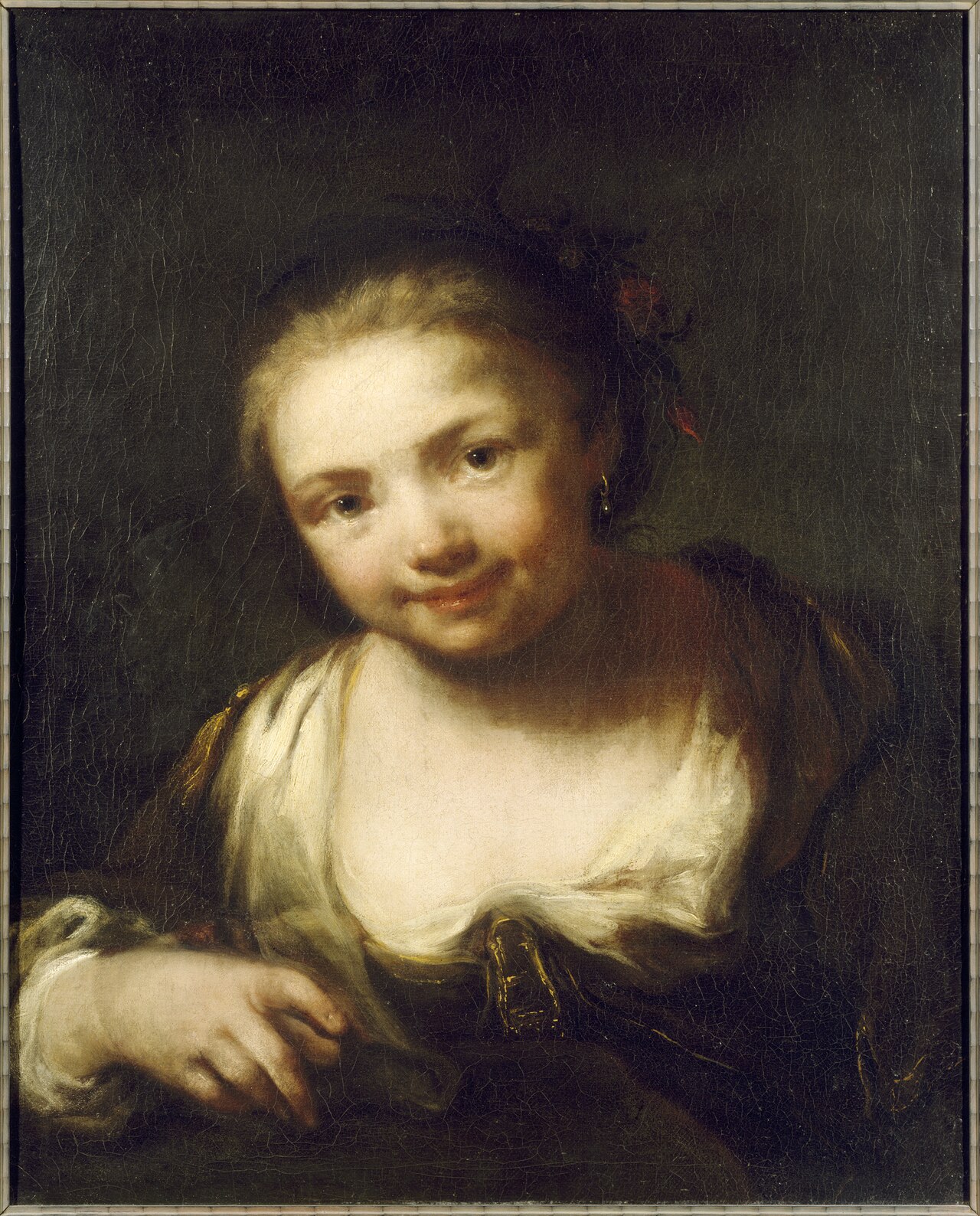
1. Half‑body format – He consistently painted figures from the waist up, allowing a focus on facial expression and upper gestures. 2. Dark, neutral backgrounds – A flat, often black or deep brown ground isolates the subject, emphasizing light and colour on the flesh. 3. Subdued palette – Earthy tones dominate, with occasional touches of richer colour to highlight accessories or fabrics. 4. Soft modelling of light – Light is rendered delicately across the face and hands, creating a gentle three‑dimensionality without harsh contrasts. 5. Attention to texture – The artist rendered fabrics, skin and objects with a tactile quality, often using fine brushwork to suggest the worn nature of clothing or the grain of a wooden basket.
These techniques combine to produce works that feel both intimate and timeless, inviting viewers to contemplate the lived experience of the sitter.
Major works Nogari’s oeuvre includes several works that exemplify his mature style:
- Young Girl – This portrait depicts a youthful figure in modest dress, her gaze directed slightly away from the viewer. The dark background and gentle lighting draw attention to the softness of her skin and the subtle turn of her head, suggesting a moment of quiet contemplation.
- A Girl with a Chicken (1725) – In this composition, a young girl holds a small chicken, an emblem of domesticity. The animal’s texture is rendered with meticulous brushwork, while the girl’s clothing is rendered in muted tones, underscoring the contrast between the lively creature and the subdued human presence.
- A Boy with a Basket of Fruit (1725) – This work presents a boy clutching a basket filled with assorted fruit. The fruit, rendered in richer hues, provides a focal point that breaks the overall restraint of the palette, while the boy’s expression remains modest, reflecting Nogari’s balance between narrative detail and emotional restraint.
- An Old Woman with a Distaff – Here Nogari portrays an elderly woman engaged in the act of winding thread. The distaff, a tool associated with domestic labour, is depicted with careful attention to wood grain and metal fittings. The sitter’s weathered face, illuminated against a dark backdrop, conveys a sense of dignity and resilience.
- Paolo Veronese (1740) – This later work is a posthumous portrait of the celebrated Venetian master Paolo Veronese. Nogari’s reverence for his predecessor is evident in the careful rendering of Veronese’s likeness, while the overall composition adheres to Nogari’s characteristic dark background and subdued lighting, linking past and present within a single visual language.
These works collectively illustrate Nogari’s commitment to portraying ordinary humanity with a depth of feeling that transcends the decorative tendencies of the broader Rococo movement.
Influence and legacy Although Giuseppe Nogari never achieved the fame of some of his Venetian contemporaries, his portraits exerted a subtle influence on later generations of Italian painters who sought to move beyond the flamboyance of high Rococo. By foregrounding emotional realism and modest attire, he anticipated aspects of the emerging Neoclassical sensibility that would dominate the late 18th century. His treatment of chiaroscuro and his focus on the interior lives of his subjects can be seen echoed in the works of later Venetian portraitists who embraced a more introspective approach.
In modern scholarship, Nogari is recognised as a bridge between the decorative exuberance of early Rococo and the more restrained, psychologically oriented portraiture that followed. His paintings are held in several Italian collections, and his works are occasionally exhibited in thematic shows exploring Venetian art beyond the grand narratives of the High Renaissance. As an artist who captured the everyday dignity of his sitters, Nogari remains a valuable reference point for understanding the broader social and artistic currents of 18th‑century Venice.
Overall, Giuseppe Nogari’s career reflects a unique blend of technical mastery, emotional insight and a quiet, contemplative aesthetic that continues to resonate with scholars and art lovers alike.
Frequently asked questions
Who was Giuseppe Nogari?
Giuseppe Nogari (1699–1766) was a Venetian painter of the Rococo period, best known for his intimate half‑body portraits of ordinary and historical figures.
What artistic style or movement is he associated with?
He worked within the Rococo era but adopted a restrained approach, focusing on subdued colour, emotional depth and dark backgrounds rather than the typical decorative exuberance.
What are his most famous works?
Key works include *Young Girl*, *A Girl with a Chicken* (1725), *A Boy with a Basket of Fruit* (1725), *An Old Woman with a Distaff*, and his posthumous portrait of *Paolo Veronese* (1740).
Why is Giuseppe Nogari important in art history?
Nogari’s portraits bridge Rococo ornamentation and the emerging Neoclassical focus on psychological realism, influencing later Venetian painters and offering a unique glimpse into 18th‑century social life.
How can I recognise a Nogari painting?
Look for half‑body portraits with dark, neutral backgrounds, a muted earthy palette, careful modelling of light on flesh, and often modest, slightly worn clothing that conveys a quiet, introspective mood.