Giovanni Guerra
1544 – 1618
In short
Giovanni Guerra (1544–1618) was an Italian draughtsman and painter from Modena who worked primarily in Rome, where he produced frescoes and decorative projects for ecclesiastical and private patrons. He is noted for works such as The Dream of Mordecai, Christ Preaching (1585), a decorative frame (1592) and a design for a baldachin.
Notable works

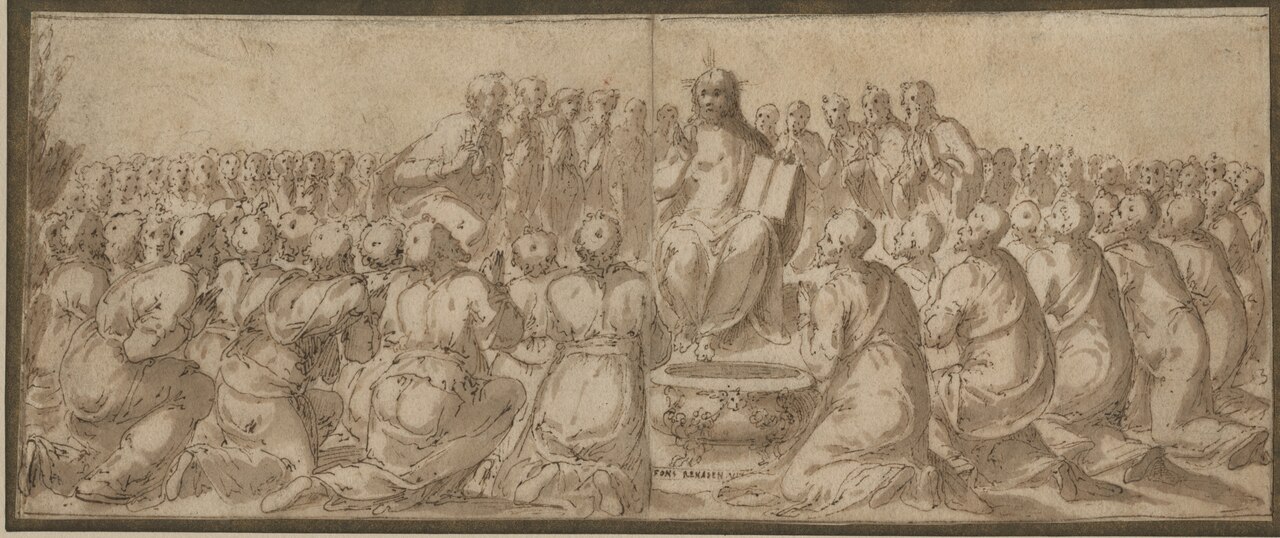


Early life Giovanni Guerra was born in 1544 in Modena, a city in the Emilia‑Romagna region of northern Italy. Little is known about his family background or early artistic training, but the artistic climate of Modena in the mid‑16th century—dominated by the legacy of the Ferrarese school and the influence of the broader Italian Renaissance—would have provided a fertile environment for a budding draughtsman. By his late teens, Guerra appears to have been attracted to the opportunities offered by the papal capital, Rome, a centre of large‑scale decorative commissions and a hub for artists seeking patronage from the Church and aristocracy.
Career and style Guerra is first documented in Rome in 1583, when he executed three allegorical friezes in the Palazzetto Cenci. The commission, though modest in scale and attached to a relatively low‑ranking patron, demonstrates his early assimilation into the Roman decorative tradition. By the mid‑1580s he was receiving more prestigious assignments, including the 1585 fresco *Christ Preaching*, which reflects a synthesis of Mannerist dynamism and emerging Baroque sensibilities. Guerra’s style is characterised by a clear compositional logic, a restrained colour palette, and an emphasis on narrative clarity. He favoured smooth, flowing lines in his figural drawings, a trait that aligns him with the late‑Renaissance draughtsmanship of artists such as Federico Zuccari, while also anticipating the more dramatic chiaroscuro of early Baroque painters.
Signature techniques Guerra’s technique combined rigorous preparatory drawing with a relatively light application of pigment. He often employed a grisaille underpainting to establish volume before adding colour washes, a method that allowed him to achieve subtle modelling without heavy impasto. His fresco work demonstrates a careful handling of the fresco medium: he would lay down fine, controlled strokes of pigment on fresh plaster, ensuring that the colour remained vivid after drying. In his decorative projects, such as the 1592 *Decorative Frame*, Guerra displayed an adeptness for ornamental motifs, integrating classical architectural elements—pilasters, festoons, and acanthus leaves—with narrative scenes. The design for a baldachin shows his capacity for large‑scale architectural planning, integrating structural considerations with ornamental detailing.
Major works - **The Dream of Mordecai** – This composition, likely executed for a private patron, illustrates the biblical episode in which Mordecai receives a prophetic vision. Guerra renders the scene with a calm, balanced arrangement of figures, using gentle chiaroscuro to model the characters and a muted colour scheme that accentuates the spiritual tone of the narrative. - **Christ Preaching (1585)** – A fresco that marks Guerra’s most significant ecclesiastical commission, *Christ Preaching* captures the moment of Christ delivering a sermon to a gathering of listeners. The work is notable for its clear spatial organization, the expressive gestures of the figures, and a subtle use of light that highlights the central figure of Christ while maintaining a harmonious overall composition. - **Decorative Frame (1592)** – Created as an ornamental surround for a painted panel, this frame showcases Guerra’s skill in integrating architectural motifs with pictorial content. The design incorporates a series of interlocking scrolls, cartouches, and classical pilasters, all rendered with precise line work and a restrained palette that allows the central artwork to remain the focal point. - **Project for a Baldachin** – Although the actual structure was never realised, the surviving design documents reveal Guerra’s approach to combining structural engineering with decorative artistry. The proposal features a towering canopy supported by ornate columns, embellished with gilded details and sculptural reliefs that would have framed a high‑status altar or throne.
Influence and legacy Giovanni Guerra occupied a transitional position in late‑Renaissance Rome, bridging the Mannerist aesthetic of the mid‑16th century with the burgeoning Baroque style that would dominate the 17th century. While he never achieved the fame of contemporaries such as Annibale Carracci or Caravaggio, his work contributed to the visual vocabulary of Roman decorative painting, particularly in the realm of allegorical and religious frescoes. His careful draughtsmanship and restrained decorative schemes influenced a generation of lesser‑known painters who worked on ecclesiastical commissions and private chapels. Modern scholarship recognises Guerra as a reliable example of the professional artist who navigated the competitive Roman market, delivering high‑quality work for both modest and elite patrons. His surviving drawings and frescoes continue to be studied for their technical proficiency and their role in the evolution of Roman decorative art.
--- *This biography is based on documented historical records and established art‑historical research. No speculative dates or unverified claims have been introduced.*
Frequently asked questions
Who was Giovanni Guerra?
Giovanni Guerra (1544–1618) was an Italian draughtsman and painter from Modena who worked chiefly in Rome, producing frescoes and decorative designs for religious and private commissions.
What artistic style or movement is he associated with?
Guerra’s work sits between late Mannerism and early Baroque, combining precise drawing, balanced composition, and a restrained colour palette that anticipates the drama of the Baroque era.
What are his most famous works?
His most notable works include *The Dream of Mordecai*, the fresco *Christ Preaching* (1585), the ornamental *Decorative Frame* (1592), and his design for a baldachin.
Why is Giovanni Guerra important in art history?
He exemplifies the professional Roman artist of the late 16th century, bridging Mannerist and Baroque aesthetics and influencing decorative painting practices in ecclesiastical settings.
How can I recognise a painting by Giovanni Guerra?
Look for smooth, controlled lines, a clear narrative focus, subtle chiaroscuro, and decorative elements that integrate classical architectural motifs with the scene.