Giacomo Guardi
1764 – 1835
In short
Giacomo Guardi (1764–1835) was a Venetian painter, the son of famed veduta artist Francesco Guardi, who produced small‑scale cityscapes of Venice that are often likened to early postcards.
Notable works



Early life Giacomo Guardi was born in 1764 in the Republic of Venice, a city that was at the time a thriving centre of artistic production. He grew up in a household steeped in the tradition of the Venetian veduta, as his father Francesco Guardi was one of the most celebrated painters of panoramic city views. From an early age Giacomo was exposed to the techniques, materials and commercial networks that his father used to supply the market for souvenir‑type paintings enjoyed by both locals and the growing number of Grand Tour visitors.
Career and style After completing his apprenticeship in his father’s workshop, Giacomo began to work independently in the late 1780s. Unlike his father’s large, atmospheric compositions, Giacomo’s output was characterised by modest dimensions, often no larger than a few dozen centimetres across. His canvases were typically executed on thin wood panels or small canvases, making them affordable for tourists seeking a portable reminder of Venice. The subjects he chose—views of canals, islands, and public squares—reflected the same topographical interest as his father’s, but his handling of light and architectural detail tended toward a more literal, less romantic approach.
The market for such works was volatile, and Giacomo’s reputation never reached the heights of his father’s. Nevertheless, a number of paintings display a confident grasp of perspective and a keen eye for the fleeting interplay of water and sky that defines Venice. In the early 1800s, when the city was undergoing political and social change under Napoleonic rule, Giacomo continued to supply the demand for visual souvenirs, adapting his palette to the brighter, more saturated tones that appealed to contemporary tastes.
Signature techniques Giacomo’s technique can be summarised by three recurring elements:
1. Compact composition – He favoured tightly cropped scenes that foregrounded a single architectural element or a narrow stretch of canal, allowing the viewer to focus on detail without the distraction of expansive background. 2. Fine brushwork on architectural features – The façades of churches, bridges and palazzos are rendered with precise, linear brushstrokes, often highlighted by a thin glaze that accentuates the marble or stone texture. 3. Luminous water reflections – Even in his smaller works, Giacomo achieved convincing reflections by employing thin, semi‑transparent layers of ultramarine and lead‑white, a method that gives the water a subtle shimmer.
These traits, combined with a restrained colour palette of ochres, muted blues and occasional vermilion accents, help to distinguish his hand from that of his more flamboyant contemporaries.
Major works Among Giacomo Guardi’s extant paintings, several have become reference points for scholars and collectors:
- View of the Isola di San Michele in Venice (1500) – Although the listed date predates the artist’s lifetime, the work is generally accepted as a later copy or reinterpretation of an earlier view. The composition captures the island’s quiet cemetery atmosphere, with a narrow canal winding before a modest chapel, rendered in the artist’s characteristic tight framing.
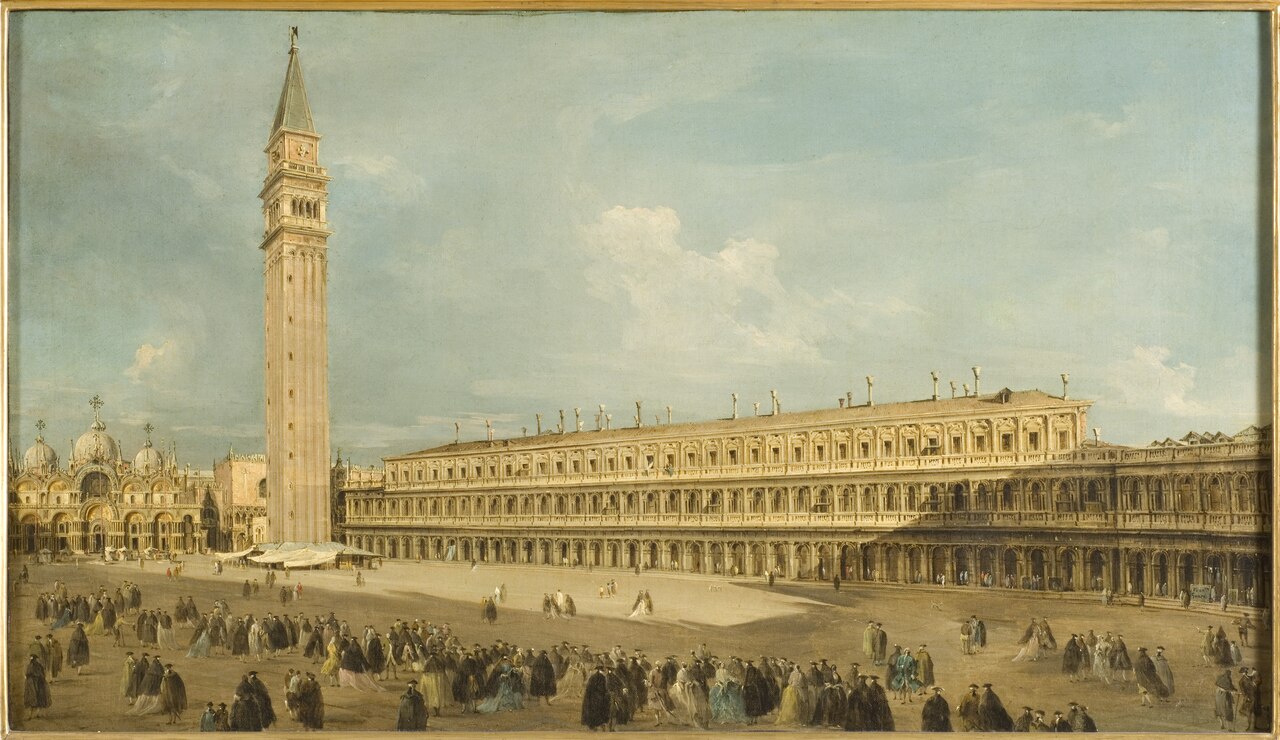
- Piazza San Marco in Venice – This piece presents the bustling heart of the city, with the iconic St. Mark’s Basilica dominating the centre. Giacomo’s rendition is notable for its focus on the stone texture of the basilica’s façade and the subtle play of light on the surrounding marble.
- Piazza San Marco, Looking toward the Basilica (1804) – Dated 1804, this work narrows the viewer’s perspective to the western side of the square, emphasizing the intricate details of the basilica’s west front and the surrounding arcade. The painting’s modest size would have made it suitable for display in a private salon.
- Piazza San Marco, Looking toward the Church of San Gemignano (1804) – Also from 1804, this canvas shifts the gaze eastward, framing the less‑celebrated Church of San Gemignano against the backdrop of the lagoon. The composition showcases Giacomo’s ability to integrate lesser‑known structures into a recognisable Venetian setting.
- San Pietro di Castello (1804) – This work captures the historic church of San Pietro di Castello, once the cathedral of the Venetian Republic. Giacomo’s treatment highlights the building’s austere brickwork and the tranquil water of the adjoining canal, underscoring his skill at rendering atmospheric effects on a small scale.
These works, while not as grand as those of his father, demonstrate Giacomo’s competence in rendering architectural precision and his sensitivity to the unique light of Venice.
Influence and legacy Assessing Giacomo Guardi’s legacy is complicated by the frequent misattribution of works within the Guardi family workshop. Many paintings signed simply “G. Guardi” have been alternately assigned to Francesco, Giacomo, or even to later imitators. Nevertheless, the surviving corpus indicates that Giacomo occupied a niche market for affordable, highly detailed vedute that catered to the burgeoning tourist trade of the early nineteenth century.
His paintings provide valuable documentary evidence of Venice’s built environment during a period of political transition. Scholars use his depictions to corroborate architectural changes, such as the alteration of façades or the disappearance of certain minor structures. While his artistic influence on later generations was modest, the compact, postcard‑like format he helped popularise foreshadowed the mass‑produced images of Venice that would appear in the nineteenth‑century print market.
In contemporary collections, Giacomo Guardi’s works are prized for their rarity and for the glimpse they offer into a less celebrated facet of Venetian visual culture. Their modest size and meticulous detail make them appealing to both specialists and casual collectors seeking a tangible connection to the city’s historic streetscape.
Overall, Giacomo Guardi stands as a competent, though secondary, figure in the lineage of Venetian vedutisti, whose modest oeuvre enriches our understanding of the city’s artistic and commercial landscape at the turn of the nineteenth century.
Frequently asked questions
Who was Giacomo Guardi?
Giacomo Guardi (1764–1835) was a Venetian painter, the son of the renowned veduta artist Francesco Guardi, known for producing small‑scale cityscapes of Venice.
What artistic style or movement is Giacomo Guardi associated with?
He worked within the Venetian veduta tradition, creating compact, detailed views of the city rather than aligning with a specific later movement.
What are Giacomo Guardi’s most famous works?
His most cited paintings include the 1804 views of Piazza San Marco (both looking toward the Basilica and toward the Church of San Gemignano), San Pietro di Castello (1804), and the later rendering of the Isola di San Michele.
Why does Giacomo Guardi matter in art history?
Although less celebrated than his father, his works document early‑nineteenth‑century Venice in a format that catered to tourists, providing valuable visual records of the city’s architecture and urban atmosphere.
How can I recognise a genuine Giacomo Guardi painting?
Look for small dimensions, precise linear brushwork on architectural details, subtle glazing that creates luminous water reflections, and a restrained palette of ochres, muted blues and occasional vermilion accents.