Gaspare Diziani
1689 – 1767
In short
Gaspare Diziani (1689–1767) was a Venetian painter of the late‑Baroque and Rococo periods, known for his dynamic narrative scenes and decorative frescoes. He worked chiefly in Venice but also received commissions in Dresden and Munich, and his large canvas is the biggest painting in the Hermitage Museum.
Notable works


Early life Gaspare Diziani was born in 1689 in Belluno, a town in the Republic of Venice. Little is recorded about his family background, but he entered the artistic milieu of the Veneto as a teenager, apprenticing under a local master before moving to Venice to study the works of the great Venetian painters of the previous century. The vibrant colour and theatrical lighting of the late‑Baroque environment in Venice shaped his early visual vocabulary.
Career and style By the 1720s Diziani had established himself as a competent painter of both religious and secular subjects. He secured commissions for altarpieces, mythological canvases, and decorative frescoes in palaces and churches across the Venetian lagoon. His style reflects a synthesis of the dramatic chiaroscuro typical of the Baroque with the lighter, more ornamental qualities of the emerging Rococo. Unlike some of his contemporaries who embraced a purely decorative approach, Diziani retained a strong narrative impulse, often depicting complex historical or biblical scenes with a clear sense of movement.
During the 1730s and 1740s he expanded his reputation beyond the Veneto, receiving invitations to work in Dresden and Munich. In these German courts he adapted his Venetian colouristic sensibility to the tastes of central European patrons, producing works that combined opulent gold tones with the dynamic compositions favoured by the courts.
Signature techniques Diziani’s paintings are characterised by several recurring technical traits: - **Vivid colour contrasts**: he juxtaposed deep ultramarine and vermilion with warm ochres, creating a luminous surface that draws the eye across the canvas. - **Dynamic diagonals**: his compositions often employ strong diagonal lines that guide the viewer’s gaze and heighten the sense of action. - **Rich texture**: through layered glazes and impasto highlights, Diziani rendered fabrics, armor and foliage with tactile realism. - **Light as narrative device**: strategic illumination accentuates key figures and moments, a technique he inherited from the Venetian masters but applied with a more theatrical flair.
These elements combine to give his work a lively, almost cinematic quality, distinguishing him from more static Baroque contemporaries.
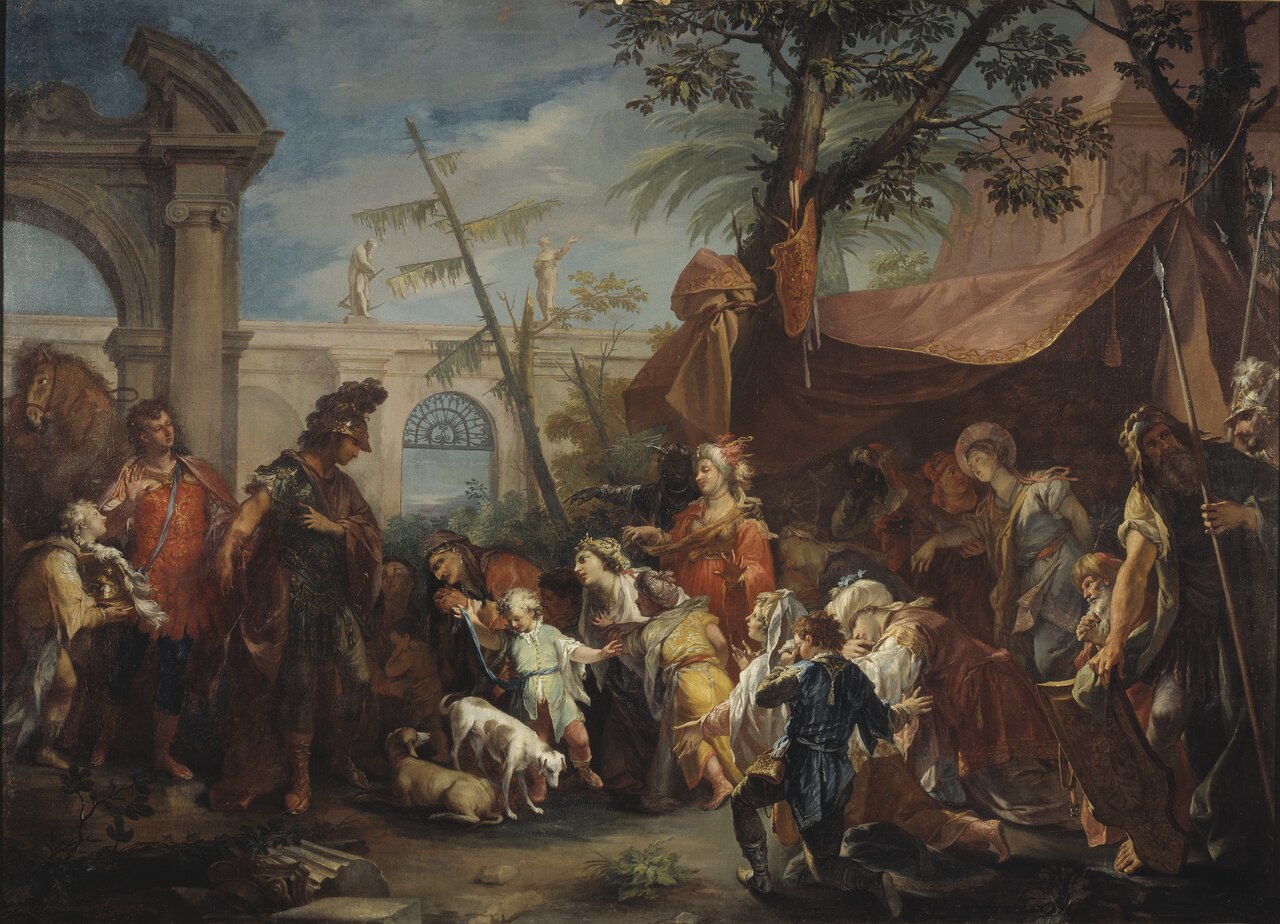
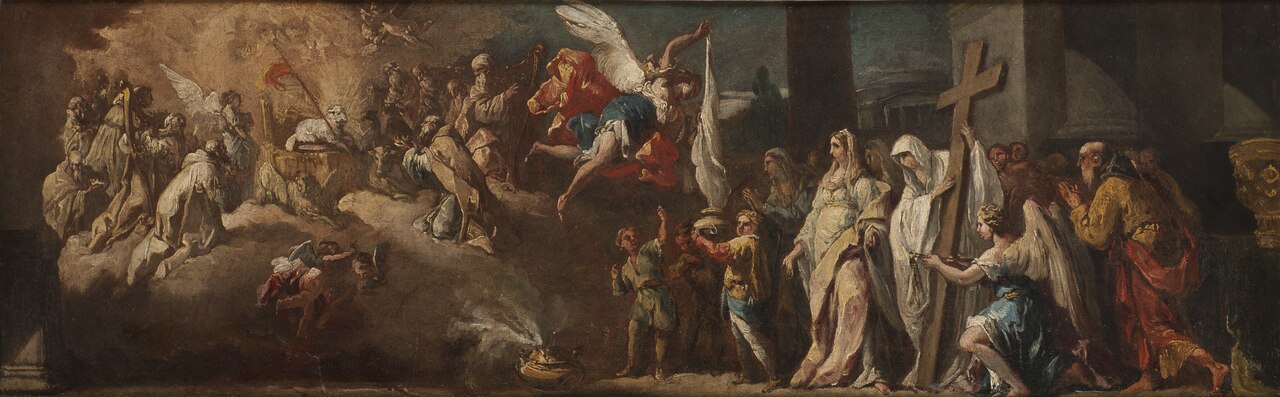
Major works - **Olympus (plafond) (1750)** – Executed for a Venetian palace, this ceiling fresco depicts the gods of Olympus in a theatrical arrangement. Diziani employed a soaring perspective and a bright palette to convey the celestial realm, while the figures are rendered with the same tactile detail as his easel paintings. - **Moses trampling on the Pharaoh’s crown (1743)** – This canvas illustrates the biblical hero Moses in a moment of triumph. The dramatic pose, the crushed crown, and the surrounding desert landscape exemplify Diziani’s ability to fuse narrative intensity with Rococo elegance. - **Adoration of the Magi (1750)** – Created for a Venetian church, the work showcases the traditional subject with a fresh, colour‑rich interpretation. The three Magi are highlighted by strong lighting, and the surrounding crowd is rendered with lively gestures that convey both reverence and movement. - **The Family of Darius Pleading to Alexander (1745)** – A historical tableau that captures the diplomatic encounter between the Persian royal family and Alexander the Great. Diziani’s composition balances political gravitas with the decorative flair of the Rococo, using a palette of deep reds and golds to underscore the regal atmosphere. - **The Adoration of the Lamb. Study** – Though a study rather than a finished piece, this work demonstrates Diziani’s preparatory process for large‑scale religious commissions. The study reveals his meticulous planning of light, colour, and figure placement, foreshadowing the grandeur of his later altar pieces.
One of Diziani’s canvases, reputedly the largest painting in the Hermitage Museum in St. Petersburg, underscores his capacity for monumental works. While the exact title of this piece varies in sources, its scale and the artist’s hand confirm his reputation as a painter capable of handling both intimate panels and grand, public commissions.
Influence and legacy Gaspare Diziani occupies a transitional niche between the high drama of the Baroque and the decorative lightness of the Rococo. His ability to merge narrative depth with ornamental elegance influenced a generation of Venetian painters who sought to modernise the city’s artistic output without abandoning its colouristic heritage. In the latter half of the 18th century, his works were collected by aristocratic patrons across Europe, reinforcing the reputation of Venetian painting as a source of sophisticated, cosmopolitan art.
Although later critics sometimes relegated him to the periphery of the great Venetian masters, recent scholarship has re‑evaluated his contributions, recognising his role in disseminating Venetian style to northern courts and his skill in adapting to diverse patronage. Today, his paintings are displayed in major museums, including the Hermitage, where his large canvas continues to attract scholarly attention for its technical brilliance and its testament to the international reach of Venetian art in the 18th century.
Diziani’s legacy endures in the way his works combine storytelling with sumptuous visual effects, offering a bridge between the dramatic intensity of the Baroque and the graceful ornamentation of the Rococo. His paintings remain valuable resources for understanding the evolution of Venetian art in a period of cultural exchange and stylistic transition.
Frequently asked questions
Who was Gaspare Diziani?
Gaspare Diziani (1689–1767) was a Venetian painter of the late‑Baroque and Rococo periods, known for dynamic narrative scenes and large decorative works.
What artistic style or movement is he associated with?
He worked at the crossroads of the Baroque and Rococo, blending dramatic chiaroscuro with the lighter, ornamental qualities of the Rococo.
What are his most famous works?
Key works include the ceiling fresco *Olympus* (1750), *Moses trampling on the Pharaoh’s crown* (1743), *Adoration of the Magi* (1750), *The Family of Darius Pleading to Alexander* (1745) and the study for *The Adoration of the Lamb*.
Why is Diziani important in art history?
He helped transmit Venetian colouristic techniques to northern European courts and demonstrated how narrative depth could coexist with Rococo elegance, influencing later Venetian artists.
How can I recognise a Diziani painting?
Look for vivid colour contrasts, dynamic diagonal compositions, rich textural detail in fabrics and armour, and a theatrical use of light that highlights key figures.