Frans Wouters
1612 – 1659
In short
Frans Wouters (1612–1659) was a Flemish Baroque painter from the Habsburg Netherlands, known for adapting Peter Paul Rubens’s monumental style to small‑scale cabinet paintings and for serving as court painter to the Roman Emperor and the Prince of Wales.
Notable works


Early life Frans Wouters was born in 1612 in the town of Lier, then part of the Habsburg Netherlands. His family was modest but supportive of his artistic interests. Lier lay within a region that produced a number of prominent painters, and the young Wouters was exposed early to the flourishing Flemish artistic tradition. He likely began his apprenticeship in the workshop of a local master before moving to Antwerp, the commercial and artistic hub of the Southern Netherlands, where he could study the works of leading Baroque artists.
Career and style By the early 1630s Wouters had established himself in Antwerp’s vibrant market for cabinet paintings—small, highly finished works intended for private collectors. His style shows a clear debt to Peter Paul Rubens, whose dynamic compositions, vigorous brushwork and dramatic lighting dominated Flemish art. Wouters, however, translated these qualities to a more intimate scale, concentrating Rubens’s grand gestures into compact formats without losing the sense of movement or emotional intensity. His canvases often feature mythological or allegorical subjects, a popular choice among aristocratic patrons seeking both aesthetic pleasure and symbolic meaning.
Wouters’ reputation grew quickly, and he secured prestigious appointments as a court painter. He served the Holy Roman Emperor Ferdinand III, producing works that adorned imperial chambers and reinforced the monarch’s cultural prestige. At the same time he cultivated connections with the English court, becoming a favourite of the Prince of Wales (later Charles II). These roles required not only artistic skill but also diplomatic tact; Wouters acted as an ambassador and art dealer, helping to circulate Flemish works across Europe and facilitating commissions for fellow artists.
Signature techniques Wouters is distinguished by several technical hallmarks. First, his use of chiaroscuro creates a strong contrast between illuminated figures and darkened backgrounds, heightening the three‑dimensional effect of his subjects. Second, his brushwork is fine and meticulous, appropriate to the limited surface of cabinet paintings; details such as drapery folds, foliage and textures are rendered with a near‑tactile precision. Third, he favours a warm palette of ochres, deep reds and muted greens, echoing Rubens’s colour harmonies while adapting them to the smaller scale. Finally, his compositions frequently employ diagonal lines and spiralling gestures that guide the viewer’s eye through the narrative, a hallmark of Baroque dynamism.
Major works Wouters’ oeuvre includes several notable pieces that exemplify his synthesis of Rubensian grandeur and intimate format.
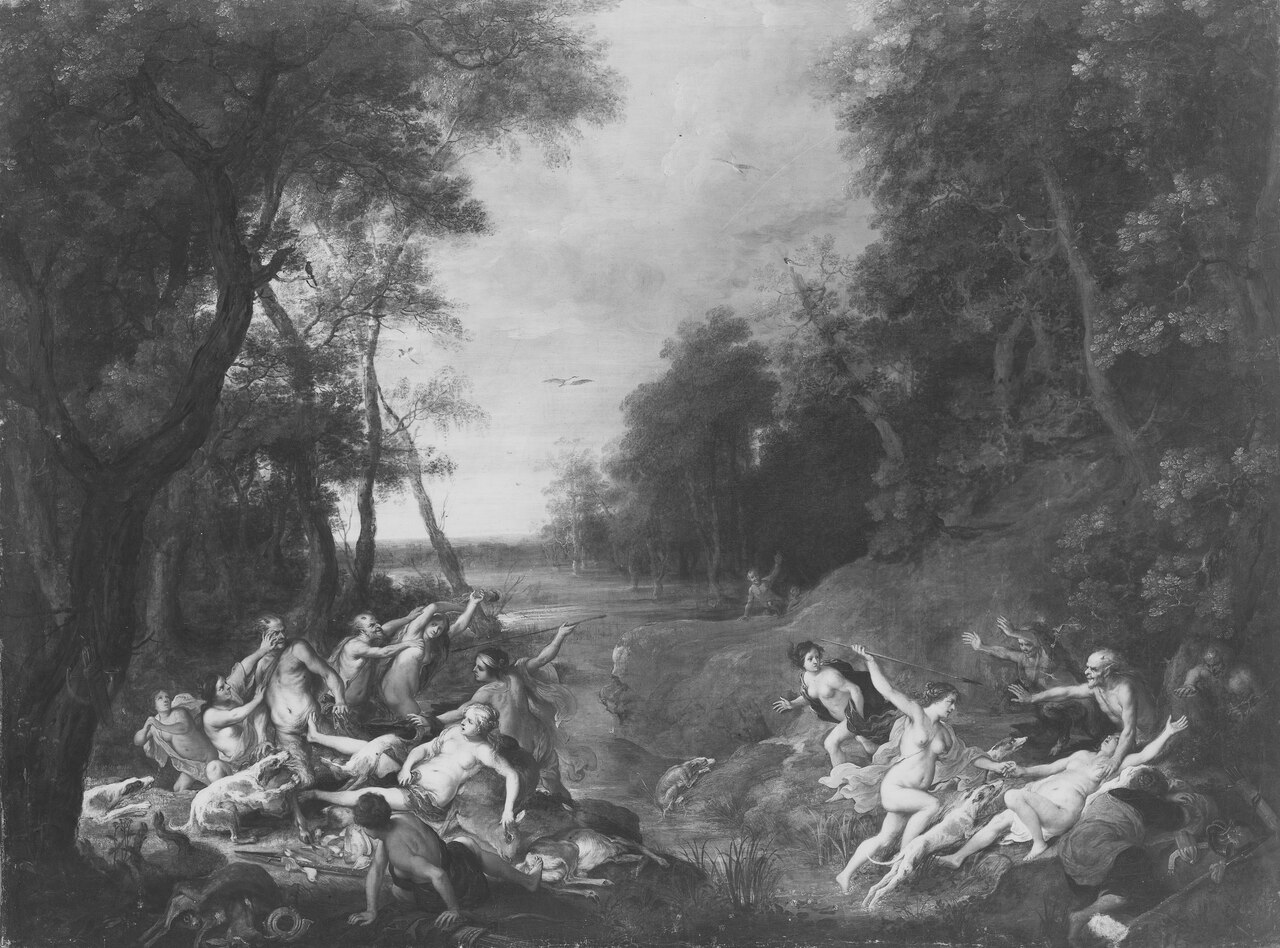
- Diana and her nymphs – This work depicts the goddess of the hunt surrounded by her attendants in a wooded setting. The composition is characterised by a lively interaction among the figures, with the play of light accentuating the silvery sheen of Diana’s attire. The painting demonstrates Wouters’ ability to convey narrative depth within a modest frame.
- Skt. Jørgen befrier prinsessen fra dragen. Allegori (1627) – An allegorical scene in which Saint George rescues a princess from a dragon. Though the date places it early in Wouters’ career, the piece already shows his command of dramatic tension and his penchant for heroic mythological subjects.
- Venus Bewailing the Slain Adonis – Here the goddess of love mourns the death of the youthful hunter Adonis. Wouters captures the pathos of the moment through soft modelling of Venus’s face and a restrained colour scheme that underscores the sorrowful mood.
- Cupid with his bow – A compact study of the winged god of desire, poised to launch an arrow. The work highlights the painter’s skill in rendering delicate anatomy and the gleam of metal, while the background remains subdued, focusing attention on the figure.
- Andromeda Chained to the Rock (1638) – This painting portrays the mythic heroine Andromeda awaiting her rescue. The composition balances a sense of vulnerability with a hint of impending rescue, achieved through the interplay of shadow and light and a careful arrangement of the surrounding sea‑rock landscape.
These works collectively illustrate Wouters’ mastery of narrative, his refined handling of the human form, and his adaptation of the Baroque aesthetic to the cabinet genre.
Influence and legacy Frans Wouters occupied a distinctive niche within the Flemish Baroque. By translating the monumental language of Rubens into smaller, highly collectible formats, he helped broaden the market for Baroque art beyond grand public commissions. His role as court painter and art dealer also facilitated the diffusion of Flemish styles throughout Europe, particularly to the Habsburg courts and the English aristocracy. Later generations of cabinet painters drew on his compositional strategies and technical finesse, ensuring that his approach remained a reference point for artists working on a reduced scale.
Although not as widely known as Rubens or Van Dyck, Wouters’ paintings continue to be studied for their elegant synthesis of narrative drama and meticulous execution. They provide insight into the tastes of 17th‑century elite patrons and exemplify how Baroque ideals could be adapted to intimate, private settings. Modern exhibitions of Flemish Baroque art often include his works to illustrate the diversity of artistic production in Antwerp during the period, and his pieces remain prized by collectors for their historical significance and visual appeal.
Frequently asked questions
Who was Frans Wouters?
Frans Wouters (1612–1659) was a Flemish Baroque painter from the Habsburg Netherlands, known for adapting Rubens’s grand style to small cabinet paintings and serving as court painter to the Roman Emperor and the Prince of Wales.
What artistic movement did he belong to?
He worked within the Baroque movement, embracing its dramatic lighting, dynamic composition and emotional intensity while applying these qualities to modestly sized works.
What are his most famous works?
Key works include *Diana and her nymphs*, *Skt. Jørgen befrier prinsessen fra dragen. Allegori* (1627), *Venus Bewailing the Slain Adonis*, *Cupid with his bow* and *Andromeda Chained to the Rock* (1638).
Why is Frans Wouters important in art history?
He demonstrated how Rubens’s monumental Baroque style could be translated into intimate cabinet paintings, expanding the market for Baroque art and influencing later small‑scale painters across Europe.
How can I recognise a Frans Wouters painting?
Look for finely detailed, small‑scale works with strong chiaroscuro, a warm colour palette, dynamic poses and mythological or allegorical subjects rendered with Rubens‑like vigor but on a compact canvas.