Frans Francken the Younger
1581 – 1642
In short
Frans Francken the Younger (1581–1642) was a Flemish painter from Antwerp, renowned for altarpieces, historical and allegorical scenes, and pioneering the collectors' cabinet genre. He was the most prolific member of the Francken family, collaborating with specialists to integrate figures into elaborate settings.
Notable works

_-_Augustiner_M_Freiburg.png)
_-_Augustiner_M_Freiburg.png)
_-_Augustiner_M_Freiburg.png)
Early life Frans Francken the Younger was born in 1581 in Antwerp, a thriving centre of artistic production in the Habsburg Netherlands. He was the son of Frans Francken the Elder, himself an established painter, and thus grew up immersed in a family workshop that spanned several generations. Training under his father, Francken the Younger absorbed the techniques of the Antwerp Guild of Saint Luke, where he later achieved master status. The city’s vibrant market for religious commissions and the burgeoning interest in secular subjects provided a fertile environment for his artistic development.
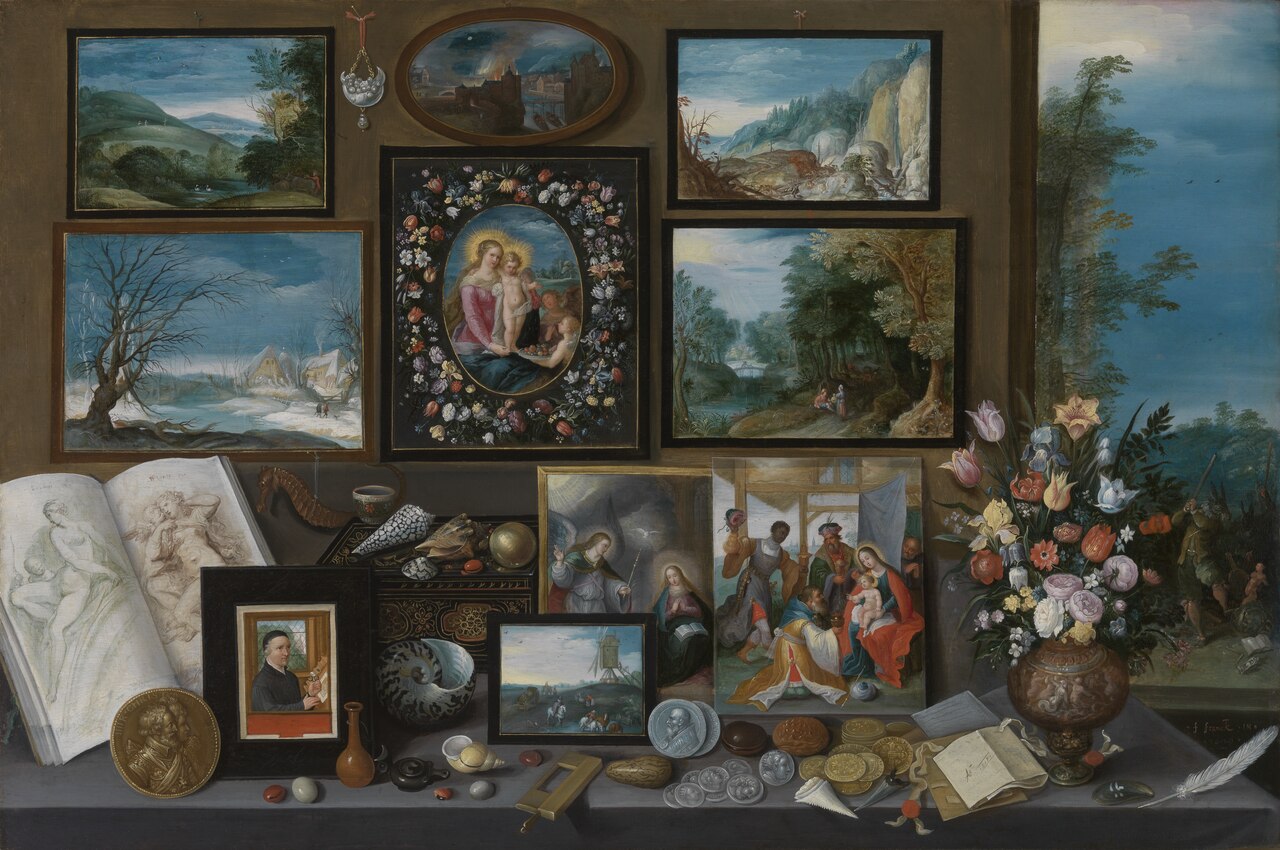
Career and style By the early 1600s Francken the Younger had established a reputation for large altarpieces that adorned the churches of Antwerp and the surrounding region. His religious works display a balanced composition, clear narrative focus and a colour palette drawn from the late‑Renaissance tradition. Parallel to his ecclesiastical output, Francken cultivated a prolific studio practice that embraced historical, mythological and allegorical subjects. His most distinctive contribution was the development of the *cabinet painting* – small‑scale, highly detailed depictions of collectors’ rooms filled with artworks, curiosities and objects of learning. These scenes not only reflected the tastes of the emerging bourgeois class but also created a new visual genre that celebrated the act of collecting itself.
Francken frequently collaborated with specialist painters. He would contribute the human figures and narrative elements while a colleague supplied the landscape, architectural background or intricate still‑life components. This collaborative model was typical of Antwerp workshops and allowed him to produce works that combined his strength in figural rendering with the technical expertise of others.
Signature techniques Several hallmarks identify a Francken the Younger painting. First, his figures are rendered with a refined, almost courtly elegance; gestures are poised, and facial expressions convey a restrained emotional tone. Second, his compositions often employ a central vanishing point that draws the viewer’s eye into a receding interior space, a technique that enhances the illusion of depth in his cabinet scenes. Third, he favoured a delicate handling of light, using subtle chiaroscuro to model forms without dramatic contrast. Finally, his brushwork is meticulous, particularly in the rendering of textiles, metalwork and the intricate details of objects that populate his collector’s cabinets.
Major works - **A Collection (1619)** – One of the earliest examples of Francken’s cabinet genre, this painting presents a richly appointed interior where a gentleman examines a series of paintings, sculptures and scientific instruments. The work demonstrates his skill in integrating diverse objects into a harmonious whole, and it set a precedent for later collectors’ scenes. - **A Visit to the Art Dealer (1636)** – Executed later in his career, this composition shows a patron engaged in dialogue with an art dealer surrounded by canvases and objects of trade. The piece reflects the growing commercialisation of art in Antwerp and showcases Francken’s ability to capture social interaction within a meticulously rendered setting. - **Feeling (1700)**, **Hearing (1700)**, **Taste (1700)** – These three works are attributed to Francken’s workshop and are dated after his death; scholars consider them posthumous copies or extensions of his stylistic legacy. Each painting personifies a sensory faculty, employing allegorical figures surrounded by symbolic objects that illustrate the respective sense. Although the exact authorship remains uncertain, the pieces retain the compositional clarity and detailed finish characteristic of the Francken workshop.
Influence and legacy Frans Francken the Younger’s impact on Flemish art was profound. By perfecting the cabinet painting, he influenced a generation of artists who sought to depict the intellectual pursuits of the rising merchant class. His collaborative approach modelled a workshop system that persisted throughout the 17th century, fostering a network of specialists whose combined efforts enriched the visual vocabulary of the period. Later painters such as David Teniers the Younger and Jan Davidsz. de Heem inherited aspects of Francken’s detailed interiors and allegorical content.
Beyond his immediate circle, Francken’s work contributed to the broader European fascination with ‘kunstkammern’ – rooms of curiosities that blended art, science and exotic objects. The genre foreshadowed the modern museum display, and his meticulous renderings provide valuable insight into the material culture of early‑modern Antwerp. Today, his paintings are held in major collections across Europe, and art historians continue to study his oeuvre for its blend of narrative clarity, technical mastery and cultural relevance.
Frequently asked questions
Who was Frans Francken the Younger?
Frans Francken the Younger (1581–1642) was a Flemish painter from Antwerp, best known for altarpieces, historical and allegorical scenes, and pioneering the collectors’ cabinet genre.
What artistic style or movement is he associated with?
He worked within the late‑Renaissance and early Baroque traditions of the Habsburg Netherlands, combining religious composition with the emerging genre of cabinet paintings.
What are his most famous works?
Key works include *A Collection* (1619), *A Visit to the Art Dealer* (1636), and the later attributed pieces *Feeling*, *Hearing* and *Taste* (c. 1700).
Why is Frans Francken the Younger important in art history?
He established the popular cabinet‑painting genre, collaborated across specialist workshops, and influenced later Flemish artists who depicted the intellectual and material culture of their time.
How can I recognise a painting by Frans Francken the Younger?
Look for finely modelled, courtly figures, a balanced interior composition with detailed objects, subtle chiaroscuro, and meticulous rendering of textiles and metalwork.