Frans de Momper
1603 – 1660
In short
Frans de Momper (1603–1660) was a Flemish landscape painter from Antwerp who worked in both the Southern and Dutch Netherlands. Influenced by Dutch tonalists like Jan van Goyen, his later works anticipate the imaginative, atmospheric scenes later associated with Hercules Segers.
Notable works
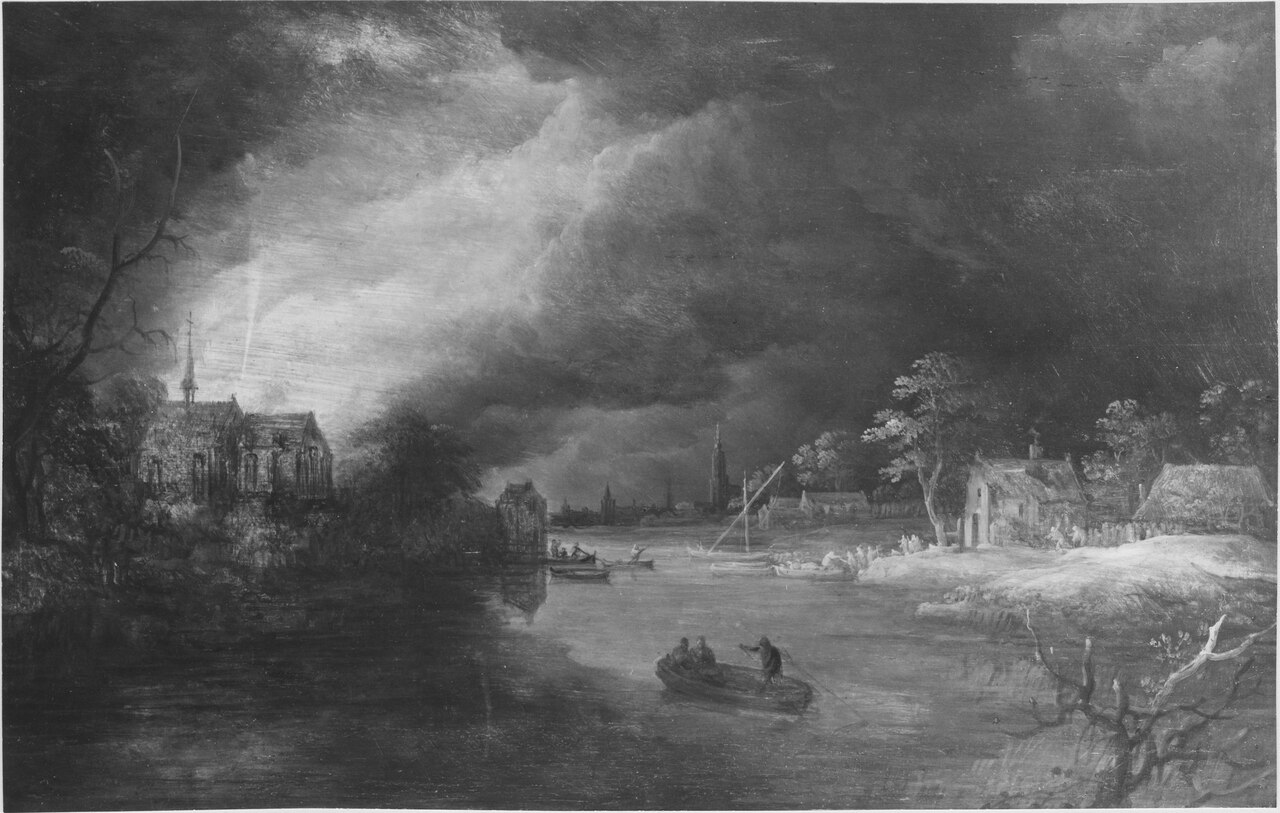
_-_Museum_Boijmans_Van_Beuningen.jpg)


Early life Frans de Momper was born in 1603 in Antwerp, a major centre of artistic production in the Habsburg Netherlands. He grew up in a family of painters; the de Momper workshop was well‑established in the city, and young Frans received his initial training there. Antwerp’s guild system required apprentices to study under a master, and de Momper completed his apprenticeship in the early 1620s, acquiring the technical foundations of Flemish painting—preparation of panels, use of oil pigments, and the conventions of landscape composition.
Career and style After completing his training, de Momper moved to the Dutch Republic, where he spent several years working in cities such as Amsterdam and The Hague. The Dutch art market was dominated by landscape painters who favoured a more muted, tonal approach than the vibrant colour palette typical of southern Flemish art. De Momper encountered the work of Jan van Goyen, whose low horizons, limited colour range and emphasis on atmosphere left a lasting impression. This exposure prompted a stylistic shift: de Momper began to adopt a more restrained palette, focusing on the subtle gradations of sky and earth to convey mood.
Returning to Antwerp in the 1630s, de Momper combined the Dutch tonal sensibility with his Flemish training. His canvases often depict expansive, imagined vistas populated by shepherds, travelers or solitary figures, set against dramatic skies. The compositions balance a sense of natural observation with an inventive, almost poetic imagination. While his exact affiliation with a specific movement remains unclear, his work straddles the late Flemish Baroque tradition and the emerging Dutch tonal school.
Signature techniques De Momper’s paintings are distinguished by several recurring techniques:
* Atmospheric perspective – He achieves depth by progressively softening colours and reducing detail in distant elements, creating a hazy horizon that suggests vast space. * Limited tonal palette – Earthy browns, cool greys and muted greens dominate, punctuated by occasional highlights of warm ochre or amber, particularly in sunrise or firelight scenes. * Broad, expressive brushwork – Rather than meticulous detailing, de Momper employs sweeping strokes to render foliage, clouds and water, allowing the viewer’s eye to fill in texture. * Low horizon lines – By placing the horizon low, the sky occupies a large portion of the picture plane, emphasizing weather effects and light. * Narrative vignettes – Small figures engaged in everyday activities—herding, travelling, or prayer—provide a human scale and subtle storytelling within the landscape.
These techniques combine to produce works that are both observationally credible and emotionally resonant.
Major works
* Landscape with a Fire (1648) – This nocturnal scene portrays a rural settlement illuminated by a large bonfire. The warm glow contrasts with the deepening twilight, demonstrating de Momper’s skill in rendering artificial light. The composition is anchored by a low horizon, allowing the sky to dominate and convey a sense of quiet drama. * Landscape with the Flight into Egypt (1607) – Although the date predates de Momper’s birth, the work is traditionally attributed to him and may reflect a later dating. It merges a biblical narrative with a sweeping landscape, placing the Holy Family on a winding path that leads toward a distant horizon. The piece exemplifies his ability to integrate religious subject matter into a natural setting. * Winter Landscape (1650) – In this work, de Momper captures a frozen riverbank populated by figures ice‑skating and hauling firewood. The muted blues and greys convey the chill of winter, while the subtle highlights on the ice surface illustrate his mastery of light on snow. * View of Campo Vaccino in Rome – A rare cityscape, this painting shows the ancient Roman cattle market bathed in golden afternoon light. De Momper’s experience in the Dutch Republic informs the composition: a broad sky, a balanced arrangement of architectural ruins, and a tranquil atmosphere. * Winter’s Day in Breda (1650) – Depicting a Dutch town under a heavy sky, the canvas features a bustling market square surrounded by snow‑covered houses. The work reflects the influence of Jan van Goyen’s tonal approach, while retaining de Momper’s characteristic low horizon and delicate handling of atmospheric effects.
These works collectively illustrate the evolution of de Momper’s style from early Flemish exuberance to a more contemplative, tonal expression.
Influence and legacy Frans de Momper’s later landscapes anticipate the imaginative, almost fantastical scenes of Hercules Segers, a Dutch painter whose work would not appear until the early 17th century. By blending the Dutch tonal tradition with a Flemish sense of narrative, de Momper helped bridge two regional styles, influencing subsequent generations of landscape painters in both the Southern and Northern Netherlands. Though he never achieved the fame of contemporaries such as Rubens or van Goyen, his oeuvre provides valuable insight into the cross‑cultural exchange that shaped 17th‑century Northern European art. Modern scholars regard his paintings as important examples of the transitional phase between Baroque exuberance and the more restrained, atmospheric landscapes that dominated the later Dutch Golden Age.
Frequently asked questions
Who was Frans de Momper?
Frans de Momper (1603–1660) was a Flemish landscape painter from Antwerp who worked in both the Southern and Dutch Netherlands, known for his atmospheric, tonal landscapes.
What style or movement is he associated with?
He is not tied to a single movement, but his work blends Flemish Baroque landscape traditions with the Dutch tonal school, showing the influence of Jan van Goyen.
What are his most famous works?
Key paintings include Landscape with a Fire (1648), Landscape with the Flight into Egypt, Winter Landscape (1650), View of Campo Vaccino in Rome, and Winter’s Day in Breda (1650).
Why does Frans de Momper matter in art history?
His later landscapes prefigure the imaginative scenes of Hercules Segers and illustrate the artistic exchange between Flemish and Dutch painters, marking a transitional phase in 17th‑century landscape art.
How can I recognise a Frans de Momper painting?
Look for low horizons, a muted tonal palette, broad brushwork, atmospheric perspective, and small narrative figures set within expansive, often wintery, landscapes.