Francesco Battaglioli
1725 – 1796
In short
Francesco Battaglioli (1725–1796) was a Venetian painter renowned for his architectural vedute and perspective studies, working in both Italy and Spain. He is best remembered for his detailed views of the Palace of Aranjuez, the Rialto Bridge, and his expertly rendered interior perspectives.
Notable works
_Architectural_perspective_by_Francesco_Battaglioli_-_Gallerie_Accademia.jpg)
.jpg)
.jpg)
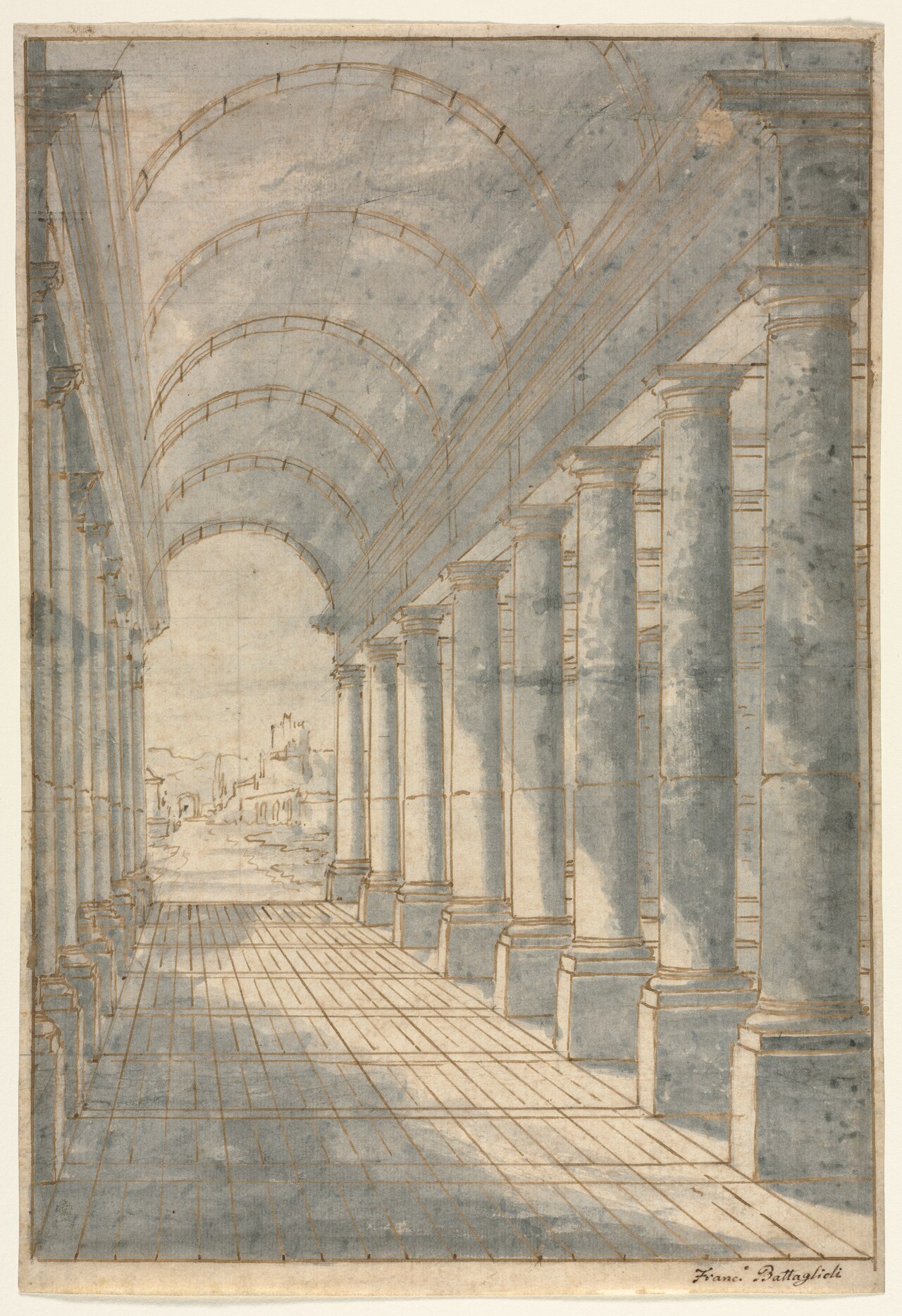

Early life Francesco Battaglioli was born in 1725 in Modena, a city that at the time lay within the territories of the Republic of Venice. Little is recorded about his family background, but contemporary sources indicate that he received his artistic training in the studios of the Veneto, where the tradition of veduta painting—highly detailed cityscapes and architectural views—was flourishing. The artistic environment of northern Italy, especially the works of Canaletto and Bernardo Bellotto, provided a model for the young Battaglioli, who quickly developed an affinity for rendering space with mathematical precision.
Career and style By the early 1750s Battaglioli had established himself in Venice, a hub for artists catering to the Grand Tour market. He specialised in architectural perspective, a genre that demanded both artistic skill and a solid grasp of geometry. His style is characterised by clear, luminous colour, careful observation of light, and a calm, almost documentary approach to architectural subjects. Unlike the more theatrical vedutisti who dramatized the city’s bustling life, Battaglioli favoured a restrained composition that foregrounded the built environment itself.
In 1756, the Spanish court, under King Ferdinand VI, commissioned a series of works to celebrate the royal gardens at Aranjuez. Battaglioli travelled to Spain, where he produced two large canvases: *View of the Palace of Aranjuez* and *Ferdinand VI and Barbara of Braganza in the Gardens of Aranjuez*. These paintings combined his Venetian training with an interest in the Spanish landscape, presenting the palace and its surroundings with a balanced perspective that highlighted both architecture and nature.
After returning to Venice, Battaglioli continued to receive commissions from both ecclesiastical patrons and private collectors. His reputation as a master of interior perspective grew, leading to later works such as the *Barrel‑Vaulted Arcade Rendered in Perspective*—a study of complex architectural forms that showcases his continued engagement with spatial illusion, even after his death when the work was published in 1800.
Signature techniques Battaglioli’s hallmark was his meticulous use of linear perspective. He employed a rigorous system of vanishing points and orthogonal lines, often working from detailed sketches or architectural drawings. Light is rendered with subtle gradations, allowing the viewer to discern the depth of arches, colonnades, and vaulted spaces. He also favoured a muted palette of earth tones punctuated by the occasional bright accent, a choice that reinforced the realism of his scenes while maintaining a harmonious visual rhythm.
In his exterior views, Battaglioli placed architectural elements against a clear sky, using atmospheric perspective—fading colour and reduced detail—to convey distance. His interior studies, by contrast, rely on chiaroscuro to model three‑dimensional space, highlighting the interplay of natural and artificial light within grand halls and arcades.
Major works - **View of The Palace of Aranjuez (1756)** – This canvas captures the royal residence from a slightly elevated viewpoint, allowing the viewer to see both the façade and the surrounding gardens. The composition balances the palace’s symmetry with the informal arrangement of trees and pathways, reflecting the Enlightenment interest in ordered nature. - **Ferdinand VI and Barbara of Braganza in the Gardens of Aranjuez (1756)** – A companion piece to the palace view, this work places the monarch and his consort within the landscaped grounds. Battaglioli’s careful placement of figures within a meticulously rendered environment underscores the power of the Spanish crown while preserving the visual integrity of the garden’s design. - **Barrel‑Vaulted Arcade Rendered in Perspective (1800)** – Although published posthumously, this study demonstrates Battaglioli’s sustained fascination with complex interior spaces. The composition showcases a series of repeating arches that recede into a vanishing point, creating a sense of infinite depth. - **The Rialto Bridge Seen from the North (1775)** – In this Venetian veduta, Battaglioli presents the iconic bridge from a northern angle, emphasizing the bridge’s architectural lines against the bustling canal. The painting is noted for its precise rendering of the bridge’s stonework and the subtle activity of boats and pedestrians, which serve to animate the otherwise static scene.
Influence and legacy Francesco Battaglioli occupies a distinctive niche in the 18th‑century European art world. While not as widely celebrated as some of his contemporaries, his work contributed to the diffusion of the Venetian veduta style beyond Italy, particularly through his Spanish commissions. His accurate perspective drawings were valued by architects and engineers, and they informed the decorative programmes of royal palaces.
In the decades following his death, Battaglioli’s interior studies were reproduced as prints, influencing a generation of artists who sought to master the illusion of space. Moreover, his approach to integrating figures within architectural settings prefigured later developments in theatrical set design, where the balance between narrative and structural realism became a central concern.
Today, Battaglioli’s paintings are held in several European collections, including the Museo del Prado in Madrid and the Gallerie dell'Accademia in Venice. Scholars appreciate his works as exemplars of the Enlightenment’s rationalist aesthetic, where scientific observation meets artistic representation. His legacy endures in the continued study of perspective drawing and in the appreciation of architectural vedute as both documentary records and works of fine art.
Frequently asked questions
Who was Francesco Battaglioli?
Francesco Battaglioli (1725–1796) was a Venetian painter known for his precise architectural vedute and perspective studies, active in both Italy and Spain.
What artistic style or movement is he associated with?
He is linked to the Venetian veduta tradition, a genre that emphasizes detailed cityscapes and architectural views, though no specific movement is recorded for him.
What are his most famous works?
His best‑known paintings include *View of the Palace of Aranjuez* (1756), *Ferdinand VI and Barbara of Braganza in the Gardens of Aranjuez* (1756), *The Rialto Bridge Seen from the North* (1775), and his interior study *Barrel‑Vaulted Arcade Rendered in Perspective* (published 1800).
Why is Battaglioli important in art history?
He helped spread the Venetian veduta style to Spain, provided valuable examples of architectural perspective, and his works bridge the gap between artistic representation and scientific observation.
How can I recognise a Battaglioli painting?
Look for meticulous linear perspective, a calm composition that foregrounds architecture, subtle lighting that models depth, and a restrained colour palette that highlights structural detail.