Evert Pieters
1856 – 1932
In short
Evert Pieters (1856–1932) was a Dutch painter noted for his naturalistic landscapes and interior scenes. Working mainly in the Netherlands, he produced a body of work that reflects the late‑19th‑century Dutch tradition of genre painting.
Notable works
.jpg)


.jpg)
Early life Evert Pieters was born in Amsterdam in 1856, during a period when the Netherlands was experiencing a resurgence of interest in its own artistic heritage. Little is recorded about his family background, but the city’s vibrant artistic milieu provided ample exposure to the works of the Dutch masters and the contemporary realist painters who were redefining genre and landscape painting. Pieters likely received his initial training in one of Amsterdam’s art schools, where he would have been instructed in drawing from life, colour theory, and the techniques of oil painting. The city’s canals, bustling markets, and surrounding countryside left a lasting impression, shaping the subjects he would later pursue.
Career and style After completing his formal studies, Pieters established himself as a professional painter in the late 1870s. He gravitated toward the naturalistic style that dominated Dutch art in the final decades of the 19th century, favouring a realistic yet lyrical representation of everyday life. His work shows the influence of the Hague School, particularly its emphasis on muted palettes, atmospheric light, and a sober treatment of subject matter. While he never aligned himself with a formal avant‑garde movement, Pieters’ paintings reflect the broader European trend toward realism and a renewed appreciation for the quiet dignity of domestic and rural scenes.
Pieters’ career progressed steadily; he exhibited regularly at local societies and gained recognition for his ability to capture both the intimacy of interior settings and the expansive tranquility of the Dutch landscape. By the turn of the century, he had built a reputation for works that combined meticulous observation with a subtle emotional undertone, often depicting ordinary people engaged in simple, timeless activities.
Signature techniques Pieters employed a restrained colour palette dominated by earth tones, soft greens, and muted blues, which allowed him to convey atmospheric depth without overwhelming the composition. His brushwork was typically fine and controlled, especially in rendering textures such as the grain of wooden furniture, the reflective surface of water, or the foliage of a garden. Light was a central element in his paintings; he often used diffused daylight to illuminate interior spaces, creating a gentle chiaroscuro that highlights the subjects while maintaining a cohesive tonal harmony.
Compositionally, Pieters favoured balanced arrangements that guide the viewer’s eye through the scene. He frequently placed figures or focal points off‑centre, employing the rule of thirds to generate a sense of natural movement. In landscape works, he used a low horizon line to emphasise the sky’s atmospheric qualities, while in interior scenes, he utilised leading lines—such as floorboards or window frames—to draw attention toward the central activity.
Major works - **A Summer's Day (1901)** – This painting captures a leisurely outdoor scene bathed in warm, summer light. The composition centres on a group of figures enjoying a meadow, with the surrounding foliage rendered in delicate greens and the sky rendered in soft blues. Pieters’ handling of light creates a serene atmosphere that epitomises his approach to leisure and natural settings.
- A Family Meal (1894) – A quintessential interior genre work, this piece depicts a family gathered around a modest table. The subdued palette and careful rendering of domestic objects convey a sense of quiet intimacy. Pieters’ attention to detail—the texture of the tablecloth, the glint of metalware—underscores his skill in portraying everyday moments with dignity.
- Man on a White Horse (1901) – Diverging from his usual domestic subjects, this composition presents a solitary rider on a striking white horse against a muted landscape. The contrast between the bright horse and the darker surroundings highlights Pieters’ capacity to create focal interest through colour juxtaposition while maintaining his characteristic naturalism.
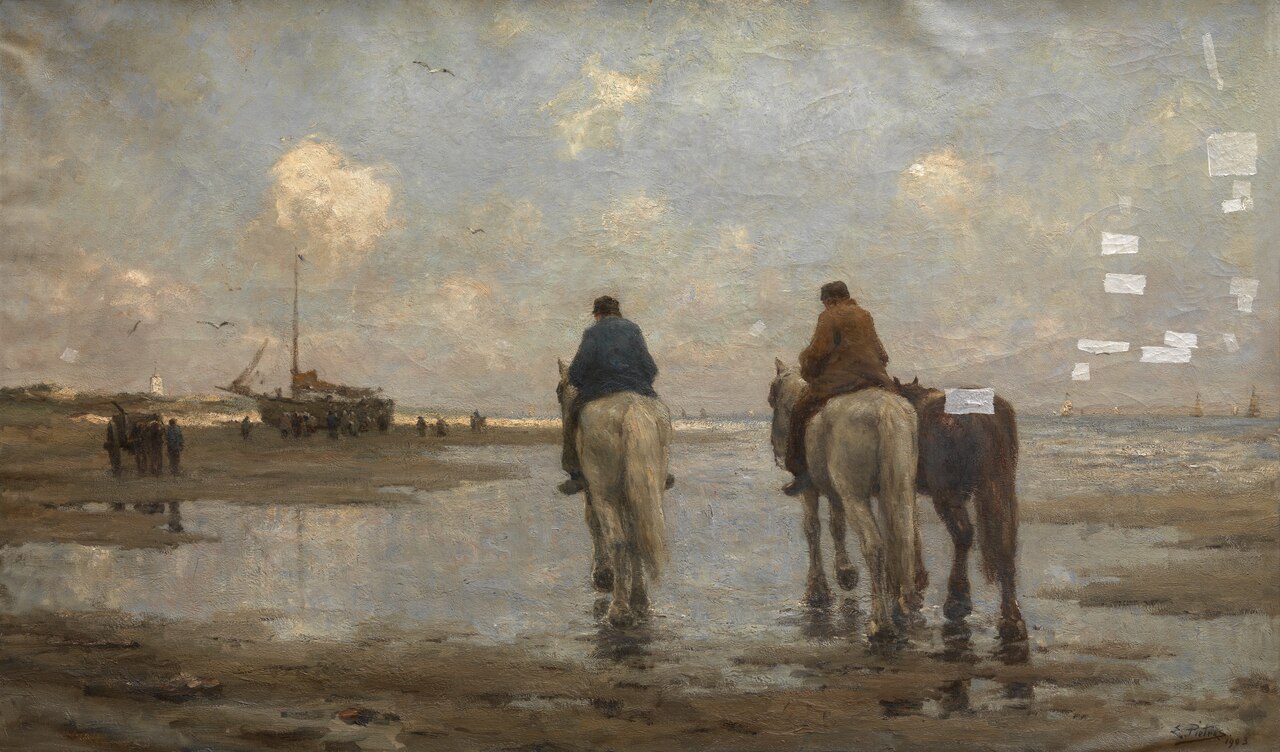
- Alongside the Beach (1903) – In this coastal scene, Pieters illustrates a stretch of shoreline where figures walk or stand, their silhouettes softened by the sea‑mist. The painting’s palette of pale blues and sandy tones reflects the atmospheric conditions of a Dutch beach, and the work demonstrates his ability to convey the subtle interplay of land, water, and sky.
- Portrait of mevrouw Pieters met de heg en mevrouw Singer in de tuin van De Wilde Zwanen (Laren) (1921) – This later work portrays two women in a cultivated garden, surrounded by hedges and flowering plants. The composition is notable for its careful placement of figures within a lush setting, highlighting Pieters’ continued interest in interior‑outdoor spaces. The delicate handling of foliage and the nuanced rendering of the women’s attire reveal his mature technique.
These works collectively illustrate Pieters’ versatility: from intimate domestic interiors to expansive landscapes, each painting is unified by a consistent naturalistic approach and a focus on quiet, everyday life.
Influence and legacy Evert Pieters did not found a distinct artistic movement, yet his paintings contributed to the continuation of the Dutch realist tradition into the early 20th century. By faithfully recording the rhythms of Dutch domestic and rural existence, he reinforced the cultural relevance of genre painting at a time when modernist tendencies were beginning to dominate European art. His works were collected by regional museums and private patrons, ensuring that his visual record of Dutch life remained accessible to later generations.
Pieters’ legacy persists primarily through the continued exhibition of his paintings in Dutch art institutions and the influence his disciplined technique had on younger artists who valued realism over abstraction. While his name may not be as widely recognised internationally as that of his contemporaries, scholars of Dutch art history regard him as an exemplar of the late‑19th‑century naturalist painter, whose oeuvre offers insight into the social and visual culture of the Netherlands during a period of transition.
In recent decades, digital archives and online encyclopedias have renewed interest in artists like Pieters, allowing a broader audience to appreciate his meticulous compositions and the quiet dignity he bestowed upon ordinary subjects. His paintings remain valuable resources for understanding the aesthetic values and everyday realities of his era, and they continue to inspire collectors and historians who seek a nuanced view of Dutch artistic development beyond the most famous masters.
Frequently asked questions
Who was Evert Pieters?
Evert Pieters (1856–1932) was a Dutch painter known for his naturalistic landscapes and interior genre scenes, active primarily in the Netherlands.
What style or movement is he associated with?
He worked within the late‑19th‑century Dutch realist tradition, drawing influence from the Hague School and emphasizing naturalistic light and colour.
What are his most famous works?
Among his best‑known paintings are *A Summer's Day* (1901), *A Family Meal* (1894), *Man on a White Horse* (1901), *Alongside the Beach* (1903) and the garden portrait from 1921.
Why does Evert Pieters matter in art history?
His work sustains the Dutch genre‑painting tradition into the early 20th century, offering a detailed visual record of everyday Dutch life and influencing later realist artists.
How can I recognise a painting by Evert Pieters?
Look for a restrained palette, careful handling of light, balanced compositions, and subjects that depict quiet domestic or rural scenes with fine, controlled brushwork.