Evert Collier
1642 – 1708
In short
Evert Collier (1642–1708) was a Dutch Golden Age painter best known for his vanitas and trompe‑l'œil still‑life paintings. Born in Breda, he worked in the Netherlands before relocating to London, where he died.
Notable works

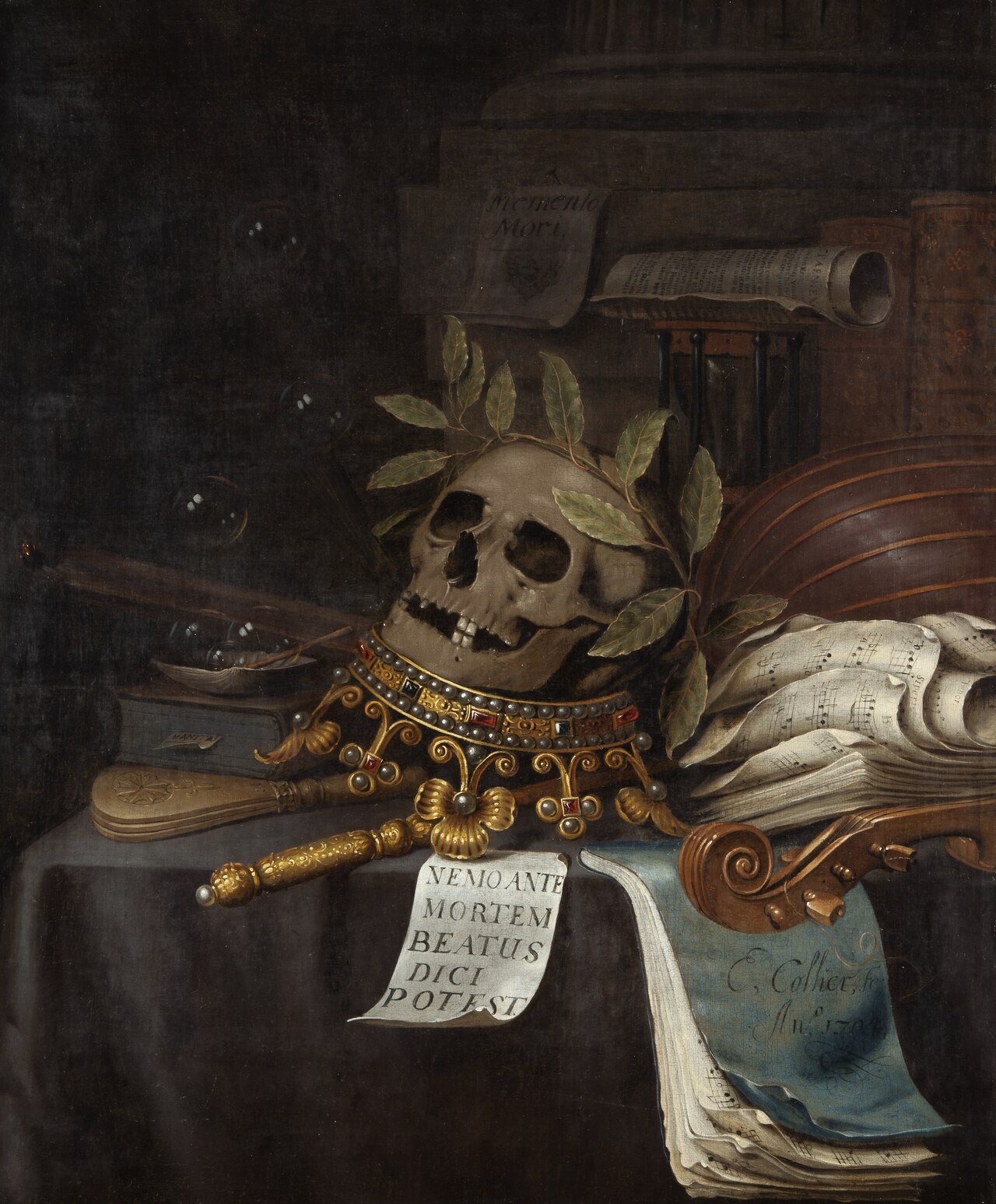


Early life Evert Collier was born in 1642 in the city of Breda, located in the southern part of the Dutch Republic. Little is recorded about his family background or his early artistic training, but the artistic climate of the Dutch Golden Age provided ample opportunity for a budding painter. Breda, though not a major artistic centre like Amsterdam or Haarlem, was situated within a network of workshops and guilds that facilitated the transmission of techniques and styles. It is likely that Collier began his apprenticeship in a local workshop before moving to larger cities where the market for still‑life paintings was more robust.
Career and style Collier’s career unfolded during a period when still‑life painting had become a dominant genre in Dutch art. He specialised in two closely related sub‑genres: vanitas, which uses symbolic objects to comment on the transience of life, and trompe l'œil, a technique that creates the illusion of three‑dimensionality on a flat surface. While the precise chronology of his movements is not fully documented, evidence suggests that he spent a significant portion of his professional life in the Dutch Republic before relocating to London, where he died in 1708. In England he continued to produce works that catered to a market fascinated by the novelty of Dutch realism and the moralising tone of vanitas imagery.
Collier’s paintings are characterised by meticulous attention to detail, a restrained colour palette, and a calm, almost clinical composition. He often employed a limited number of objects, arranging them with a precision that draws the viewer’s eye to the symbolic meaning of each item. The overall effect is one of quiet contemplation rather than overt drama, a hallmark of many Dutch vanitas works.
Signature techniques Collier’s trompe l'œil paintings demonstrate his command of perspective, light, and texture. By rendering paper, metal, glass and wood with such realism that the viewer might be tempted to reach out and touch the depicted objects, he blurs the boundary between representation and reality. He achieved this effect through a combination of fine brushwork, subtle gradations of tone, and careful modelling of shadows. In his vanitas pieces, Collier employed a symbolic lexicon that included skulls, extinguished candles, wilted flowers, and time‑keeping devices such as hourglasses and watches. These symbols were rendered with the same technical precision as his trompe l'œil works, reinforcing the moral message that material wealth and earthly pleasures are fleeting.
Another recurring element in Collier’s oeuvre is the use of everyday writing implements—ink pots, quills, and letters—often arranged on a wooden rack or a tabletop. These objects serve a dual purpose: they showcase the artist’s skill in depicting varied textures, and they underscore the intellectual and communicative aspects of the vanitas theme, reminding viewers of the permanence of the written word contrasted with the impermanence of life.
Major works - **Trompe l'œil with a letter rack holding newspapers, letters, writing equipment and a comb** – This composition exemplifies Collier’s ability to render a convincing illusion of depth. The letter rack, rendered in rich wood grain, supports an array of paper items, each caught in a different stage of use. The inclusion of a comb adds a domestic touch, while the overall arrangement invites the viewer to consider both the materiality of the objects and the fleeting nature of the information they contain. - **Vanitas (1704)** – Created late in Collier’s career, this painting brings together classic vanitas symbols: a skull, a wilted flower, an hourglass, and a candle guttering out. The muted background enhances the starkness of the objects, reinforcing the moral lesson that all earthly pursuits are temporary. - **Vanitas Still Life (1675)** – An earlier example of Collier’s vanitas work, this piece features a more elaborate setting, with a decorative vase, a peeled lemon, and a mirror reflecting a distant scene. The inclusion of luxury items alongside the inevitable symbols of decay highlights the tension between wealth and mortality. - **Trompe l'œil with Writing Materials (1702)** – In this work Collier returns to the theme of illusion, depicting a desk cluttered with ink pots, quills, and parchment. The precise rendering of the metallic sheen on the ink pots and the translucency of the glass bottles demonstrates his mastery of light and texture. - **A Vanitas (1669)** – One of Collier’s earliest dated vanitas pieces, it presents a modest arrangement of a skull, a watch, and a partially burnt candle. The simplicity of the composition underscores the universality of the vanitas message, making it accessible to a broad audience.
These works collectively illustrate Collier’s consistent engagement with the themes of mortality, illusion, and the fleeting nature of human endeavour. While each painting varies in scale and complexity, they all share a disciplined compositional logic and a refined technical execution.
Influence and legacy Evert Collier occupies a distinctive niche within the Dutch Golden Age, bridging the meticulous realism of Dutch still‑life painters with the theatrical illusionism of trompe l'œil. His works were collected by connoisseurs who appreciated both the moral undertones of vanitas and the visual trickery of illusionistic painting. Although he did not found a distinct school, his paintings contributed to the broader European fascination with trompe l'œil, influencing later artists in England and the Low Countries who explored similar visual deceptions.
Collier’s legacy is evident in the continued scholarly interest in his paintings, which are frequently cited in studies of Dutch vanitas iconography and the development of illusionistic techniques. Museums in the Netherlands, the United Kingdom, and beyond hold examples of his work, ensuring that his contribution to the visual culture of the 17th and early 18th centuries remains visible to contemporary audiences. By combining moral reflection with technical virtuosity, Collier helped to cement the still‑life as a genre capable of both aesthetic pleasure and philosophical depth.
Frequently asked questions
Who was Evert Collier?
Evert Collier (1642–1708) was a Dutch Golden Age painter renowned for his vanitas and trompe‑l'œil still‑life works, active in the Netherlands before moving to London.
What artistic style or movement is he associated with?
Collier worked within the Dutch Golden Age tradition, specialising in vanitas paintings that explore mortality and trompe l'œil works that create optical illusion.
What are his most famous works?
His notable pieces include the trompe l'œil with a letter rack, Vanitas (1704), Vanitas Still Life (1675), Trompe l'œil with Writing Materials (1702) and A Vanitas (1669).
Why does Evert Collier matter in art history?
He exemplifies the blend of moral symbolism and technical illusionism that defined Dutch still‑life painting, influencing later artists and contributing to the genre’s philosophical depth.
How can I recognise an authentic Collier painting?
Look for meticulous detail, a restrained palette, realistic rendering of paper and metal objects, and the inclusion of vanitas symbols such as skulls, candles and timepieces, often arranged in a trompe‑l'œil composition.