Elizabeth Boott
1846 – 1888
In short
Elizabeth Boott (1846–1888) was an American Impressionist painter known for her still lifes, landscapes and portraits. Born in Boston and later based in Florence, she was the daughter of composer Francis Boott and the wife of her former teacher Frank Duveneck.
Notable works



Early life Elizabeth Otis Lyman Boott was born in Boston in 1846 into a cultured American family. Her father, Francis Boott, was a noted composer and music professor, while her mother, also named Elizabeth, encouraged artistic pursuits. Growing up in an environment where music and the visual arts were both valued, Boott received a broad liberal education and showed an early aptitude for drawing. By her teenage years she was producing sketches of domestic interiors and garden scenes, a foundation that would later inform her still‑life practice.
Career and style In the early 1870s Boott travelled to Europe to further her artistic training, a common path for American women seeking professional instruction. She enrolled at the academy run by Frank Duveneck in Munich, where she met the American painter who would become both her mentor and husband. Duveneck’s emphasis on vigorous brushwork and a tonal palette left a marked impression on Boott’s developing style. After marrying Duveneck, the couple settled at the Villa Castellini in Florence, a hub for expatriate artists.
Boott’s mature work reflects the influence of French Impressionism, particularly its focus on light, atmosphere and the fleeting qualities of nature. She applied these concerns to both landscape and still‑life subjects, favouring a muted yet luminous colour scheme. Her paintings often combine a careful compositional balance with an immediacy that suggests the artist was working en plein air or from a quick observational study.
Signature techniques Boott’s technique is characterised by loose, yet controlled brushstrokes that convey texture without sacrificing form. In her still‑lifes she layered thin glazes of colour to achieve a delicate translucency, especially in the rendering of fruit skins and flower petals. When depicting foliage, she employed a broken‑colour approach, juxtaposing complementary hues to suggest the play of sunlight on leaves. Her portraiture demonstrates a sensitivity to facial expression, achieved through subtle modulation of tone rather than overt detailing, allowing the sitter’s character to emerge through suggestion.
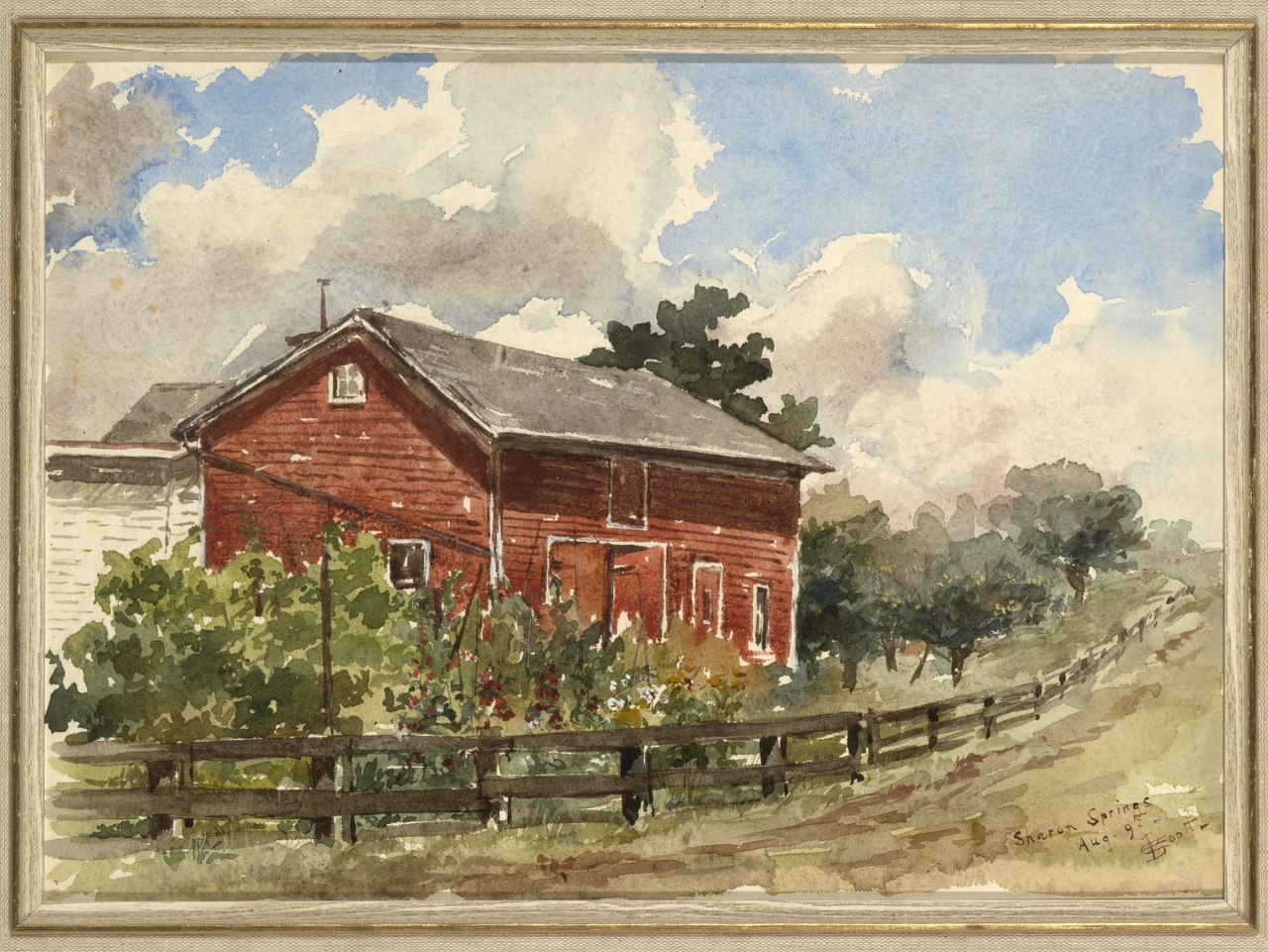
Major works - **Richmond (1884)** – This landscape captures the gentle undulations of the English countryside near Richmond. Boott renders the scene with a soft, pastel palette, employing dappled brushwork to convey the interplay of cloud‑filtered light on the fields. - **Sharon Springs (1883)** – Set in the historic spa town of Sharon Springs, New York, the painting portrays the tranquil waters of the local springs. Boott’s treatment of water reflects her Impressionist leanings, with rippling reflections rendered in short, overlapping strokes. - **Narcissus on the Campagna (1872)** – An early work that demonstrates Boott’s fascination with classical themes, this piece depicts the mythological figure Narcissus amid the rolling hills of the Roman Campagna. The composition balances the figure’s introspection with the expansive sky, using a restrained colour range that anticipates her later, more luminous works. - **Apple Blossoms (1882)** – This still‑life celebrates the fleeting beauty of spring. Boott captures the delicate pink of the blossoms against a muted background, employing delicate stippling to suggest the texture of petals and the subtle play of light. - **Autumn Foliage (1882)** – In this landscape, Boott renders the rich, warm tones of an autumnal forest. Her use of layered ochres, russets and deep greens creates depth, while her brushwork suggests the rustle of leaves in a gentle breeze.
Each of these works exemplifies Boott’s ability to blend a disciplined compositional structure with the spontaneity of Impressionist brushwork, resulting in paintings that feel both grounded and atmospheric.
Influence and legacy Although Boott’s career was cut short by her death in Florence in 1888, her oeuvre contributed to the transatlantic diffusion of Impressionist ideas. Her paintings were exhibited in both Europe and the United States, where they helped to broaden American perceptions of contemporary European art. Scholars note that Boott’s integration of still‑life precision with landscape spontaneity prefigured later American Impressionists such as Childe Hassam and Mary Cassatt. Moreover, her life as a female artist navigating a male‑dominated art world provides an early example of professional artistic agency for women in the late nineteenth century. Today her works are held in several museum collections, and her legacy endures through ongoing scholarly reassessment of women’s contributions to Impressionism.
Frequently asked questions
Who was Elizabeth Boott?
Elizabeth Boott (1846–1888) was an American painter associated with Impressionism, known for her still lifes, landscapes and portraits.
What artistic style or movement is she linked to?
She worked within the Impressionist movement, adopting its focus on light, colour and atmospheric effects.
What are her most famous works?
Key works include "Richmond" (1884), "Sharon Springs" (1883), "Narcissus on the Campagna" (1872), "Apple Blossoms" (1882) and "Autumn Foliage" (1882).
Why is Elizabeth Boott important in art history?
Boott helped transmit Impressionist ideas between Europe and the United States and demonstrated the professional possibilities for women artists in the nineteenth century.
How can I recognise an Elizabeth Boott painting?
Look for loose yet controlled brushwork, a subtle colour palette that captures light, and a blend of precise composition with the spontaneous feel of Impressionist technique.