Elias van den Broeck
1652 – 1708
In short
Elias van den Broeck (1652–1708) was a Dutch still‑life painter renowned for his detailed flower, insect and small‑animal compositions, working mainly in Amsterdam after an apprenticeship in Antwerp with Jan Davidsz. de Heem.
Notable works
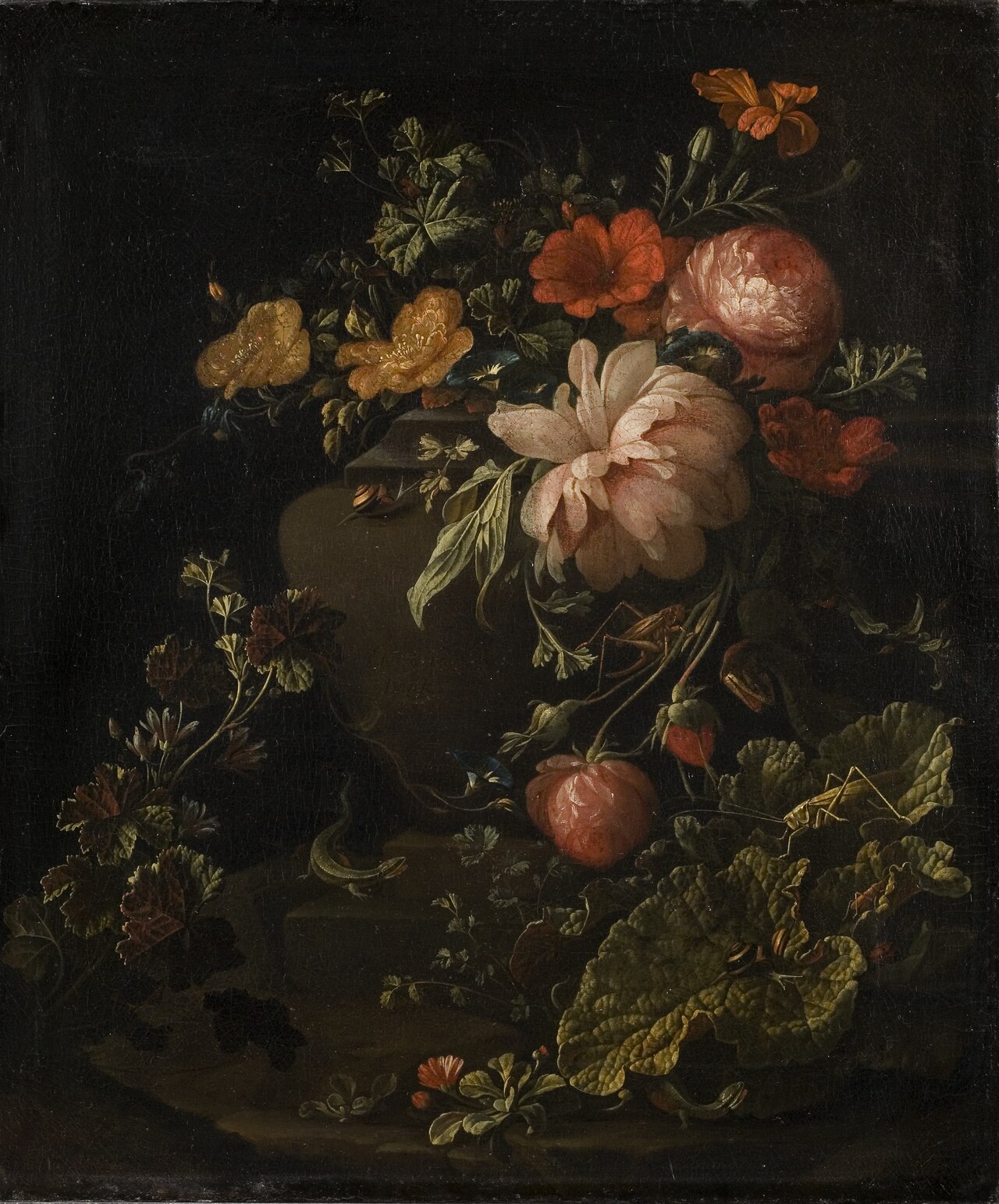
_Rosiers,_fleurs,_insectes_et_serpents_-_Elias_van_den_Broeck_-_Mus%C3%A9e_des_Beaux-Arts_de_Narbonne.jpg)



Early life Elias van den Broeck was born in Amsterdam in 1652, a period when the Dutch Republic was at the height of its Golden Age. Little is recorded about his family background, but the city’s bustling art market provided ample opportunities for a young talent to enter an apprenticeship. He is believed to have begun his training under the guidance of Jan Davidsz. de Heem, a leading figure in the Flemish‑Dutch still‑life tradition. This early exposure to de Heem’s workshop, which operated out of Antwerp, introduced van den Broeck to the meticulous techniques that would later define his own work.
Career and style After completing his apprenticeship, van den Broeck spent several years in Antwerp, then part of the Habsburg Netherlands. The city’s vibrant artistic community, characterised by a blend of Dutch realism and Flemish ornamental richness, shaped his aesthetic sensibilities. By the late 1670s he had returned to Amsterdam, where he established himself as a specialist in flower and insect still‑lifes. His paintings are characterised by a luminous colour palette, a keen observation of botanical detail, and a subtle interplay of light and shadow that gives his subjects a three‑dimensional presence. While his work aligns with the broader Dutch still‑life tradition, van den Broeck’s compositions often include unexpected elements—such as snakes, lizards or bird’s nests—that add a narrative tension to otherwise decorative arrangements.
Signature techniques Van den Broeck’s technical repertoire combines the precise brushwork of his Flemish training with a Dutch emphasis on naturalism. He prepared his canvases with a smooth, light‑coloured ground that allowed the bright pigments of his flowers to shine. In painting petals, he employed layered glazing to achieve translucency, rendering delicate veining and subtle colour shifts. Insects and reptiles are rendered with fine, almost microscopic detail, achieved through the use of fine sable brushes and a controlled, almost stippled application of pigment. Light is often directed from a single, off‑centre source, creating highlights that accentuate the glossy surfaces of petals and the wet sheen of insect exoskeletons. This handling of light contributes to a sense of immediacy, as if the viewer could reach out and touch the objects.
Major works - **Roses, flowers, insects and snakes (1700)** – This late work exemplifies van den Broeck’s mature style. A lush bouquet of roses and assorted blossoms occupies the centre, surrounded by a scattering of insects and a coiled snake that winds through the stems. The composition balances beauty with a hint of danger, a common motif in Dutch symbolism where snakes could signify mortality. - **Still Life with Passionflowers (1690)** – Featuring an arrangement of exotic passionflowers, this painting showcases the artist’s skill in rendering unusual botanical forms. The flowers are set against a dark, muted background, allowing their vivid reds and yellows to dominate the visual field. - **Still Life with Roses (1690)** – In this work van den Broeck presents a classic Dutch bouquet of roses, each bloom rendered with meticulous attention to petal texture. The inclusion of tiny insects hovering near the flowers adds a dynamic element, reinforcing the theme of fleeting beauty. - **Flowers, Lizards and Insects** – Although undated, this composition groups a variety of wildflowers with lizards and insects, highlighting the artist’s fascination with the natural world’s less‑celebrated inhabitants. The lizards are painted with a glossy finish that contrasts with the soft matte of the petals. - **Bird's nest at the foot of a tree (1700)** – Departing from his usual floral focus, this painting depicts a bird’s nest nestled among fallen leaves and twigs at a tree’s base. The work demonstrates van den Broeck’s ability to capture texture, from the rough bark to the delicate feathers, and reflects his broader interest in forest‑floor subjects.
Influence and legacy Elias van den Broeck occupies a niche within the Dutch Golden Age, bridging the ornamental exuberance of Flemish still‑life with the restrained naturalism of his Dutch contemporaries. His paintings were collected by affluent merchants in Amsterdam, and his reputation as a specialist in flower and insect subjects secured commissions throughout his career. While he never achieved the fame of contemporaries such as Willem Kalf or Rachel Ruysch, his works contributed to the evolution of the sub‑genre that combined botanical accuracy with symbolic intrigue. Modern scholars regard his oeuvre as an important reference point for studying the exchange of artistic ideas between the Dutch Republic and the Southern Netherlands in the late 17th century. Today, van den Broeck’s paintings are held in several European museum collections, and his meticulous technique continues to inspire contemporary still‑life painters who seek to balance scientific observation with aesthetic composition.
Frequently asked questions
Who was Elias van den Broeck?
Elias van den Broeck (1652–1708) was a Dutch painter best known for his highly detailed still‑life works featuring flowers, insects and small animals.
What artistic style or movement is he associated with?
He worked within the Dutch Golden Age still‑life tradition, blending Flemish ornamental richness with a Dutch focus on naturalistic detail.
What are his most famous works?
Key works include *Roses, flowers, insects and snakes* (1700), *Still Life with Passionflowers* (1690), *Still Life with Roses* (1690), *Flowers, Lizards and Insects*, and *Bird's nest at the foot of a tree* (1700).
Why is van den Broeck important in art history?
He exemplifies the cross‑regional exchange between Dutch and Flemish still‑life painting and contributed to the development of botanical realism combined with symbolic elements.
How can I recognise a van den Broeck painting?
Look for meticulous botanical detail, a luminous colour palette, the inclusion of insects or reptiles, and a subtle, single‑light source that creates highlights on petals and exoskeletons.