David de Coninck
1636 – 1699
In short
David de Coninck (1636–1699) was a Flemish painter from Antwerp who specialised in animal and fruit still‑life scenes, working in the Habsburg Netherlands and spending extended periods in Paris, Rome and Vienna.
Notable works


.jpg)
Early life David de Coninck was born in Antwerp in 1636, a city that was at the time a thriving centre of the Flemish Baroque. Little is known about his family background, but the name "Rammelaer"—under which he sometimes signed—suggests a connection to the guild of the rope‑makers, a common practice for artists who trained within the city's painterly workshops. Antwerp’s rich artistic environment, dominated by the legacy of Peter Paul Rubens and the prolific output of still‑life specialists such as Jan Fyt, provided a fertile ground for a young painter interested in the natural world. De Coninck likely apprenticed in a workshop that combined animal painting with the detailed observation of fruit and game, a combination that would become his hallmark.
Career and style By the 1650s de Coninck had established himself as a competent painter of animal subjects, a niche that enjoyed strong demand among the aristocracy and wealthy merchants of the Spanish Netherlands. His style reflects the Flemish Baroque emphasis on texture, colour and dramatic lighting, yet it also incorporates an Italianate sensibility acquired during his stays in Rome. In those years he absorbed the compositional clarity of the Roman still‑life tradition, which favoured orderly arrangements of fruit and game against subdued architectural backdrops. The result was a hybrid visual language: the lush, almost tactile rendering of flesh and foliage typical of Flemish masters, combined with the spacious, garden‑like settings favoured by Italian artists.
De Coninck’s work was characterised by an acute observation of animal behaviour. Whether depicting a cat and a dog locked in a tussle or a flock of birds perched amidst fruit, he rendered each creature with a sense of movement and individuality. This naturalism was supported by a palette that ranged from the deep, velvety blacks of a raven‑winged crow to the bright, glossy reds of ripe pomegranates. His paintings often juxtapose the vitality of living animals with the stillness of inanimate objects, creating a dynamic tension that invites the viewer to contemplate the cycles of life and death.
The artist’s career was notably international. After establishing a reputation in Antwerp, he accepted commissions that took him to Paris, where he supplied works for the court of Louis XIV, and to Vienna, where his paintings were sought after by the Habsburg elite. These travels not only broadened his patron base but also exposed him to a variety of decorative schemes, from the ornate French interiors to the formal gardens of Central Europe. The cross‑cultural influences are evident in the way he integrates formal garden architecture with the more spontaneous, pastoral scenes of the Flemish countryside.
Signature techniques De Coninck’s technique rests on three interlocking pillars:
1. Layered glazing – He built up colour through multiple thin glazes, achieving a depth of hue that allows fruit skins and animal fur to appear almost three‑dimensional. This method also gives his works a luminous quality, particularly in the way light catches the sheen of a parrot’s feathers or the glossy surface of a grape. 2. Fine‑brush detailing – Using a fine sable brush, de Coninck rendered individual strands of fur, the delicate veining of a leaf, and the subtle play of light on a feathered wing. These details are most apparent in close‑up sections of his compositions, where the viewer can appreciate the painter’s meticulous observation. 3. Dynamic composition – Rather than arranging objects in a rigid, symmetrical fashion, he often employed a diagonal axis that leads the eye across the canvas. Animals are placed in mid‑action, while fruit and objects form a supportive framework, creating a sense of narrative movement within a still‑life.
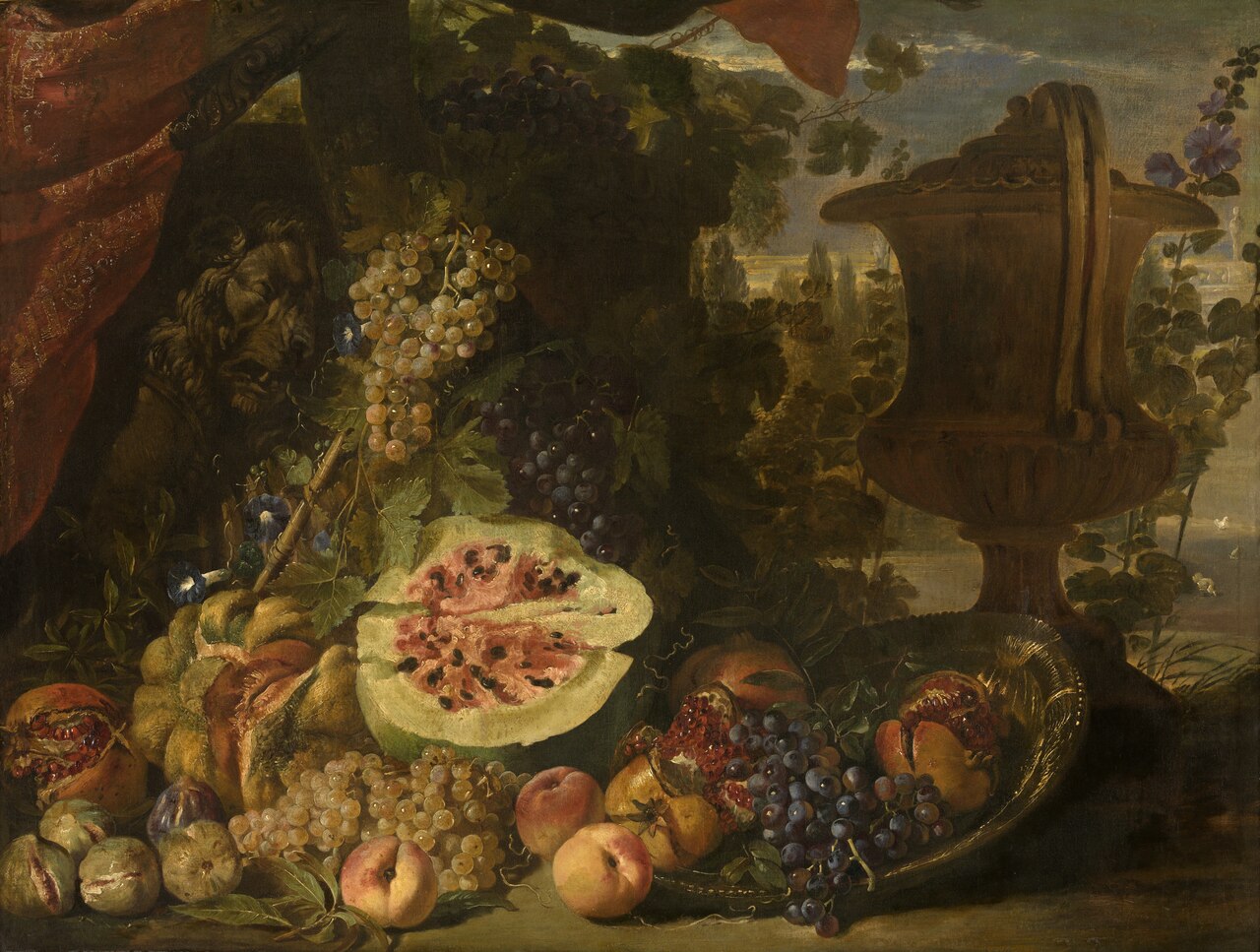
Major works - **A cat and a dog fighting over fowl (1680)** – This painting captures a moment of tension, with a scruffy cat and a watchful dog locked in a struggle over a captured bird. The composition is set against a muted backdrop that emphasises the animals’ musculature and the glossy texture of the fowl’s feathers. The work demonstrates de Coninck’s skill in portraying animal anatomy and the drama of a hunting scene. - **A parrot, melons, peaches, pomegranates, grapes and cherries in an Italianate park (1680)** – Here the artist combines an exotic bird with an abundance of ripe fruit, arranged within a landscaped park that hints at Italian garden design. The parrot, rendered with vivid greens and blues, stands out against the soft, sun‑lit foliage, while the fruit is depicted with a realistic sheen that showcases his glazing technique. - **A cockerel, hens, doves and a parrot in a formal garden setting** – This work expands the animal motif to include a variety of birds, each rendered with distinct plumage. The formal garden provides architectural order, with hedges and pathways that frame the lively avian group. The painting exemplifies de Coninck’s ability to balance multiple species within a single composition. - **Fruit still life of pumpkin, melon, grapes, peaches and pomegranates; right a garden vase, left a sarcophagus (1679)** – A striking juxtaposition of everyday fruit with classical architectural elements, the sarcophagus introduces a funerary undertone that contrasts with the lushness of the produce. The garden vase on the right adds a decorative touch, while the careful placement of each fruit creates a harmonious colour harmony. - **Animals in a garden** – Though the title is generic, this piece typifies de Coninck’s recurring theme of integrating fauna within cultivated spaces. The garden is rendered with precise perspective, and the animals—often dogs, cats, or birds—are depicted in natural poses, underscoring the artist’s observational skill.
Influence and legacy David de Coninck occupies a distinct niche in the canon of Flemish Baroque painting. While not as widely known as Rubens or Van Dyck, his contributions to animal and fruit still‑life painting were significant for several reasons. First, his international career helped disseminate Flemish techniques across Europe, influencing local painters in Paris and Vienna who adopted his approach to texture and composition. Second, his works anticipate the more naturalistic animal paintings of the 18th century, bridging the gap between the highly ornamental Baroque and the emerging Enlightenment interest in scientific observation.
De Coninck’s paintings are held in major European collections, including the Royal Museums of Fine Arts of Belgium and the Kunsthistorisches Museum in Vienna. Scholars cite his ability to combine the Flemish love of detailed realism with the spatial clarity of Italianate settings as a hallmark of his oeuvre. Contemporary artists who specialise in hyperrealistic still‑lifes often reference his layered glazing and precise brushwork as a technical model.
In recent years, interest in de Coninck has been revived by exhibitions that focus on the cross‑cultural exchange of still‑life traditions. Curators highlight his role as a conduit between the Netherlands, Italy, France and the Habsburg lands, underscoring how his work reflects the cosmopolitan nature of 17th‑century artistic production. As art‑history continues to reassess the contributions of lesser‑known Baroque painters, David de Coninck’s name is increasingly recognised as a key figure in the development of animal and fruit still‑life painting.
---
His legacy endures not only in museum walls but also in the continued scholarly discourse on the relationship between genre painting and the scientific curiosity of the early modern period. By portraying animals with both aesthetic beauty and anatomical accuracy, de Coninck helped lay the groundwork for later naturalist illustrators and contributed to the broader visual culture that celebrated the natural world.
Frequently asked questions
Who was David de Coninck?
David de Coninck (1636–1699) was a Flemish painter from Antwerp who specialised in animal and fruit still‑life scenes, working for patrons in the Habsburg Netherlands, Paris, Rome and Vienna.
What style or movement is he associated with?
He worked within the Flemish Baroque tradition, blending its rich texture and colour with Italianate compositional clarity and a naturalistic focus on animal behaviour.
What are his most famous works?
Key works include *A cat and a dog fighting over fowl* (1680), *A parrot, melons, peaches, pomegranates, grapes and cherries in an Italianate park* (1680), and the *Fruit still life of pumpkin, melon, grapes, peaches and pomegranates* (1679).
Why does David de Coninck matter in art history?
He helped spread Flemish still‑life techniques across Europe, bridged Baroque ornamentation with emerging naturalistic observation, and influenced later animal painters and naturalist illustrators.
How can I recognise a painting by David de Coninck?
Look for detailed, tactile rendering of animal fur and fruit skin, layered glazing that gives a luminous sheen, and compositions that place lively animals within orderly garden or architectural settings.