Daniel van Heil
1604 – 1662
In short
Daniel van Heil (1604–1662) was a Flemish Baroque landscape painter from Brussels, noted for his dramatic fire scenes, ruin‑filled vistas and winter landscapes, and for works such as Fire in Antwerp and Italian Seaport.
Notable works
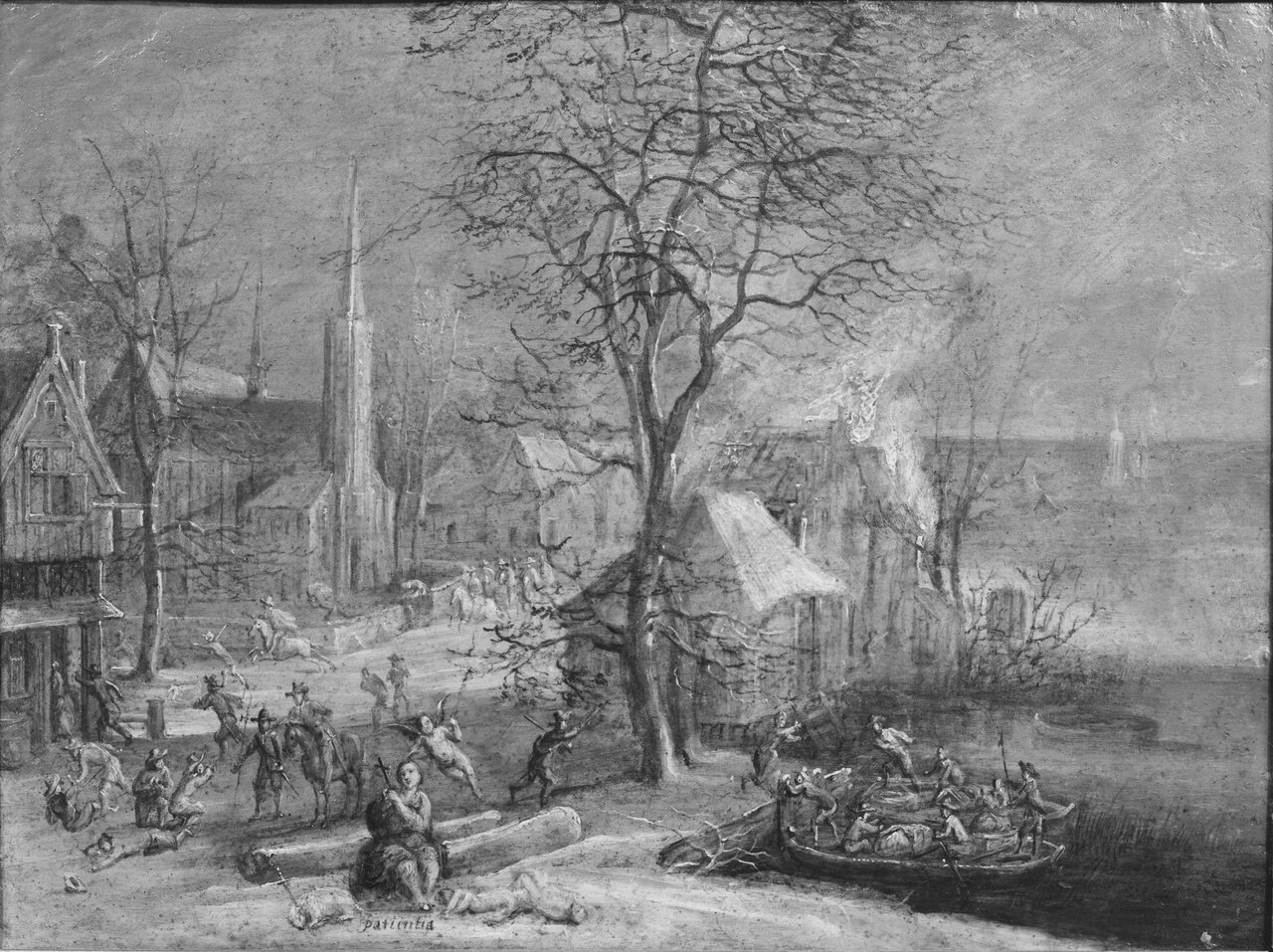


Early life Daniel van Heil was born in Brussels in 1604, a city that was then part of the Habsburg Netherlands. Little is recorded about his family background, but archival sources indicate that he grew up in a milieu dominated by the thriving artistic workshops of the Southern Netherlands. Brussels, as a secondary capital of the Spanish Habsburg empire, offered a vibrant market for religious and secular art, and young artists typically entered apprenticeships in local guilds. Van Heil is presumed to have received his training within this system, likely under a master who specialised in landscape painting—a genre that was gaining prestige in the early seventeenth century.
Career and style By the 1630s van Heil had established himself as an independent painter, producing works for both private collectors and civic patrons. His oeuvre reflects the broader Baroque fascination with drama, movement and theatrical lighting, yet he applied these principles to landscape rather than narrative history. Van Heil divided his output into three recurring themes: fire‑lit urban scenes, landscapes punctuated by classical ruins, and winter vistas that capture the stark beauty of the Low Countries in frost.
The fire series, perhaps his most recognizable, combines a meticulous rendering of architectural detail with the volatile energy of flame. In these paintings the artist captures the moment when a city or harbour is engulfed, using chiaroscuro to contrast the bright blaze against a darkening sky. The ruin series, on the other hand, draws on the classical tradition of the Roman ruin, placing decaying columns and arches within bucolic settings to evoke a sense of transience. Van Heil’s winter landscapes are comparatively subdued, employing a muted palette of blues and greys to convey the chill of snow‑covered fields, while still maintaining the Baroque emphasis on atmospheric perspective.
Signature techniques Van Heil’s technique is distinguished by several recurring devices. First, he employed a layered painting method, beginning with a thin underpainting of the sky and terrain before building up successive glazes to achieve depth and luminosity. This allowed him to render the flickering quality of fire with a delicate balance of warm oranges and cool shadows. Second, he favoured a compositional structure that places a bright focal point—typically a blaze or a luminous ruin—near the centre, surrounded by receding architectural elements that guide the eye toward the horizon. Third, his handling of foliage and water shows a fine brushwork that captures the texture of leaves, reeds and reflective surfaces, lending his scenes a convincing naturalism.
In the fire paintings, van Heil often used a technique known as “impasto” to give the flames a three‑dimensional texture. The thick application of oil paint catches light in a way that mimics the crackling of real fire. In the ruin landscapes, he employed linear perspective with precision, aligning architectural lines to a vanishing point that enhances the sense of distance. His winter works are marked by a subtle use of glazing to render the translucency of ice and the soft diffusion of light across snow.
Major works **Dutch Town sacked by the Spaniards** – This work illustrates van Heil’s capacity to blend historical narrative with his signature fire motif. The painting depicts a bustling Dutch settlement under attack, with a conflagration consuming the town’s rooftops. The artist’s treatment of smoke and ember highlights his skill in rendering atmospheric effects, while the composition reflects the political turmoil of the Eighty‑Years’ War.
Ved høje bjerge ligger en italiensk søhavn med galejer og felukker (1644) – Although the title appears in Danish, the scene is unmistakably Italian, showing a harbour set against towering mountains. Van Heil captures the Mediterranean light and the bustling activity of ships in the harbour, employing his characteristic contrast of bright sky and deep water tones. The work demonstrates his ability to adapt the Baroque landscape idiom to a variety of geographic settings.
Italian Seaport (1644) – Similar in subject to the previous painting, this piece focuses on a tranquil Italian port at sunrise. The gentle glow on the water and the delicate rendering of distant hills reveal a softer side of van Heil’s palette, while still maintaining the dramatic chiaroscuro that defines his style.
Fire in Antwerp (1650) – Perhaps his most celebrated fire scene, this painting records a blaze that engulfed a section of Antwerp’s historic centre. Van Heil’s composition places the inferno at the centre of the canvas, with the city’s iconic spires silhouetted against a smoky sky. The work is praised for its vivid colour contrast and for the emotional intensity conveyed through the frantic figures fleeing the flames.
Landscape with Ruins (1650) – In this composition, van Heil juxtaposes a crumbling Roman temple with a lush, verdant countryside. The ruins, rendered with precise linear perspective, dominate the foreground, while a winding path leads the viewer’s eye toward a distant horizon. The painting exemplifies the artist’s fascination with the passage of time and the juxtaposition of human achievement and nature’s resilience.
Influence and legacy Daniel van Heil remained active in Brussels until his death in 1662, and his work continued to circulate in the artistic markets of the Low Countries and beyond. While he never achieved the renown of contemporaries such as Peter Paul Rubens, his specialised focus on fire and ruin landscapes carved a niche that influenced later Flemish painters who sought to dramatise urban catastrophes. Collectors of the seventeenth‑century Dutch and Flemish schools prized his ability to capture both the spectacle of disaster and the quiet melancholy of abandoned structures.
Modern scholarship recognises van Heil as an important representative of the Baroque landscape tradition, particularly for his contribution to the sub‑genre of fire paintings—a theme that resonated with contemporary audiences familiar with the frequent conflagrations that plagued European cities. His works are held in a number of European museums, and they continue to be studied for their technical virtuosity and their evocative portrayal of light, atmosphere and the fleeting nature of human settlements.
Overall, Daniel van Heil’s legacy lies in his masterful synthesis of dramatic narrative and meticulous natural observation, a combination that makes his paintings both historically informative and aesthetically compelling.
Frequently asked questions
Who was Daniel van Heil?
Daniel van Heil (1604–1662) was a Flemish Baroque landscape painter from Brussels, known for his dramatic fire scenes, ruin‑filled vistas and winter landscapes.
What artistic movement did he belong to?
He worked within the Baroque movement, applying its emphasis on drama, chiaroscuro and dynamic composition to landscape subjects.
What are his most famous works?
His most recognised paintings include Fire in Antwerp (1650), Dutch Town sacked by the Spaniards, Italian Seaport (1644) and Landscape with Ruins (1650).
Why is Daniel van Heil important in art history?
He pioneered the specialised genre of fire‑lit urban landscapes and contributed a distinctive blend of narrative drama and natural observation to Flemish Baroque painting.
How can I recognise a Daniel van Heil painting?
Look for vivid firelight or glowing ruins set against a dark sky, precise architectural perspective, and a finely rendered atmospheric texture that highlights dramatic contrast.