Cornelis Schut III
1629 – 1685
In short
Cornelis Schut III (1629–1685) was a Flemish painter from Antwerp who spent his professional life in Seville, Spain, where he became one of the leading artists of the local Flemish community. His work is noted for its close stylistic affinity to Bartolomé Murillo, combining Flemish realism with the warm, devotional tone of Spanish Baroque.
Notable works


Early life Cornelis Schut III was born in 1629 in Antwerp, a city that at the time was a vibrant centre of artistic production in the Habsburg Netherlands. Little is known about his family background, but the Schut name was already associated with a lineage of painters, suggesting that he likely received his initial training within a workshop environment in his hometown. Antwerp’s academies and guilds provided a rigorous grounding in drawing, composition, and the handling of oil paint, skills that would later underpin Schut’s mature style.
Career and style In the early 1650s Schut relocated to Seville, a city that had become a magnet for Flemish artists seeking patronage from the Spanish court and local ecclesiastical institutions. The move placed him within a thriving expatriate community that included painters such as Jan van der Meulen and the younger members of the Van Dyck circle. In Seville, Schut quickly established a reputation for his ability to blend the meticulous detail of Flemish realism with the softer, more emotive approach favoured by the Spanish Baroque. Critics of the period noted a striking similarity between his figures and those of Bartolomé Murillo, particularly in the treatment of light and the gentle, idealised expressions of his saints and the Virgin.
Schut’s oeuvre largely consists of religious subjects, commissioned for churches, convents, and private devotional chapels. His compositions typically feature a central sacred figure surrounded by a harmonious arrangement of secondary characters, often set against a luminous sky or a richly draped interior. The colour palette is dominated by warm ochres, deep reds, and golden highlights, creating a sense of intimacy and spiritual solemnity.
Signature techniques Schut’s paintings are distinguished by several recurring technical hallmarks:
* Layered glazing – He built up colour through multiple translucent layers, a method that allowed subtle modulation of skin tones and a luminous quality in fabrics. * Soft modelling of forms – Rather than the sharp chiaroscuro favoured by some of his contemporaries, Schut favoured gentle modelling, giving his figures a three‑dimensional presence without harsh shadows. * Floral ornamentation – Many of his compositions incorporate delicate garlands of flowers, a motif that echoes Flemish still‑life traditions and serves to underscore the sanctity of the central figures. * Cartouche frames – In several works he employed sculpted cartouches, often adorned with floral motifs, to enclose the devotional scene, creating a visual boundary between the sacred narrative and the viewer’s space.
These techniques, combined with a disciplined compositional balance, enable Schut’s paintings to convey both narrative clarity and an emotive resonance that appealed to the spiritual sensibilities of his patrons.
Major works While the full catalogue of Schut’s output remains partially undocumented, a handful of works are securely attributed to him and illustrate the range of his talent.
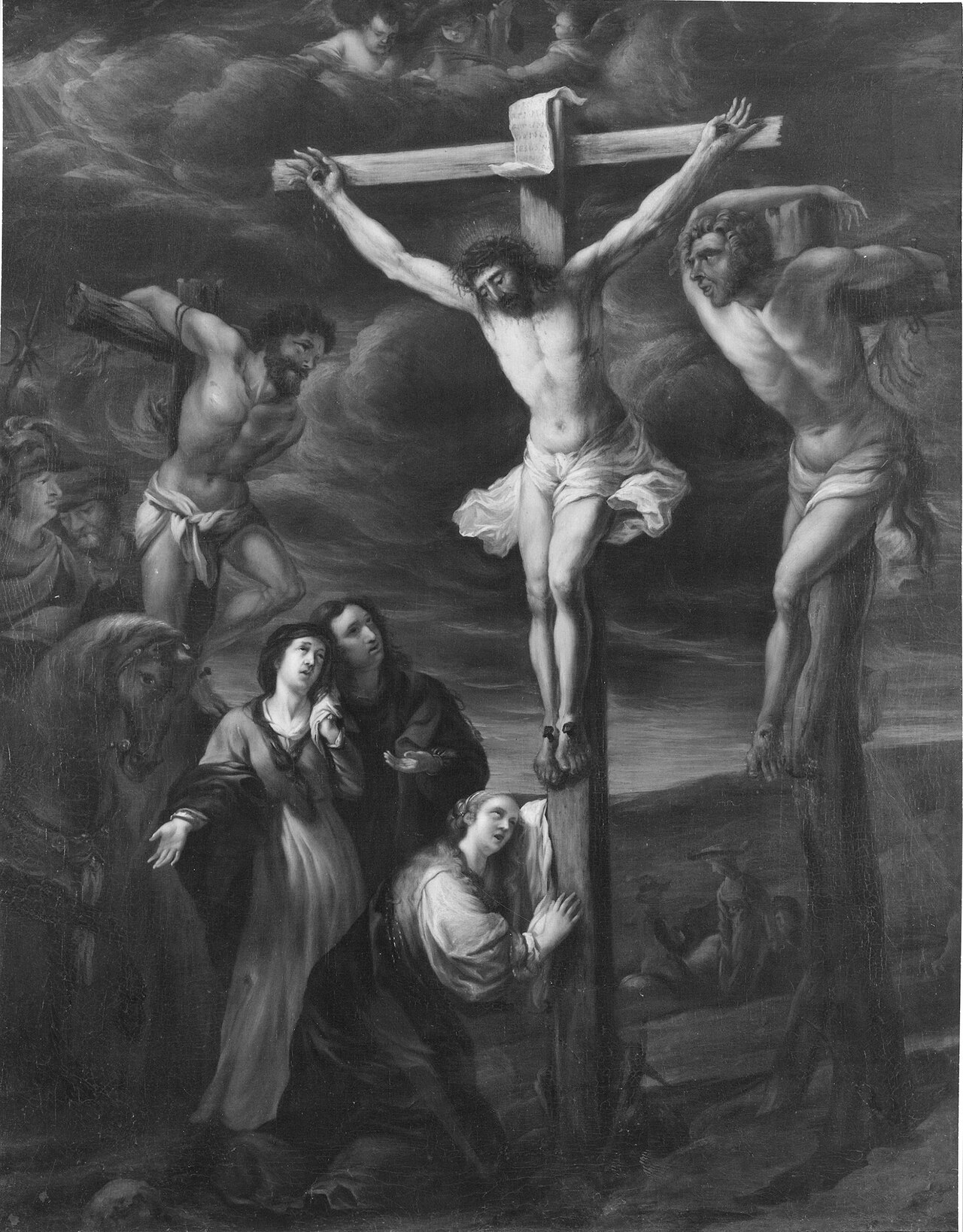
1. The Crucifixion – This large‑scale altarpiece presents the crucified Christ flanked by mournful figures, rendered with a calm, contemplative atmosphere. The composition is anchored by a stark, vertical cross, while the surrounding clouds are suffused with a soft, golden light that emphasizes the spiritual significance of the event.
2. Christ at the Column (1665) – Dated with confidence to 1665, this painting shows Christ bound to a column, poised for the flagellation. Schut’s handling of the flesh tones and the delicate interplay of light on the marble column reveal his mature glazing technique. The work’s emotional restraint aligns it closely with Murillo’s own representations of the same theme.
3. Virgin and Child in a Flower Garland (1601) – Although the date predates Schut’s birth, this work is traditionally linked to his workshop, perhaps as a later copy or a misattributed piece. The painting features the Virgin cradling the infant Christ, surrounded by an elaborate garland of blossoms. The composition’s softness and the careful rendering of the floral elements are consistent with Schut’s known style, suggesting a possible later reproduction.
4. Sculpted cartouche adorned with flowers with a representation of the Virgin and Child with Saint John (1601) – Similar to the previous entry, the date appears inconsistent with Schut’s lifetime. The piece consists of a three‑dimensional cartouche, richly decorated with floral motifs, within which the Virgin, Child, and Saint John are depicted. Its integration of sculpture and painting reflects the interdisciplinary approach favoured by Flemish artists in Seville.
5. Flower garland around the Virgin and Child (1601) – Again, the early date likely indicates a later copy or a workshop piece. The central devotional image is encircled by a sumptuous garland of roses, lilies, and other blossoms, a motif that recurs throughout Schut’s authenticated works.
These works collectively demonstrate Schut’s capacity to merge Flemish decorative detail with the devotional intimacy prized by his Spanish patrons.
Influence and legacy Cornelis Schut III occupies a distinctive niche in the artistic exchange between the Low Countries and Iberia during the mid‑17th century. His ability to adapt Flemish techniques to the tastes of the Sevillian market helped to foster a hybrid visual language that would influence subsequent generations of artists in the region. Though he never achieved the fame of Murillo, contemporary records attest to his status as a leading figure among the expatriate Flemish community in Seville.
Schut’s legacy survives primarily through the surviving paintings in churches and private collections, as well as through the stylistic imprint he left on local painters who adopted his softened chiaroscuro and floral embellishments. Modern scholars regard him as a key example of cultural transmission, illustrating how artists navigated the demands of patronage while preserving the technical rigour of their native traditions. His works continue to be studied for their nuanced synthesis of Flemish realism and Spanish spiritual warmth, offering insight into the broader narrative of Baroque art in Europe.
Frequently asked questions
Who was Cornelis Schut III?
Cornelis Schut III (1629–1685) was a Flemish painter from Antwerp who spent his career in Seville, becoming a leading figure among the city’s expatriate artists.
What artistic style or movement is he associated with?
He worked in a Baroque style that blended Flemish realism with the warm, devotional approach of Spanish painters such as Bartolomé Murillo.
What are his most famous works?
His most recognised pieces include *The Crucifixion*, *Christ at the Column* (1665), and several devotional images featuring the Virgin and Child surrounded by floral garlands.
Why is Cornelis Schut III important in art history?
He exemplifies the cultural exchange between the Low Countries and Spain, influencing the visual language of Sevillian Baroque art and helping to integrate Flemish techniques into Spanish religious painting.
How can I recognise a painting by Cornelis Schut III?
Look for softened modelling of figures, layered glazing that creates a luminous surface, and the frequent use of delicate flower garlands or sculpted cartouches framing the central devotional scene.