Cornelis Beelt
1640 – 1702
In short
Cornelis Beelt (1640–1702) was a Dutch Golden Age landscape painter from Rotterdam, noted for his marine and cityscape scenes. His extant works include depictions of coastal towns, naval fleets and historic events, reflecting the maritime culture of the Dutch Republic.
Notable works
.jpg)


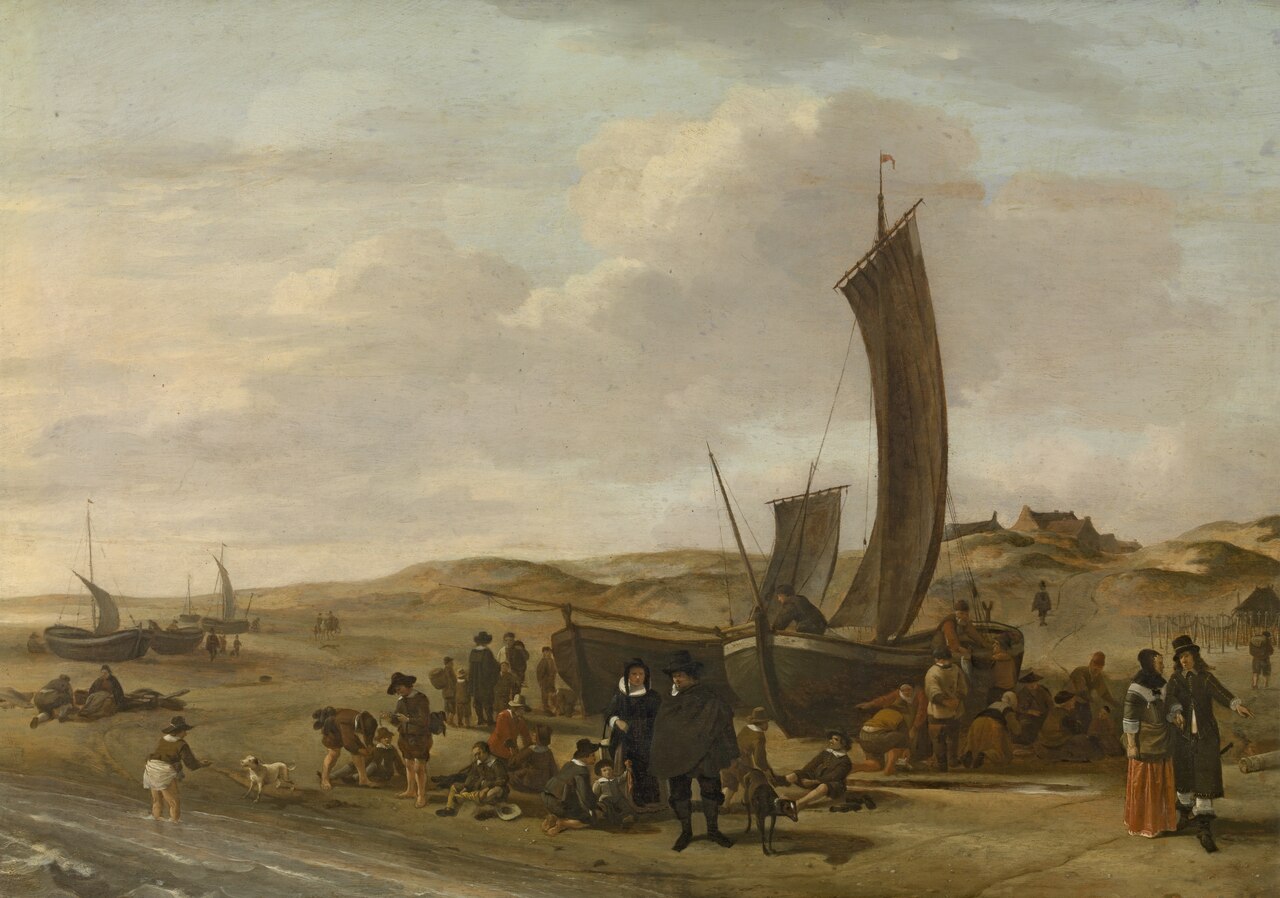
Early life Cornelis Beelt was born in 1640 in Rotterdam, a bustling port city of the Dutch Republic. Little is known about his family background or formal education, but the artistic environment of the Netherlands in the mid‑17th century provided ample opportunities for apprenticeship. Rotterdam’s proximity to the North Sea and its lively trade networks likely exposed Beelt to maritime subjects from an early age, shaping his later focus on coastal and naval scenes.
Career and style Beelt emerged as a professional painter during the later phase of the Dutch Golden Age. While his exact training remains undocumented, his work shows the influence of contemporary Dutch landscape and marine painters who combined topographical accuracy with atmospheric effects. Beelt’s paintings are characterised by a restrained palette of muted blues, greys and earthy tones, which convey the often brisk, breezy conditions of the Dutch coast. His compositions balance detailed foreground activity—such as fishermen, ships or townsfolk—with expansive skies and water, reflecting a harmonious relationship between humanity and nature.
Signature techniques Beelt employed several technical approaches that became hallmarks of his oeuvre. He favoured a layered glazing method, applying thin translucent washes of pigment over a carefully rendered underdrawing. This technique allowed him to achieve depth in clouds and water, as well as subtle colour shifts that suggest changing weather. His brushwork is generally tight in the foreground, rendering individual figures and vessels with clarity, while becoming looser and more suggestive in distant elements, a practice that enhances the sense of scale. Additionally, Beelt often used a muted, almost silvered tone for distant horizons, a device that underscores the flatness of the Dutch landscape.
Major works Beelt’s surviving catalogue includes several notable pieces that illustrate his thematic range. *The Beach at Egmond aan Zee* (1650) portrays a windswept shoreline with fishermen’s cottages and dunes, captured in a palette of greys and ochres that convey the stark beauty of the North Sea coast. *The Dutch Herring Fleet under Sail* (1680) depicts a fleet of herring boats navigating a calm sea, their sails billowing against a sky rendered in delicate, layered clouds. In *The Departure of King Charles II of England from Scheveningen, 2 June 1660* (1680), Beelt records a historic moment, showing the royal barge leaving the Dutch port amid a gathering of spectators, demonstrating his ability to blend documentary detail with his characteristic atmospheric style. *The Grote Markt, Haarlem at the announcement of the Treaty of Munster, 1648* (1680) offers a bustling urban scene, with townspeople gathered around the market square as news of peace spreads; the work showcases Beelt’s skill in rendering architectural elements and crowd dynamics. Finally, *The Beach at Scheveningen* (1664) presents a popular seaside resort with a mixture of leisure activities and fishing operations, highlighting the dual nature of Dutch coastal life.
Influence and legacy Although Cornelis Beelt did not found a distinct artistic movement, his work contributes to the broader understanding of Dutch maritime painting in the latter half of the 17th century. His attention to topographical detail provides valuable visual records of coastal towns and naval activities, complementing the more widely known works of contemporaries such as Willem van de Velde the Elder and Jan van Goyen. Modern scholarship regards Beelt as a competent, if not revolutionary, practitioner whose paintings exemplify the Dutch Republic’s fascination with the sea and its economic significance. His works continue to appear in museum collections and auction houses, where they are valued for both their historical content and their atmospheric quality. By preserving scenes of everyday life and momentous events along the Dutch coast, Beelt’s legacy endures as a visual chronicle of a nation defined by water.
Frequently asked questions
Who was Cornelis Beelt?
Cornelis Beelt was a Dutch Golden Age landscape and marine painter (1640–1702) from Rotterdam, known for his depictions of coastal towns, naval fleets and historic events.
What style or movement is he associated with?
Beelt worked within the Dutch Golden Age tradition of landscape and marine painting, employing realistic detail and atmospheric effects rather than aligning with a specific later movement.
What are his most famous works?
His best‑known paintings include *The Beach at Egmond aan Zee* (1650), *The Dutch Herring Fleet under Sail* (1680), *The Departure of King Charles II of England from Scheveningen* (1680), *The Grote Markt, Haarlem at the announcement of the Treaty of Munster* (1680) and *The Beach at Scheveningen* (1664).
Why does Cornelis Beelt matter in art history?
Beelt provides a valuable visual record of 17th‑century Dutch coastal life and maritime activity, complementing the work of more famous contemporaries and enriching our understanding of the era’s cultural and economic landscape.
How can I recognise a Cornelis Beelt painting?
Look for meticulous foreground detail, a muted colour palette, layered glazing that creates depth in sky and water, and subjects that centre on Dutch coastal scenes or historic maritime events.