Copley Fielding
1787 – 1855
In short
Copley Fielding (1787–1855) was a British water‑colour painter noted for his atmospheric landscapes and marine scenes, who rose from a pupil of John Varley to become President of the Old Water‑colour Society.
Notable works


_-_A_Heath_near_the_Coast_-_1797_-_Fitzwilliam_Museum.jpg)

Early life
Anthony Vandyke Copley Fielding was born in 1787 in the village of Sowerby Bridge, a small industrial settlement near Halifax in the West Riding of Yorkshire. His family was modest but supportive of his early interest in drawing. By his teenage years, Fielding had shown enough promise to attract the attention of the leading landscape water‑colourist John Varley, who was then teaching in London. Under Varley's guidance, the young Fielding acquired a solid grounding in the principles of drawing, colour mixing, and the handling of the wash that would become the hallmark of his later work.
Career and style
Fielding moved to London in the first decade of the nineteenth century, where he quickly entered the vibrant water‑colour community centred on the Old Water‑colour Society (later the Royal Water‑Colour Society). In 1810 he was accepted as an associate exhibitor, and three years later he secured full membership. His election reflected both his technical skill and his ability to capture the fleeting effects of light and atmosphere that were highly prized by the society’s patrons.
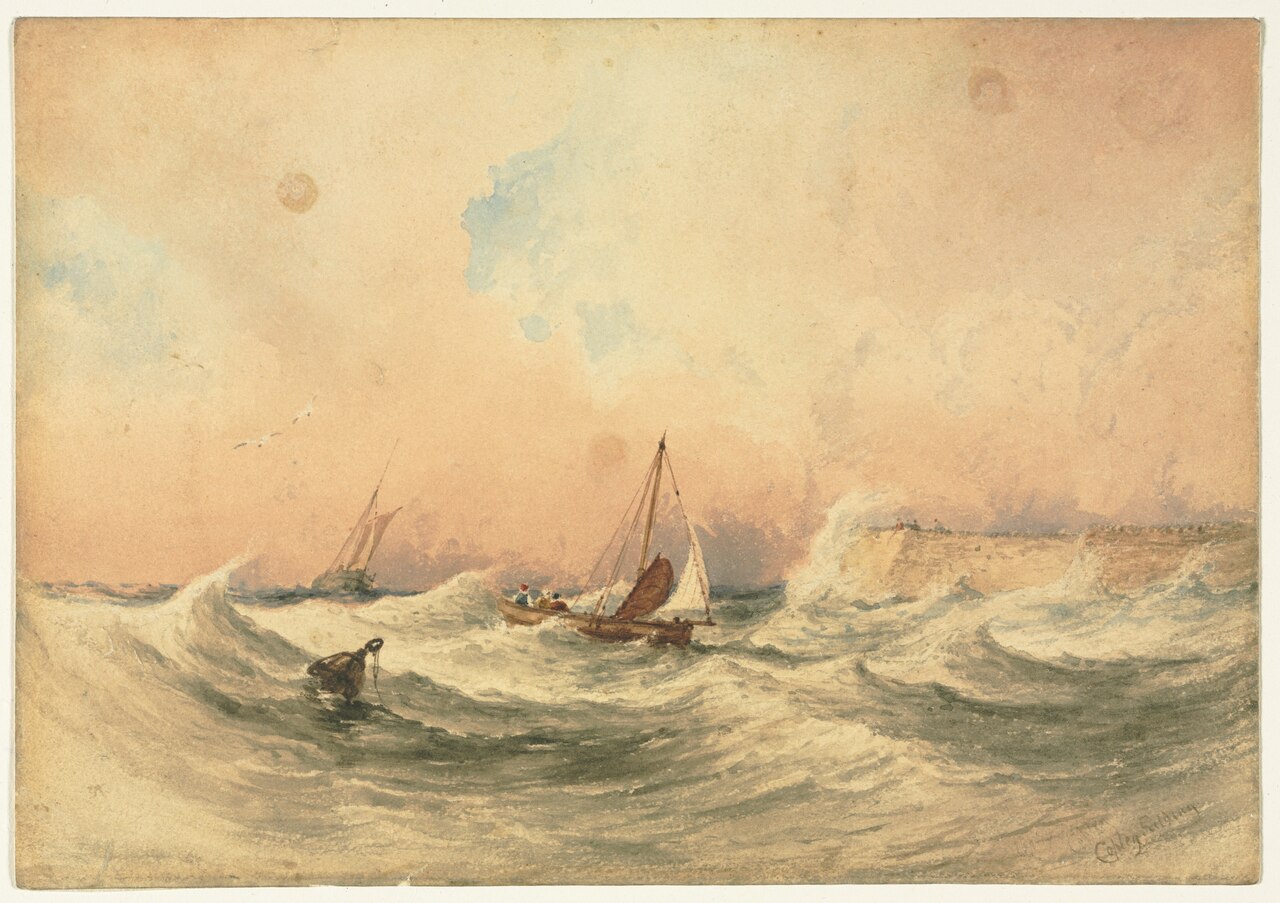
Throughout the 1810s and 1820s, Fielding cultivated a style that combined the delicate translucency of early English water‑colour with a more vigorous, almost painterly approach to the medium. He favoured a muted palette of earth tones, greys and blues, punctuated by occasional bursts of warm ochre or amber to suggest sunrise, sunset, or the glint of sunlight on water. His compositions often placed a modest human element—a lone figure, a shepherd’s hut, or a distant boat—within a broader, sweeping landscape, thereby emphasizing the power of nature over human concerns.
Fielding’s reputation extended beyond Britain. In 1824 he exhibited at the Paris Salon, where he was awarded a gold medal alongside contemporaries such as Richard Parkes Bonington and John Constable. The accolade affirmed his status as one of the leading exponents of the British water‑colour tradition, a medium that was still gaining recognition as a serious artistic discipline on the Continent.
In 1831, Fielding was elected President of the Old Water‑colour Society, a post he retained until his death. As president, he advocated for higher exhibition standards, encouraged younger artists, and helped to secure a more permanent home for the society’s growing collection of works. His leadership coincided with a period when water‑colour was increasingly collected by the British middle class, and his own paintings fetched respectable prices at auction.
Signature techniques
Fielding’s water‑colours are distinguished by three technical hallmarks:
1. Layered washes – He built depth by applying multiple transparent layers, allowing the paper’s whiteness to shine through in the brightest highlights. This method created a luminous quality that is especially evident in his sky and water passages. 2. Dry‑brush detailing – After establishing the broad atmospheric washes, Fielding would employ a dry brush loaded with pigment to suggest texture—rocky cliffs, heather‑covered hills, or the frothy crest of a wave. The contrast between the soft washes and the crisp dry‑brush strokes adds a sense of immediacy. 3. Edge modulation – Rather than hard outlines, Fielding softened edges with a wet rag or a fine brush, allowing colours to bleed into one another. This technique helped convey mist, fog, and the hazy atmosphere typical of his coastal and mountainous subjects.
These methods, together with his disciplined compositional sense, gave his works a distinctive balance of realism and poetic suggestion.
Major works
Fielding’s oeuvre includes a range of subjects, from rugged coastlines to pastoral interiors. Among the works most frequently cited by scholars are:
- A Scene on the Coast, Merionethshire – Storm Passing Off (1818) – This water‑colour captures a dramatic Welsh shoreline as a storm recedes. The composition is dominated by a low horizon line, allowing the turbulent sky to dominate the picture plane. Fielding’s handling of the clouds—soft, layered washes with subtle pink‑orange highlights—conveys the momentary calm after a tempest.
- Newark Castle (1810) – One of his earlier exhibited pieces, this work depicts the historic castle set against a placid river. The painting demonstrates Fielding’s early mastery of architectural rendering within a watery setting, using fine linear detail for the stonework while maintaining a loose atmospheric wash for the surrounding foliage.
- A Heath Near the Coast – Though the precise date is unclear, this piece exemplifies Fielding’s fascination with open, windswept terrain. The heather‑filled foreground is rendered with dry‑brush stippling, while the distant sea is suggested by a faint blue wash that fades into the sky.
- Snowdon from Llyn Nantlle (1830) – In this work, Fielding turns his eye to the Welsh mountains. The lake foreground reflects the towering peak, rendered in delicate blues and greys. The painting’s subtle tonal gradations demonstrate his ability to convey both the cold clarity of mountain air and the reflective surface of water.
- Marine – A more generic title, this work belongs to a series of seascapes where Fielding explored the interplay of light on water. The composition often features a small sailing vessel, rendered with crisp dry‑brush strokes, set against a vast expanse of sky and sea, underscoring his preoccupation with the sublime.
These pieces collectively illustrate Fielding’s consistent interest in how weather, light and topography interact, and they remain valuable exemplars of early‑nineteenth‑century British water‑colour.
Influence and legacy
Copley Fielding’s influence on British water‑colour painting was profound. As president of the Old Water‑colour Society, he mentored a generation of artists who would carry forward the medium’s reputation as a serious artistic practice. His teaching emphasized disciplined observation of nature, a rigorous approach to layering washes, and an appreciation for the emotive potential of atmospheric effects.
His works were widely reproduced in the illustrated journals of the period, such as *The Art Union* and *The Illustrated London News*, bringing his style to an audience that extended beyond the gallery. Collectors in the United Kingdom and abroad acquired his paintings, and several of his pieces entered the collections of institutions such as the Victoria and Albert Museum and the British Museum.
Later nineteenth‑century painters, including members of the later Royal Water‑Colour Society, acknowledged Fielding’s technical innovations, particularly his adept use of dry‑brush to suggest texture. In the twentieth century, art historians have reassessed his contributions within the broader narrative of British landscape painting, recognising him as a bridge between the early Romantic sensibility of Constable and the more impressionistic experiments of Bonington.
Fielding died in March 1855 in Worthing, where he had spent his later years at Park Crescent. His legacy endures not only in his surviving canvases but also in the continued appreciation of water‑colour as a medium capable of both precise observation and lyrical expression.
Frequently asked questions
Who was Copley Fielding?
Copley Fielding (1787–1855) was a British water‑colour painter celebrated for his atmospheric landscapes and marine scenes, and he served as President of the Old Water‑colour Society.
What artistic style or movement is he associated with?
He worked within the early‑nineteenth‑century British water‑colour tradition, blending Romantic landscape sensibilities with a disciplined, layered wash technique.
What are his most famous works?
Key works include *A Scene on the Coast, Merionethshire – Storm Passing Off* (1818), *Newark Castle* (1810), *Snowdon from Llyn Nantlle* (1830), and a series of coastal and heathland water‑colours such as *A Heath Near the Coast* and *Marine*.
Why does Copley Fielding matter in art history?
He helped elevate water‑colour to a respected fine‑art medium, influenced younger artists through his presidency and teaching, and contributed technically to the development of atmospheric effects in landscape painting.
How can I recognise a Copley Fielding painting?
Look for delicate, layered washes that create luminous skies, dry‑brush textures for land or sea surfaces, softened edges that suggest mist, and a muted palette punctuated by occasional warm highlights.