Cesare Dell'Acqua
1821 – 1905
In short
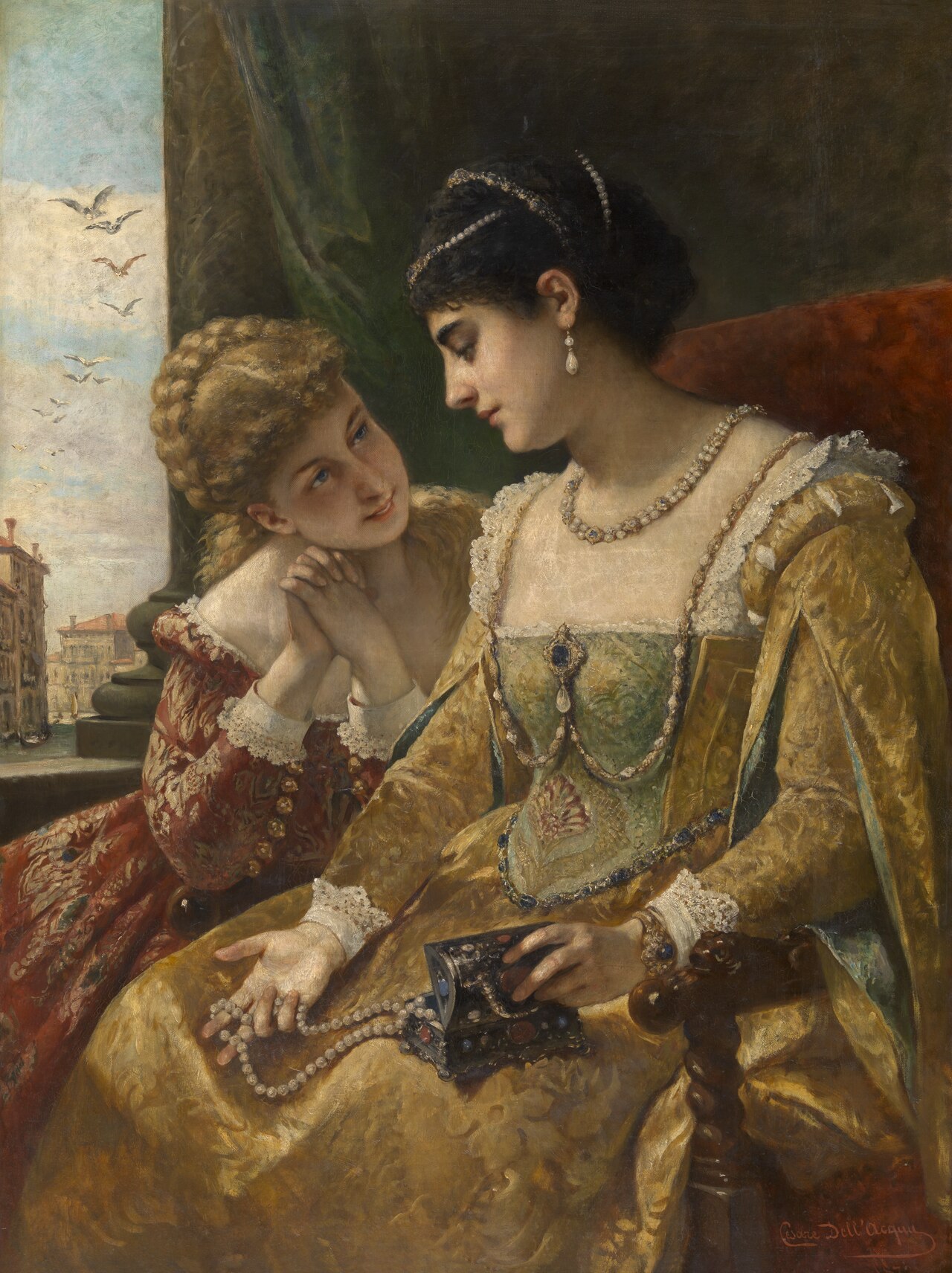
Cesare Dell'Acqua (1821–1905) was an Italian painter born in Piran who specialised in historical and genre scenes. He worked across Europe, producing notable works such as The bridal jewelry. Venetian women in the 16th century (1872) and The voluntary submission of Trieste to the Duke of Austria in 1382 (1856).
Notable works
.jpg)
.jpg)
,_by_Cesare_Dell%27Acqua.jpg)

Early life Cesare Dell'Acqua was born on 29 October 1821 in the coastal town of Piran, then part of the Austrian Empire (today in Slovenia). His family belonged to the Italian‑speaking community of the region, which fostered a strong cultural connection to the broader Italian peninsula. From a young age Dell'Acqua displayed an aptitude for drawing, and his early education was supplemented by apprenticeships with local artisans. Recognising his promise, his parents arranged for him to study in the artistic centres of the time, which eventually led him to the Academy of Fine Arts in Venice. The rigorous academic training he received there grounded him in the classical techniques of drawing, composition, and the study of historical subjects.
Career and style After completing his studies, Dell'Acqua embarked on a peripatetic career that took him to several European capitals. By the mid‑1850s he had established a reputation as a history painter, a genre that enjoyed patronage from aristocratic and municipal commissions. While he never aligned himself with a specific avant‑garde movement, his work reflects the academic realism of the mid‑nineteenth century, characterised by meticulous draftsmanship, a polished finish, and a narrative emphasis. Dell'Acqua was equally comfortable with portraiture and genre scenes, often blending the two to create works that conveyed both individual likeness and broader cultural context.
In the 1860s Dell'Acqua spent time in Paris and Brussels, where he encountered the burgeoning interest in Orientalism and the fascination with exotic subjects that pervaded French salons. This exposure broadened his thematic range, leading to works such as *An Ottoman beauty* (1869) and *The Japanese Guide*, which demonstrate his ability to incorporate foreign motifs while maintaining his academic sensibility. Throughout his career he remained attentive to the demands of his patrons, producing both large‑scale historical canvases for public institutions and smaller, more intimate pieces for private collectors.
Signature techniques Dell'Acqua’s technique is distinguished by several recurring features. First, his drawing is exceptionally precise; he often prepared his canvases with detailed charcoal or graphite studies, ensuring accurate anatomy and proportion. Second, his palette favours a restrained range of colours—muted earth tones punctuated by richer hues for focal points—allowing the narrative content to dominate the visual field. Third, he employed a layered glazing method, applying thin, translucent layers of oil over a solid underpainting. This approach produced a luminous depth, particularly evident in fabrics and skin tones. Finally, his compositions frequently utilise a balanced, often triangular arrangement, guiding the viewer’s eye toward the central action or figure.
Major works - **The bridal jewelry. Venetian women in the 16th century (1872)** – This large canvas depicts a group of aristocratic women examining elaborate jewellery, a scene that reflects both the opulence of Renaissance Venice and Dell'Acqua’s interest in costume detail. The painting is noted for its intricate rendering of textiles and metalwork, as well as the subtle interplay of light that highlights the jewellery. - **The Japanese Guide** – Though the exact date is uncertain, this work illustrates a Western figure accompanied by a Japanese attendant, exemplifying the 19th‑century fascination with East Asian culture. Dell'Acqua captures the contrast between European attire and Japanese dress, using a delicate colour scheme to emphasise the cultural exchange. - **Self‑portrait (1851)** – Executed early in his career, the self‑portrait presents the artist with a thoughtful expression, set against a neutral background. The work showcases his mastery of chiaroscuro and his confidence in handling the human form. - **An Ottoman beauty (1869)** – Part of his Orientalist series, this painting portrays a young woman adorned in traditional Ottoman costume. Dell'Acqua’s attention to decorative patterns and the soft modelling of the figure conveys both exotic allure and respectful observation. - **The voluntary submission of Trieste to the Duke of Austria in 1382 (1856)** – This historical canvas commemorates a pivotal diplomatic event. Dell'Acqua arranges the principal actors around a central table, employing a dramatic lighting scheme that underscores the gravity of the moment. The work was well received by contemporary audiences for its narrative clarity and historical fidelity.
Influence and legacy Cesare Dell'Acqua’s oeuvre offers a valuable snapshot of mid‑nineteenth‑century academic painting, bridging the gap between the grand historical narratives of earlier decades and the more eclectic tastes of later Victorian audiences. Although he never achieved the fame of contemporaries such as Alexandre Cabanel or Francesco Hayez, his works were regularly exhibited in European salons and acquired by municipal collections, ensuring a degree of public visibility. Scholars today regard Dell'Acqua as a representative figure of the academic tradition, whose disciplined technique and thematic versatility provide insight into the cultural currents of his era. His paintings continue to appear in exhibitions focused on historic genre scenes and Orientalist art, and they serve as reference points for the study of cross‑cultural representation in 19th‑century European painting.
In addition to his artistic production, Dell'Acqua contributed to the diffusion of Italian artistic training abroad, particularly through his connections in Belgium and France. His later years were spent in Ixelles, a suburb of Brussels, where he died on 23 March 1905. Posthumously, his works have been reassessed by art historians interested in the interplay between national identity and artistic practice, confirming his place within the broader narrative of European art history.
Frequently asked questions
Who was Cesare Dell'Acqua?
Cesare Dell'Acqua (1821–1905) was an Italian painter born in Piran who specialised in historical, portrait and genre scenes across Europe.
What style or movement is he associated with?
He worked within the academic realism tradition of the mid‑19th century, without aligning to a specific avant‑garde movement.
What are his most famous works?
His best‑known paintings include *The bridal jewelry. Venetian women in the 16th century* (1872), *The voluntary submission of Trieste to the Duke of Austria in 1382* (1856), and *An Ottoman beauty* (1869).
Why is Cesare Dell'Acqua important in art history?
He exemplifies the academic painter who combined historical narrative with meticulous technique, offering insight into 19th‑century European cultural and artistic trends.
How can I recognise a Dell'Acqua painting?
Look for precise draftsmanship, a balanced composition, a restrained palette with subtle glazing, and an emphasis on detailed costume and fabric rendering.