Carlo Caliari
1570 – 1596
In short
Carlo Caliari (1570–1596), known as Carletto, was a Venetian painter of the late Renaissance, the youngest son of Paolo Veronese, who inherited and managed his father's workshop in Venice.
Notable works
_S._Agostino_detta_le_sue_Regole_ai_canonici_lateranensi_-_Carlo_Caliari_-_gallerie_Accademia_Venice.jpg)

_-_Martyrdom_of_St._James_the_Less_by_Carlo_Caliari.jpg)

Early life Carlo Cannovaro Caliari was born in 1570 in the Republic of Venice, the youngest son of the celebrated painter Paolo Veronese. Growing up in the Veronese studio, he was immersed in a vibrant artistic environment from an early age. His family connections extended beyond his father: his brother Gabriele Caliari and his uncle Benedetto Caliari were also active artists, providing a collaborative network that shaped his formative years. The young Carlo received his initial training under the direct supervision of his father, absorbing the colouristic brilliance and compositional grandeur that characterised Veronese’s mature oeuvre.
Career and style Carlo’s professional career unfolded almost entirely within Venice, where he succeeded his father after Veronese’s death in 1588. He inherited a substantial workshop that catered to a clientele accustomed to the lavish decorative schemes of the Venetian elite. While the historical record does not name a specific art movement for Carlo, his work is generally placed within the late Renaissance, a period that increasingly blended the High Renaissance ideals of balance with the emerging Baroque sensibility of dramatic narrative.
In practice, Carlo’s style closely mirrors that of his father, characterised by a luminous palette, expansive architectural settings, and a preference for grand, often ceremonial subjects. He continued to produce large banquet scenes, a genre that Veronese had popularised, and these works display the same opulent treatment of drapery, light, and spatial depth. The continuity of style has sometimes made it difficult for scholars to separate Carlo’s hand from that of his father, especially in collaborative pieces that involved other family members.
Signature techniques Although Carlo’s oeuvre does not diverge dramatically from Veronese’s, several technical hallmarks can be associated with his hand:
1. Colour modulation – A subtle shift from Veronese’s bold, saturated hues toward slightly softer tones, particularly in the rendering of skin and fabric. 2. Brushwork – A slightly more restrained, yet still fluid, brushstroke in the treatment of foliage and secondary figures, suggesting a personal refinement of his father’s technique. 3. Composition – An inclination toward balanced groupings that foreground narrative interaction, evident in scenes where multiple saints or figures are engaged in a shared activity. 4. Use of light – A careful modulation of chiaroscuro that accentuates the three‑dimensionality of central figures while preserving the overall brightness typical of Venetian painting.
These signatures are most discernible when comparing signed works or documentary evidence that directly attribute a piece to Carlo.
Major works The catalogue of works traditionally linked to Carlo Caliari includes several religious subjects that illustrate his adherence to the Veronese idiom.
- St. Augustine dictates his "Rules" to the Lateran canons – A large altarpiece that depicts the saint in a solemn pose, surrounded by canons receiving his teachings. The composition foregrounds the intellectual exchange, while the surrounding architecture frames the scene with a sense of grandeur.
- Annunciation – This work captures the moment of the angel Gabriel’s appearance to the Virgin Mary. Carlo employs a luminous sky and an elegant interior, echoing Veronese’s treatment of sacred narratives with a soft, golden light.
- Martyrdom of St. James the Less (1650) – The date attached to this painting post‑dates Carlo’s death; scholars therefore treat the attribution with caution, suggesting it may be a later copy or a work from his workshop that continued under his name.
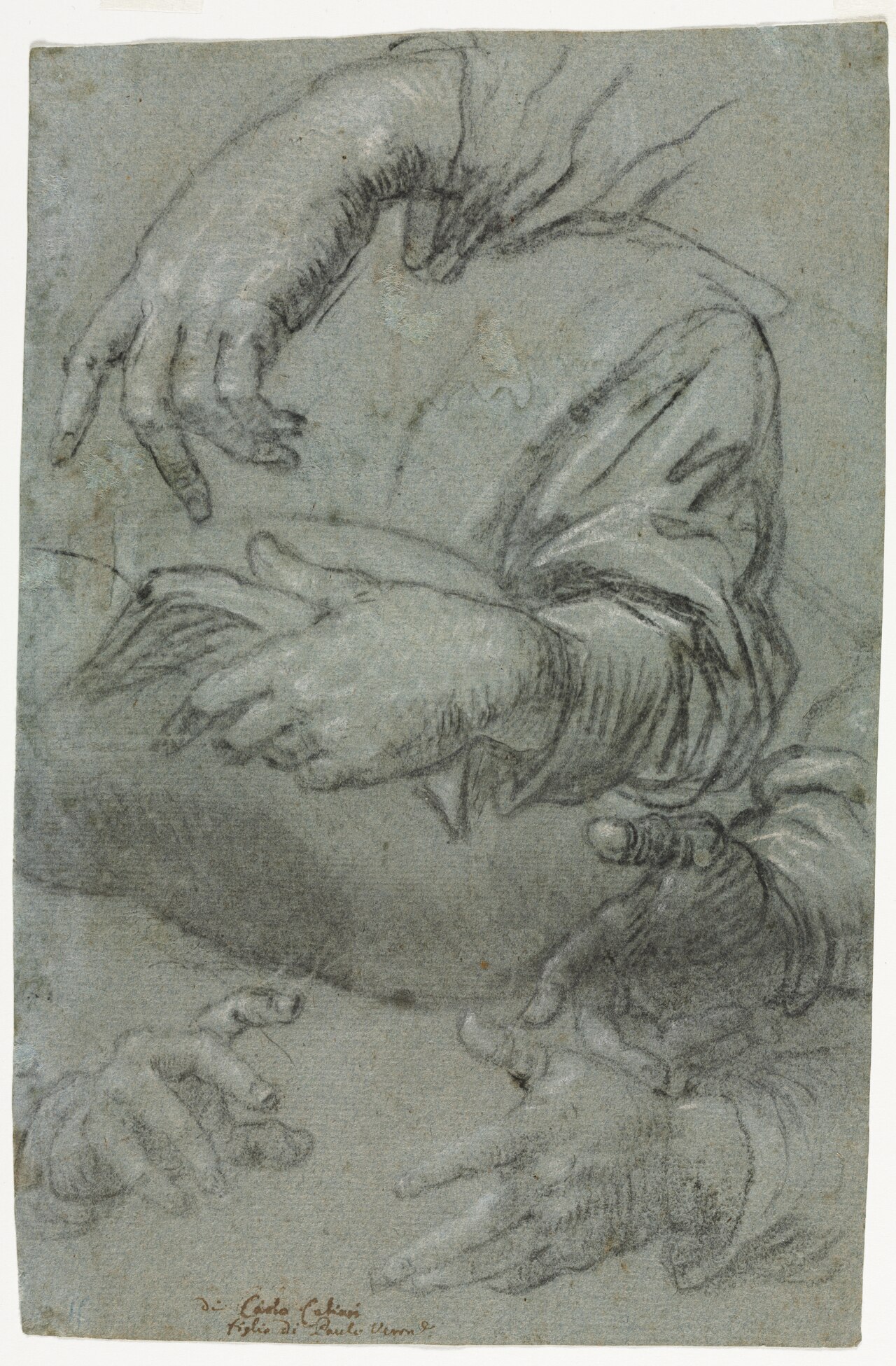
- Studies of Hands (recto) (1586) – A series of preparatory sketches that reveal Carlo’s meticulous study of anatomy and gesture. The drawings demonstrate his commitment to mastering the subtleties of hand positioning, an essential skill for narrative clarity.
- Holy Family with the Infant Saint John (1550) – The early date indicates a probable misattribution; the painting is more likely a product of the Veronese studio that later acquired a Carlo signature through workshop practices.
These works collectively showcase Carlo’s role as a custodian of his father’s visual language, while also offering glimpses of his own artistic decisions.
Influence and legacy Carlo Caliari’s legacy is intertwined with that of his father’s. By maintaining the Veronese workshop after 1588, he ensured the continued production of high‑quality Venetian paintings for a generation of patrons. His studio served as a training ground for younger artists, most notably Alessandro Turchi, who spent a brief period under Carlo’s supervision before establishing his own reputation.
Although Carlo’s own name has not achieved the fame of Paolo Veronese, his contribution to the preservation and dissemination of the Veronese style is significant. The continuity of the decorative banquet genre, the sustained demand for large religious compositions, and the mentorship of emerging painters all attest to his impact. Modern scholarship, while cautious about attributing specific works, recognises Carlo’s role in the transitional phase from the High Renaissance toward the early Baroque, a period in which Venetian painting retained its colouristic brilliance while embracing more dynamic storytelling.
In contemporary exhibitions, works from the Veronese workshop—including those likely overseen by Carlo—are often presented to illustrate the collaborative nature of Renaissance ateliers. His name therefore appears in museum catalogues and academic discussions as a representative figure of the late‑Renaissance Venetian artistic tradition, bridging the gap between his father’s golden age and the evolving tastes of the early seventeenth century.
Frequently asked questions
Who was Carlo Caliari?
Carlo Caliari (1570–1596), also known as Carletto, was a Venetian painter of the late Renaissance and the youngest son of Paolo Veronese.
What style or movement is Carlo Caliari associated with?
He worked in the late Renaissance style, closely following the colourful, grand manner of his father’s Veronese school.
What are Carlo Caliari’s most famous works?
His most frequently cited works include *St. Augustine dictates his "Rules" to the Lateran canons*, the *Annunciation*, and a series of preparatory studies such as the *Studies of Hands (recto) (1586).*
Why is Carlo Caliari important in art history?
He sustained the Veronese workshop after his father’s death, ensuring the continuation of a major Venetian artistic tradition and mentoring younger artists like Alessandro Turchi.
How can I recognise a work by Carlo Caliari?
Look for the luminous palette, balanced compositions, and subtle brushwork that echo Veronese’s style but often show softer colour modulation and careful study of hands and gestures.